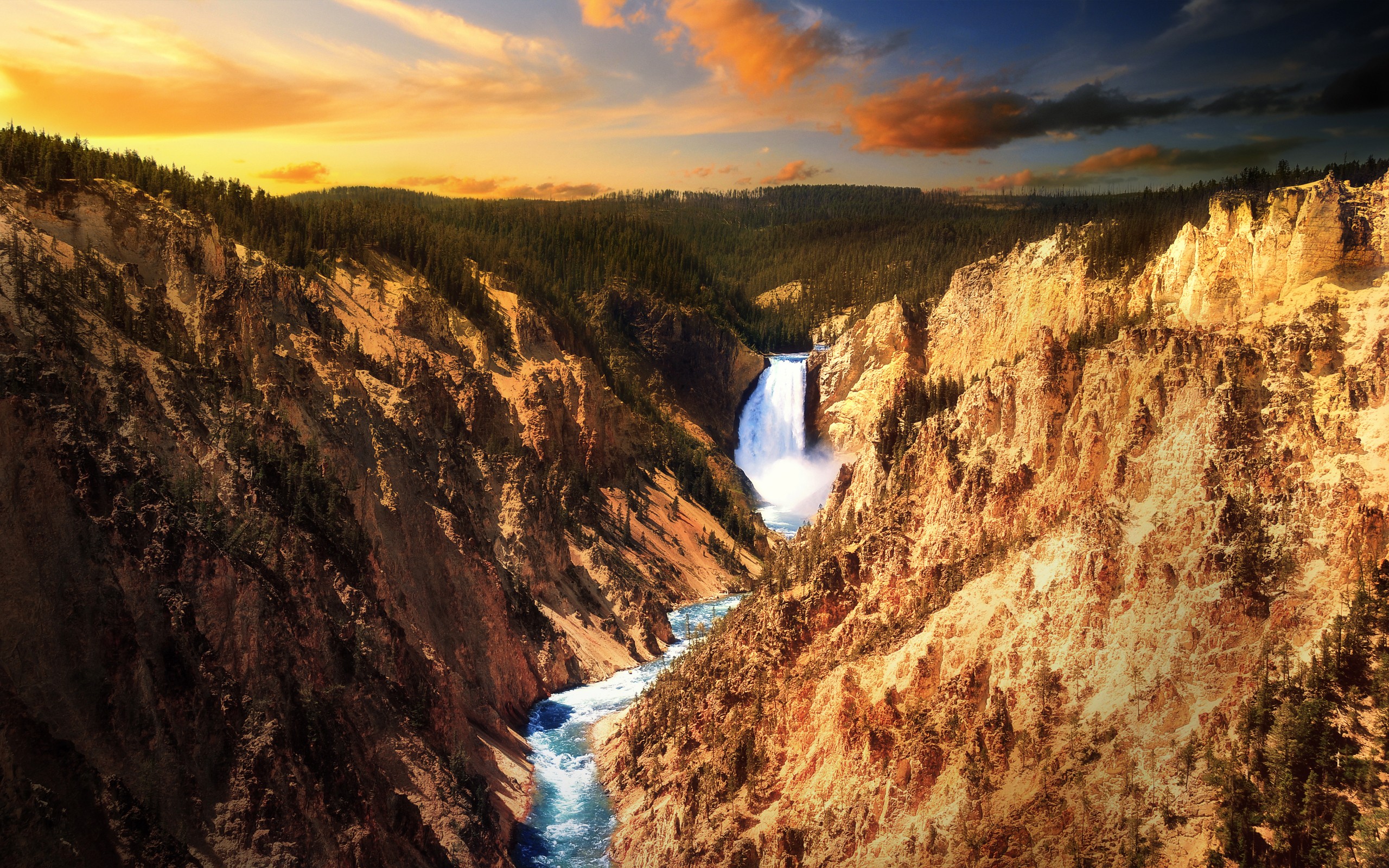
Standing on the edge of the Brink of the Lower Falls, the ground vibrates. It’s not a metaphorical vibration. It is a physical, bone-deep hum that travels from the soles of your boots up into your chest. 308 feet of vertical drop. That is twice the height of Niagara Falls. Most people think the "Big One" in Yellowstone is Old Faithful, but honestly? Old Faithful is a scheduled performance. The Lower Falls is a riot.
You’ve probably seen the postcards. The yellow canyon walls, the green-blue ribbon of the Yellowstone River, and that massive white curtain of water. But a photo can’t capture the sheer volume. We’re talking about an average of 5,000 to 60,000 gallons of water per second depending on whether the snowpack is melting or the summer heat has settled in. It is the most photographed spot in the park for a reason, but most tourists make the mistake of just hitting the "Lookout Point" and leaving. They miss the spray, the rainbows, and the geological weirdness that makes this place happen.
The Geology of the Yellow Stone
Let’s get one thing straight: the canyon isn't yellow because of sulfur. That’s a common myth people tell their kids while they’re walking the trails. In reality, the "Yellow" in Yellowstone comes from iron compounds in the rhyolite rock that have been "cooked" by hydrothermal fluids. Basically, the rock has been chemically altered, or rusted, from the inside out.
The Lower Falls exists because of a massive mistake in the Earth's crust. Or, well, a transition. The river flows over a section of hard, heat-resistant basalt and then suddenly hits the softer, hydrothermal-altered rhyolite. The water eats away at the soft rock much faster than the hard rock. Boom. You get a waterfall. The canyon itself is roughly 20 miles long and 1,000 feet deep in some spots. It’s a giant, colorful gash in the earth that looks like it was carved by a frantic god with a chisel.
The color palette is wild. You’ll see reds, oranges, and even pinks. Those are different oxidation states of iron. When you look down from Artist Point—which, by the way, was named by Thomas Moran whose paintings actually helped convince Congress to make this a National Park in 1872—you aren't just looking at a view. You are looking at the literal skeleton of a volcano.
Brink of the Lower Falls: The Best Way to Feel Small
If you want the real experience, you have to hike down the Brink of the Lower Falls trail. It’s short. Maybe 0.4 miles. But the switchbacks are steep, and the return trip will remind you exactly how much altitude affects your lungs. You are at roughly 7,000 feet here.
At the bottom of that trail, there’s a platform. You are standing right where the river decides to jump. The water is green—a deep, glassy emerald—until it hits the air. Then it shatters into white foam.
- Pro tip: Go in the morning.
- The sun hits the spray at just the right angle to create circular rainbows.
- Wait for a break in the crowd.
- Just listen.
The sound isn’t a "whoosh." It’s a rhythmic thudding. It sounds like heavy machinery. It’s the sound of the Yellowstone River moving through the Grand Canyon of the Yellowstone, which is actually the third canyon to exist in this spot. The river has carved and re-carved this path over hundreds of thousands of years, battling against the rising and falling of the Yellowstone Caldera.
Why Artist Point is Overrated (and Where to Go Instead)
Artist Point is the "hero shot." It’s where everyone takes their Instagram photos. It’s beautiful, sure. But it’s crowded. You’ll be shoulder-to-shoulder with people holding iPads. If you want a perspective that actually shows the scale of the Lower Falls, head to the South Rim Trail.
Uncle Tom’s Trail used to be the go-to for a "down in the guts" view, but it’s been closed for significant maintenance for quite a while now. Instead, focus on Red Rock Point. It involves some stairs—okay, a lot of stairs—but it puts you right in the middle of the canyon wall. You can see the Lower Falls from a side-angle that makes the 308-foot drop look even more terrifying than it does from the top.
The Wildlife and the Spray
People forget that the canyon is a habitat. Look up. You will often see Ospreys nesting on the jagged rock pinnacles (called needles or spires) that stick out from the canyon walls. These birds are specialists. They dive into the river, grab a trout, and fly back up to their chicks. Watching an Osprey navigate the thermal updrafts of the canyon while the Lower Falls roars in the background is one of those "National Geographic" moments that actually happens in real life.
There are also ravens. Big ones. They are incredibly smart and have figured out that tourists mean snacks. Don't feed them. Seriously. Their natural diet is much better for them than your leftover jerky. Plus, they are bold enough to unzip backpacks if you leave them unattended while you’re busy staring at the waterfall.
Seasonal Shifts: When to Visit
Timing is everything.
- June: The water volume is terrifying. This is peak snowmelt. The roar is at its loudest, and the mist will soak you from a hundred yards away.
- September: The crowds thin out. The water is lower, revealing more of the rock structure behind the falls. The colors of the canyon seem deeper in the autumn light.
- Winter: This is the secret season. The Lower Falls partially freezes, creating a massive "ice cone" at the base that can reach hundreds of feet high. You have to take a snowcoach or snowmobile to get there, but seeing the falls surrounded by white snow and blue ice is haunting.
Understanding the "Grand Canyon" Confusion
Wait, isn't the Grand Canyon in Arizona? Yeah. But this is the Grand Canyon of the Yellowstone. It’s younger, narrower, and arguably more colorful. The Arizona version is all about scale and deep time—billions of years of history. The Yellowstone version is about power and volcanic violence.
The rock here is volcanic rhyolite. It’s brittle. It’s crumbly. That’s why you see so many rockslides. If you look closely at the canyon walls, you can see steam vents (fumaroles) still puffing away. The ground is still hot. The volcano is still there, just underneath you. The Lower Falls is basically a waterfall built on top of a giant pressure cooker.
Common Misconceptions
People think the Lower Falls is the only one. It’s not. There’s the Upper Falls (109 feet), which is just upstream. It’s impressive, but it lacks the sheer "drop into the abyss" feel of the Lower Falls. There is also Crystal Falls, tucked away between the two. Most people walk right past it. Don't be that person.
Another big mistake? Thinking you can "do" the falls in 20 minutes. If you just park, walk to the overlook, and leave, you’ve seen the image, but you haven't experienced the place. You need at least three hours to hike a portion of the rim, get down to the brink, and actually watch the light change on the walls.
Practical Logistics for Your Visit
Parking at the Canyon Village area is a nightmare between 10:00 AM and 4:00 PM. If you show up at noon in July, you’re going to spend forty minutes circling a lot like you’re at a shopping mall on Black Friday.
Instead, get there at 7:00 AM. The light is better for photos, the air is crisp, and you might actually have a moment of silence at the Brink of the Lower Falls. There are two main drives: the North Rim Drive and the South Rim Drive. Both are one-way loops.
- North Rim Drive: Gives you access to Brink of the Lower Falls, Lookout Point, and Grand View.
- South Rim Drive: Leads to Artist Point and the trailhead for the South Rim Trail.
If you are hiking, bring water. Even if it's "just a short walk." The combination of high altitude and dry mountain air will dehydrate you faster than you realize. Also, stay on the designated paths. The canyon walls are literally crumbling. Every year, someone tries to get a "better angle" for a photo, slips on the loose rhyolite, and ends up needing a search and rescue team—or worse.
Actionable Steps for Your Lower Falls Trip
To truly experience the Lower Falls without the typical tourist stress, follow this specific circuit:
- Start at the North Rim early (before 8:00 AM): Hike down to the Brink of the Lower Falls first. This is the most physically demanding part, so do it while you're fresh and the crowds are thin.
- Walk the North Rim Trail toward Inspiration Point: This trail connects the major overlooks. You’ll see the canyon change shape as you move. Most people drive between these spots; walking them gives you a much better sense of the scale.
- Cross over to the South Rim for Artist Point in the late afternoon: While it’s crowded, the sun moves behind you in the afternoon, illuminating the falls and the canyon walls perfectly.
- Check the "Yellowstone NPS" App: It provides real-time updates on trail closures. This is crucial because the park is constantly under construction or dealing with natural shifts that close certain viewpoints.
- Bring a pair of binoculars: Not just for the birds, but to look at the "rust" patterns on the walls. You can see where the hydrothermal vents are still active by looking for the steam and the bright white patches of bleached rock.
The Lower Falls is the heartbeat of Yellowstone. It’s the sound of the continent being worn down, one gallon at a time. It’s loud, it’s messy, and it’s arguably the most beautiful thing in the American West. Just make sure you get out of the car to see it.