Yellowstone is weird. You’ve probably seen the photos of Grand Prismatic—that massive, swirling eye of orange and blue—and thought, "I need to get in that." But if you actually tried, you’d literally melt. It’s a strange paradox. Most of the famous Yellowstone hot springs are essentially boiling vats of acid and silica that will dissolve a human boot in hours, yet people flock there specifically to get close to the water.
The reality of visiting these thermal features is a lot messier and more interesting than the postcards suggest. You’re dealing with a landscape that is actively trying to swallow the boardwalks. It smells like rotten eggs because of the hydrogen sulfide. It’s loud. It’s crowded. And yet, there is absolutely nothing else like it on Earth. If you’re planning a trip, you need to know which springs are for looking, which are for soaking (hint: almost none inside the park), and how to not become a cautionary tale on the evening news.
The Chemistry of Why They Look Like That
People always ask why the colors are so vivid. It isn't dye or some weird mineral trick. It’s life. Specifically, extremophiles. These are microscopic organisms that thrive in heat that would kill almost anything else.
In the center of a spring like Morning Glory Pool, the water is so hot that nothing can live there. That’s why the middle is a piercing, deep blue—it’s the natural color of light scattering in deep, clear water. As the water moves away from the center and cools down, different "mats" of bacteria take over. Yellow bacteria like Synechococcus thrive in temperatures around 160°F. When it gets cooler, you get the oranges and reds from carotenoids, similar to what you find in carrots.
Honestly, the chemistry is a bit terrifying. Take the Norris Geyser Basin. It’s the hottest, oldest, and most acidic thermal area in the park. The water there is often acidic enough to sting your skin if it splashes. Scientists like Dr. Jeff Hungerford, a park geologist, have spent years tracking how these systems shift. One day a spring is clear; the next, a small earthquake turns it into a muddy, boiling cauldron. It's alive.
The Only Places You Can Actually Touch the Water
Let’s be extremely clear: jumping into a random pool in Yellowstone is a death sentence. We’ve all seen the headlines. The ground is often just a thin crust of calcium carbonate or silica over a void of 200-degree water.
However, you can soak in the general area if you know where to go.
- Boiling River: This used to be the go-to spot where a hot spring met the cold Gardner River. Unfortunately, massive flooding in 2022 drastically altered the landscape here. Check current NPS alerts, but for now, it's often closed or inaccessible.
- Firehole River Swim Area: This is a popular spot, but don't expect a hot tub. It’s more like "lukewarm bathtub water" mixed with a cold mountain stream. It’s refreshing, but it isn’t a thermal soak.
- Yellowstone Hot Springs (The Business): This is located just north of the park in Gardiner, Montana. It’s a commercial facility, but they use the actual mineral water from the local geothermal veins. If you want the health benefits of the minerals without the risk of being dissolved, this is where you go.
The Tragedy of Morning Glory Pool
Morning Glory is the perfect example of why humans suck sometimes. It used to be a brilliant, deep blue. Now, it’s mostly green and orange. Why? Because for decades, tourists threw coins, rocks, and trash into it.
This junk got lodged in the "throat" of the spring, partially blocking the hot water flow from the depths. When the water temperature dropped, the blue-water bacteria died off, and the yellow-orange bacteria moved in from the edges. It’s basically a clogged toilet made of prehistoric minerals. The park rangers occasionally try to vacuum it out, but the damage is largely done. It’s a vivid, colorful reminder that these ecosystems are incredibly fragile.
Mammoth Hot Springs: A Different Beast Entirely
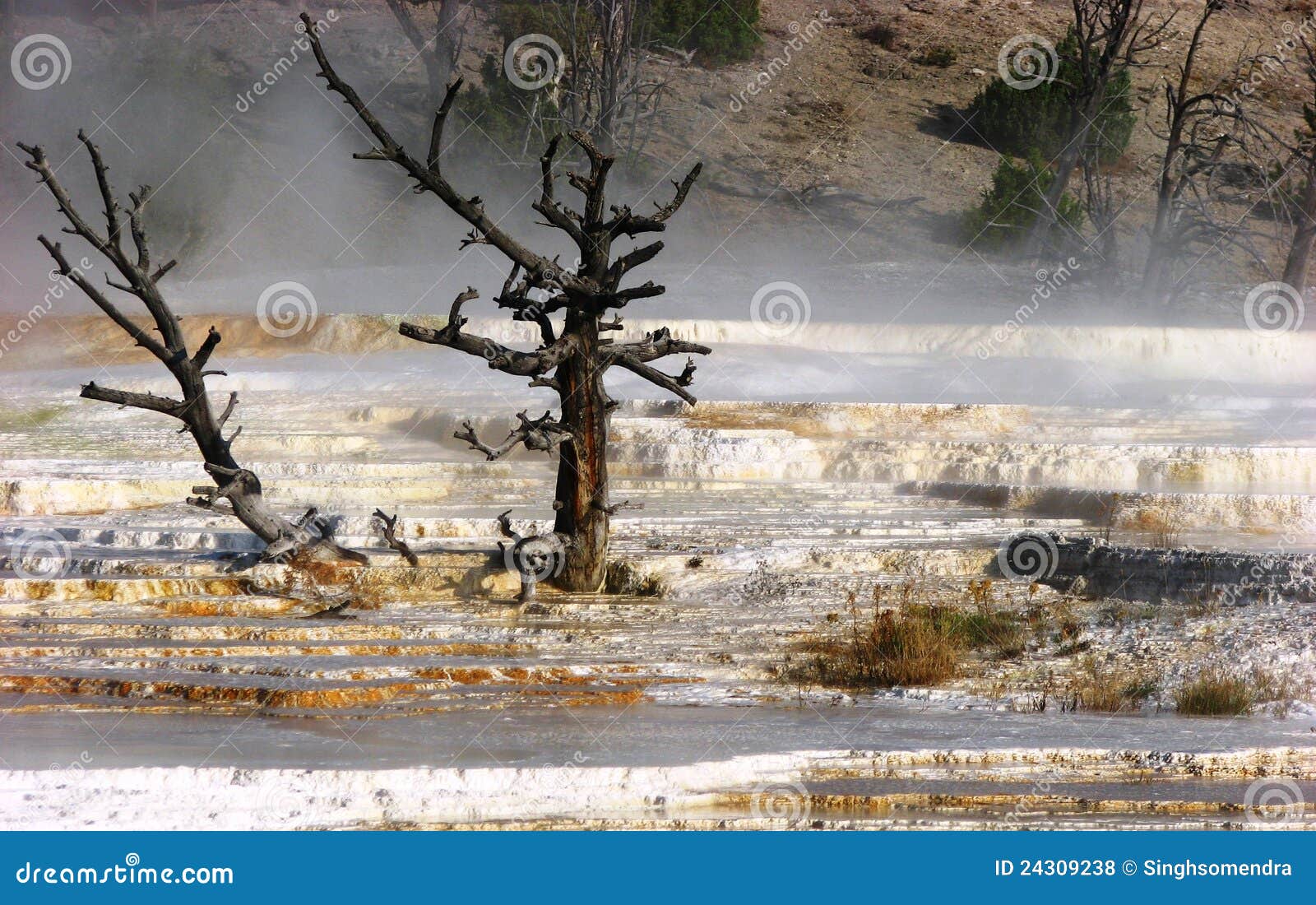
Most of the park's features are "rhyolitic," meaning they come from volcanic rock. Mammoth is different. It’s built on limestone.
When the hot water rises through the limestone, it dissolves the rock and carries it to the surface as calcium carbonate. This creates those "travertine terraces" that look like a frozen, melting white staircase. It’s eerie. Because the rock is so soft, these springs change shape much faster than the ones at Old Faithful. You can visit one year and see a vibrant, flowing terrace, and return two years later to find it gray, dry, and crumbling.
Survival Tips for the Thermal Basins
You’d think "don't walk on the boiling ground" would be common sense, but every year, someone tries it. The "soil" around these springs is often just a fragile overhang.
- Stay on the Boardwalks. This isn't a suggestion. It’s the law, and it’s for your life. People have stepped off the path and fallen through the crust into boiling acidic water. There is no saving you from that.
- Watch the Wind. If you’re at Grand Prismatic or Excelsior Geyser Crater, the steam can be overwhelming. It carries sulfur and high humidity. If you have asthma, be careful on heavy steam days.
- Go Early or Late. During the middle of the day in July, the boardwalks feel like a Disney World line. If you want to actually hear the water bubbling and the "hiss" of the earth, get there at 6:00 AM. The steam looks better in the cold morning air anyway.
- Polarized Sunglasses. This is a pro tip. The glare off the white silica flats is blinding. Polarized lenses cut through the reflection on the water's surface, letting you see the deep blues and greens of the pools much more clearly.
Why We Are Still Obsessed
There is something primal about Yellowstone. It’s one of the few places left where you can actually see the earth’s internal engine running. It’s loud, it’s smelly, and it’s dangerous.
The springs are a window into the past—and potentially the future. Researchers use these pools to study how life might exist on other planets, like Mars or Europa. If a bacteria can survive in a boiling acid bath at Norris Geyser Basin, why couldn't it survive in a volcanic vent on a distant moon?
When you stand in front of something like the Sapphire Pool, you aren't just looking at a pretty pond. You’re looking at a geological event that has been in progress for thousands of years. It’s humbling. Sorta makes your 9-to-5 problems seem pretty small when you realize you're standing on top of a supervolcano that’s just chilling, waiting to rearrange the continent.
Actionable Steps for Your Visit
If you're heading out there, don't just wing it. The park is bigger than some US states.
- Download the NPS App. Download the offline maps specifically. Cell service in the thermal basins is non-existent.
- Check the Geyser Times. Some springs are also geysers. Use the "GeyserTimes" app (it’s crowdsourced) to see if a pool is about to erupt. Seeing a pool transition from a calm mirror to a violent eruption is a core memory experience.
- Bring a Wide-Angle Lens. You can't get far enough back on the boardwalks to capture the scale of these springs with a standard phone lens. A clip-on wide-angle or a dedicated camera is worth the weight.
- Pack a Mask. Honestly, some days the sulfur at Mud Volcano or Sulphur Caldron is so thick it’ll make your eyes water. Having a gaiter or mask can help filter the worst of the "rotten egg" smell.
- Prioritize West Thumb. Everyone goes to Old Faithful. West Thumb Geyser Hill is right on the edge of Yellowstone Lake. Seeing the hot springs bubbling up through the cold lake water is a much more intimate, less crowded experience.