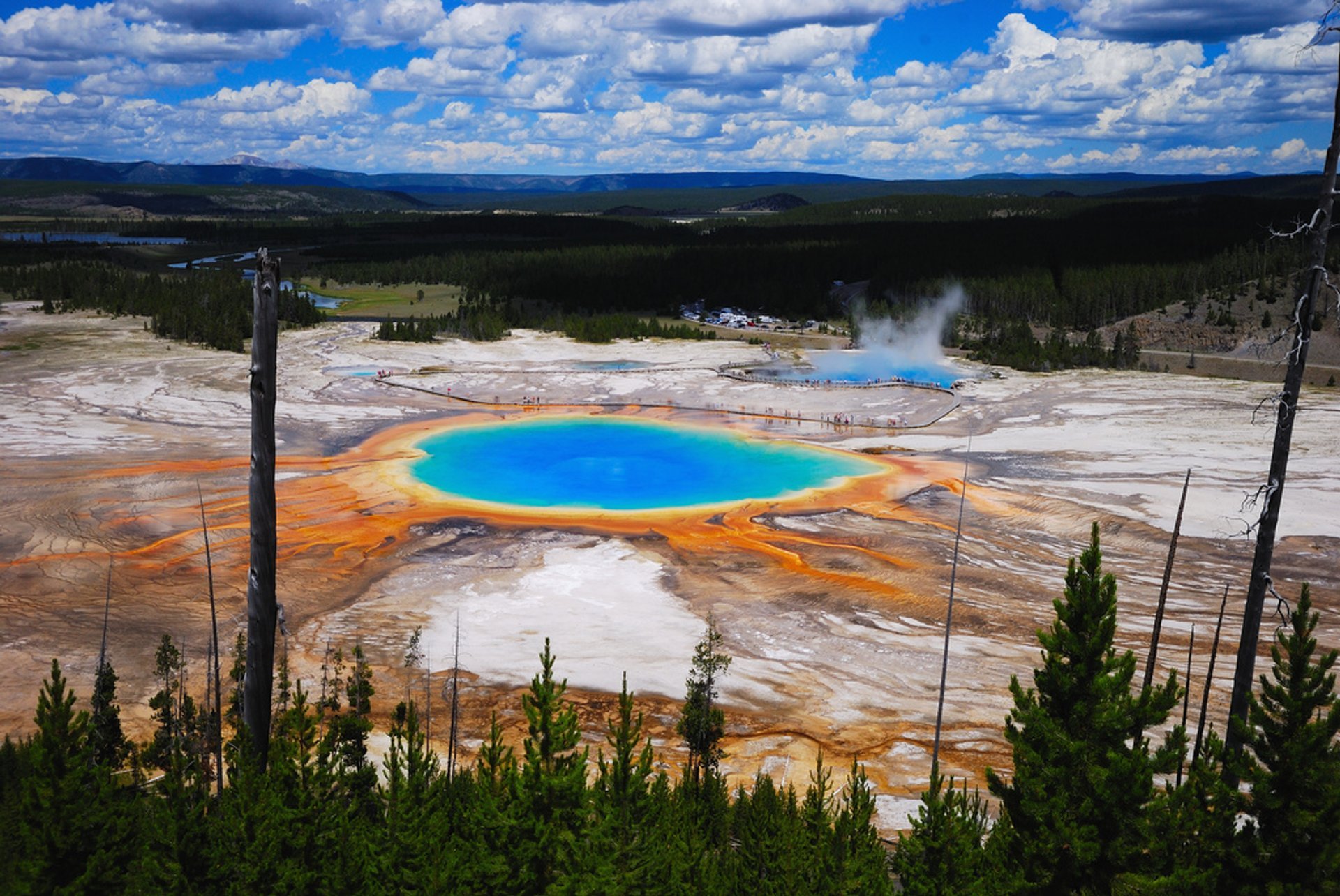
You’ve seen the photos. Those saturated, neon-blue pools ringed by fire-orange crust that look like they were taken on a different planet or, more likely, heavily abused in Photoshop. When people finally stand on the boardwalk at the Yellowstone Grand Prismatic Spring, the first thing they usually do is squint. It’s huge. It’s steaming. But sometimes, it looks more like a giant, misty puddle than a rainbow masterpiece.
That’s the thing about this place. It’s a living, breathing biological system, not a static monument. Located in the Midway Geyser Basin, this spring is the largest hot spring in the United States and the third-largest in the world. It’s deeper than a 10-story building. It’s wider than a football field. It pumps out roughly 560 gallons of 160-degree water every single minute.
But why is it so bright? Honestly, the answer is kind of gross and incredibly cool at the same time.
The Science of Those Neon Rings
The colors aren't just minerals. That’s a common misconception. While the deep blue in the center is physics—the result of water scattering blue light wavelengths back to your eyes—the yellows, oranges, and reds are alive. We’re talking about thermophiles. These are heat-loving bacteria and archaea that have figured out how to thrive in water that would literally peel your skin off.
Imagine a microscopic mat of life. In the hottest water, near the center, almost nothing can live. As the water flows outward and cools down, different species take up residence. According to the National Park Service, the green and yellow rings are often dominated by Synechococcus, a genus of cyanobacteria. These little guys use photosynthesis. During the summer, when the sun is punishingly bright, they produce more carotenoids—the same pigments in carrots—to protect themselves from UV rays. This turns the spring bright orange or red. In the winter, when there’s less light, they go back to being greenish.
It’s basically a massive, natural mood ring.
Why the "Overlook" is the Only Way to See It
If you walk the boardwalk at ground level, you’re mostly going to see steam. Lots of it. Because the water is so hot and the mountain air is often chilly, the spring creates its own micro-climate of fog. You’ll catch glimpses of the orange "fingers" of microbial mats, but you won't see the "eye" shape.
To actually see what you see in the magazines, you have to hike.
The Fairy Falls Trailhead is where you want to go. About a mile in, there’s a spur trail that leads to the Grand Prismatic Overlook. It’s a bit of a climb, but not devastating. From up there, the perspective shifts. You can see the distinct bands of color and the way the runoff creates these intricate, vein-like patterns across the Midway Geyser Basin. This is where the scale of the Yellowstone Grand Prismatic Spring actually hits you.
The High Cost of a "Selfie"
Let's talk about the boardwalks. They aren't there just to keep your shoes dry. The ground around the spring is a thin, fragile crust of sinter—silica deposits. Beneath that crust is boiling water and acidic mud.
People die here.
It sounds morbid, but it’s the reality of Yellowstone. In 2016, a man died in the nearby Norris Geyser Basin after leaving the boardwalk; the water was so acidic and hot that his body was dissolved before recovery teams could reach him. While Grand Prismatic isn't as acidic as Norris, the thermal burns are no joke. Then there’s the impact on the spring itself. If you drop a hat or a pair of sunglasses into the water, they don't just float away. They sink and can plug the vents that feed the spring. This happened at Morning Glory Pool, which used to be brilliant blue but is now "fading" because trash and coins thrown in by tourists shifted the temperature and allowed different, darker bacteria to grow.
Keep your hat on tight. Wind gusts in the basin are notoriously sudden.
Timing Your Visit (What the Guides Don't Tell You)
Most people arrive at 11:00 AM because that’s when they finish breakfast at Old Faithful. Bad move. The parking lot at Midway Geyser Basin is a nightmare. It was built for a different era of travel and hasn't been expanded to match the millions of people who visit annually.
If you want the best colors, you actually need the sun.
Going at sunrise sounds poetic, but the temperature difference between the air and the water creates so much steam you won't see anything but a white cloud. Wait until the air warms up. Between 12:00 PM and 2:00 PM is peak "color" time because the sun is high enough to penetrate the water and light up those microbial mats. Yes, the crowds will be thick. Yes, you might have to circle the parking lot for twenty minutes. It’s worth it for the saturation.
A Note on the "Smell"
It smells like eggs. Rotten ones. That’s the hydrogen sulfide gas produced by the volcanic activity deep underground. You get used to it after ten minutes, but if you’re sensitive to smells, maybe bring a bandana. It’s the scent of a sleeping supervolcano.
The Microbial Mystery
The Yellowstone Grand Prismatic Spring isn't just a tourist stop; it’s a laboratory. NASA and extremophile researchers spend a lot of time here. Why? Because if we find life on other planets or moons—like Europa or Enceladus—it’s probably going to look a lot like the bacteria in this spring. These organisms survive in conditions we used to think were impossible for life.
When you’re looking at those orange ripples, you’re looking at an environment that mirrors the early Earth, billions of years ago. It’s a time machine.
Practical Steps for Your Trip
Don't just wing it. Yellowstone is the size of Rhode Island and Delaware combined.
- Check the Wind: If the wind is blowing toward the boardwalk, you’ll be engulfed in steam. Try to approach from the upwind side if possible.
- The Fairy Falls Hike: Do the overlook first, then continue to Fairy Falls if you have the energy. The waterfall is 200 feet tall and much quieter than the spring.
- Polarized Sunglasses: This is the secret pro tip. Polarized lenses cut the glare off the surface of the water, allowing you to see the deep blue center much more clearly. It’s like turning on an "HDR" filter for your eyes.
- Avoid Peak Season if Possible: Late September is the sweet spot. The crowds have thinned, but the sun is still strong enough to burn off the morning steam and keep the colors vivid.
- Footwear Matters: The boardwalks can get slippery when wet with thermal spray. Wear shoes with actual grip, not just flip-flops.
Final Insights on the Basin
The Yellowstone Grand Prismatic Spring is a reminder that the Earth is alive. It’s not just a backdrop for a photo. It’s a volatile, shifting, chemical reaction that happens to be beautiful.
To get the most out of it, stop trying to get the "perfect" shot for five minutes. Put the phone down. Feel the heat of the steam hitting your face. Listen to the strange, hollow thumping of the earth beneath the boardwalk. That’s the sound of water moving through subterranean plumbing.
When you're ready to leave, head toward the Excelsior Geyser Crater right next door. It’s a massive, bubbling pit of sapphire water that used to erupt over 300 feet into the air. Now it just pours thousands of gallons of hot water into the Firehole River. It’s a stark contrast to the rainbow colors of Grand Prismatic and shows just how varied the thermal features in this one small basin can be.
Pack plenty of water, stay on the marked paths, and give yourself more time than you think you need. The scale of the place demands it.