It happened on March 1, 1872. President Ulysses S. Grant picked up a pen and changed everything about how humans look at the dirt beneath their feet. He signed the Yellowstone National Park Protection Act. Suddenly, over two million acres of rugged wilderness were "reserved and withdrawn from settlement, occupancy, or sale."
That's the textbook answer to when Yellowstone was established. But honestly, the date is just the boring part. The real story is a mess of political gambling, terrified explorers, and a bunch of guys sitting around a campfire trying to figure out if they should get rich or stay honest. It wasn't some grand environmental epiphany. It was a desperate race against time.
Why 1872 matters more than you think
Before 1872, the concept of a "National Park" didn't exist. Not here, not anywhere. People looked at land and saw two things: timber or gold. If you couldn't mine it or chop it down, it was basically useless. Yellowstone was different because it was so weird it scared people.
Early mountain men like Jim Bridger came back with stories of "glass mountains" and "water spouts" that shot hundreds of feet into the air. People thought they were drunk. They called Bridger a liar. They called the region "Colter’s Hell" after John Colter, who had wandered through it in 1807 and described a landscape that sounded more like a fever dream than a map.
It took decades for anyone to take these "tall tales" seriously.
When the Washburn-Langford-Doane Expedition finally poked around the area in 1870, they realized the stories were true. The ground shook. The mud boiled. It was alien. Cornelius Hedges, a member of that party, is often credited with the "campfire idea"—the notion that this place shouldn't be carved up into private ranches. He argued it should be a public park.
It was a radical, arguably insane idea for the 19th century.
The 1871 Hayden Expedition: The Proof
The park wouldn't have been established in 1872 without Ferdinand V. Hayden. He was a geologist with a massive ego and a gift for bureaucracy. He knew that Congress wouldn't care about "pretty views." They needed data. And pictures.
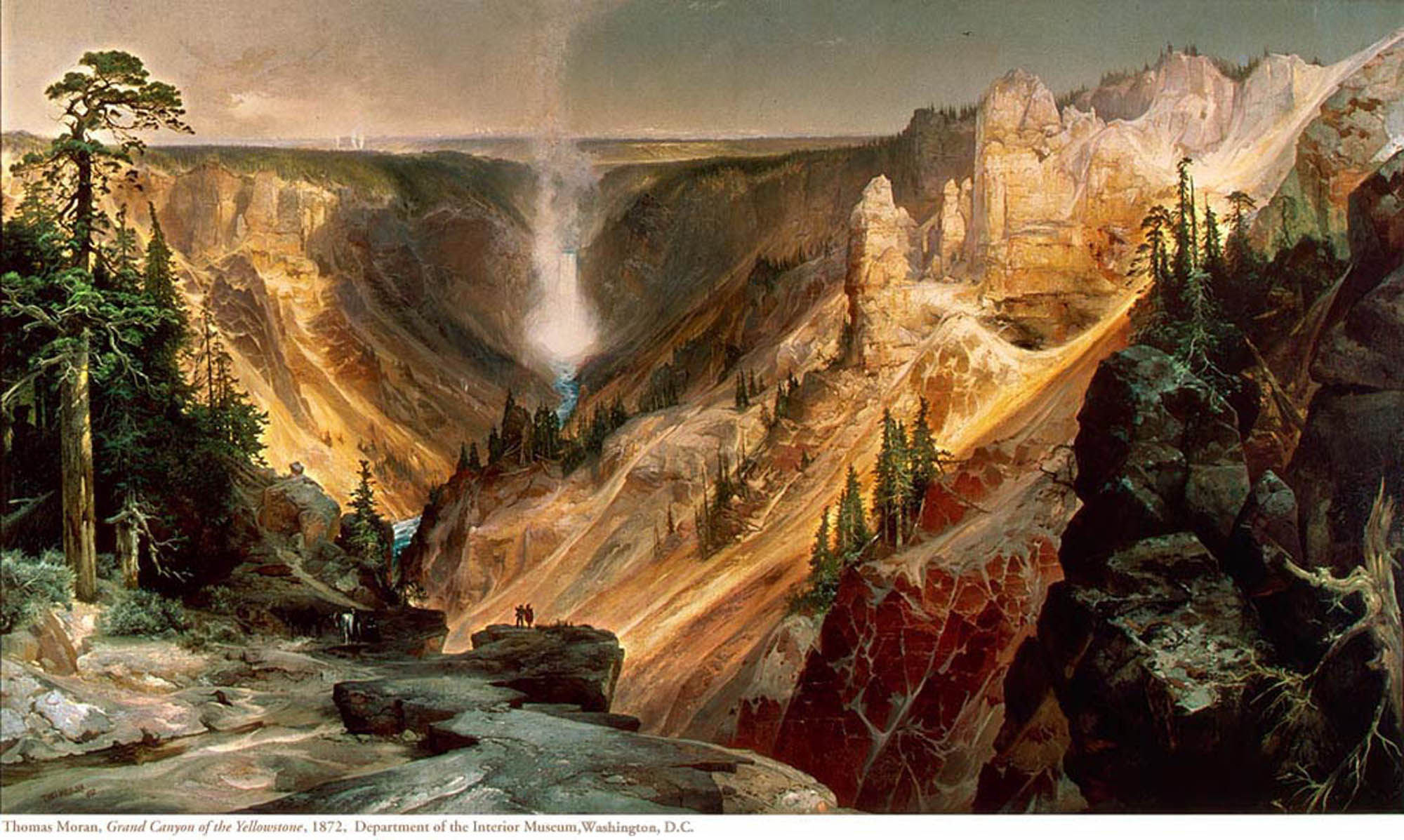
Hayden secured $40,000—a fortune back then—to lead a scientific survey. He brought along two secret weapons: painter Thomas Moran and photographer William Henry Jackson.
Seeing is Believing
Words weren't working. Congressmen thought the reports were exaggerated. But when Jackson’s black-and-white photos and Moran’s vibrant watercolors started circulating in Washington D.C., the mood shifted. You couldn't call a photograph a liar.
The images of Old Faithful and the Grand Canyon of the Yellowstone were the first "viral" content in American history. They showed a landscape that looked like a cathedral. Suddenly, protecting the land wasn't just about nature; it was about national pride. America didn't have ancient castles like Europe, but we had this.
The Battle in Congress
Even with the photos, getting the Act passed was a nightmare. Many politicians thought it was a waste of perfectly good resources. Why lock up land?
The lobbyists for the Northern Pacific Railroad were actually the ones who pushed the hardest. They weren't tree-huggers. They were businessmen. They realized that if the government made Yellowstone a "wonderland," people would pay for train tickets to go see it. It was a tourism play from the start.
The bill passed the Senate in January 1872. It cleared the House in February. When Grant signed it in March, Yellowstone was established, but it was a park in name only. There was no money. No staff. No plan.
A Park Without a Budget
For the first few years, the "world’s first national park" was a lawless mess. Nathaniel P. Langford was the first superintendent, but he was given exactly zero dollars for a salary. He didn't even live there. Poachers moved in. They killed thousands of elk and bison. Vandalism was rampant. People used to throw their laundry into the geysers because the boiling water acted like a washing machine (and often broke the geyser’s delicate plumbing).
It got so bad that the U.S. Army had to take over in 1886. For 30 years, soldiers in blue coats patrolled the park, chasing off poachers and guarding the hot springs. If you visit today and think the Rangers look a bit "military," that’s why. Their hats and uniforms are a direct evolution of the cavalry units that saved the park from being destroyed by its own visitors.
The Indigenous Perspective
We can't talk about 1872 without acknowledging a massive, uncomfortable fact: Yellowstone wasn't "untouched" or "empty."
For thousands of years, the Tukudeka (Sheep Eaters), Crow, Blackfeet, and Nez Perce lived in and moved through this region. The 1872 Act essentially ignored them. The government wanted to promote the park as a "pristine wilderness," which meant pretending nobody had ever lived there. They actively pushed Indigenous groups out to make the park feel "wild" for white tourists.
This is a nuance that often gets skipped in the "birthday" celebrations. The establishment of the park was a triumph of conservation, but it was also a story of displacement.
Why 1872 Still Matters in 2026
Yellowstone is the blueprint. Before it, no country had ever set aside a massive tract of land just for "the benefit and enjoyment of the people."
Today, there are over 4,000 national parks worldwide. Every single one of them traces its lineage back to that single signature from Ulysses S. Grant.
When you stand at the rim of the Grand Canyon of the Yellowstone today, you’re seeing exactly what Thomas Moran saw in 1871. That’s the miracle. In a world that gets paved over every ten seconds, this place stayed the same because a few guys got lucky with a bill in 1872.
Actionable Next Steps for Your Visit
If you’re planning to visit the place that started it all, don't just wing it.
- Go Early or Late: If you show up at Old Faithful at 11:00 AM in July, you aren't experiencing nature; you're experiencing a parking lot. Get into the geyser basins by 7:00 AM. The steam looks better in the cold morning air anyway.
- Check the NPS App: Download the official National Park Service app and save the Yellowstone maps for offline use. Cell service in the park is basically non-existent.
- Look for the Army History: When you visit Mammoth Hot Springs, take a second to look at the buildings. They aren't log cabins; they are old stone barracks from the Army era. It’s a physical reminder that the park survived because of the military.
- Respect the "Hot": People die every few years because they step off the boardwalks. The crust is thin, and the water is acidic. Stay on the wood.
- Watch the Wildlife, Not Your Phone: If a bison is close enough to take a selfie with, you are in the "danger zone." Give them 100 yards of space. They are faster than you.
The history of Yellowstone isn't just a date in a textbook. It’s a messy, living experiment that we’re still trying to get right. It’s about the fact that sometimes, humanity decides that some things are worth more than the money they could make.