Everyone loves a good apocalypse story. You’ve probably seen the maps on social media—those terrifying red circles that swallow half of North America, suggesting that if Yellowstone's caldera ever decides to wake up, we're basically all history. It sells clicks. It makes for great disaster movies. But honestly? Most of those maps are total garbage.
The actual blast radius of Yellowstone isn't a single "death zone" where everything just vanishes into a crater. It's way more complicated than that. Geologists at the United States Geological Survey (USGS) and the Yellowstone Volcano Observatory spend their lives trying to explain that while a "supereruption" would be a global-scale mess, it’s not an instant "game over" screen for the United States.
The Immediate Kill Zone: Ground Zero
If the big one happens, the actual "blast" is a local event. We're talking about the area immediately surrounding the park. This is where the pyroclastic flows happen. If you’re standing in Old Faithful when it goes, you aren't going to have time to tweet about it. These flows are dense, fast-moving clouds of hot gas and volcanic matter. They move at hundreds of miles per hour. They level everything.
But the reach of these flows is relatively limited. Most models show they would stay within about 40 to 70 miles of the eruption vents. So, the "blast radius" in terms of total incineration is mostly contained within the park and the immediate national forests. That’s cold comfort if you’re in Jackson Hole, but it means most of the country isn't getting hit by a wall of fire.
The Ash Fall: The Real Monster
The real problem—the thing that actually defines the blast radius of Yellowstone for most of us—is the ash. Volcanic ash isn't like the soft stuff in your fireplace. It’s pulverized rock. It’s glass. It’s heavy as hell.
A supereruption would eject more than 1,000 cubic kilometers of this material into the sky. When it falls, it’s not just a dusting.
- The 3-Foot Club: Close to the park (think Idaho, Montana, Wyoming), you’re looking at several feet of ash. This is enough to collapse every roof in a city. It turns into concrete when it gets wet.
- The Midwest Blanket: Cities like Denver, Salt Lake City, and maybe even Omaha could see several inches. That sounds like a heavy snowstorm, but you can’t plow ash. It kills car engines instantly. It shorts out power grids.
- The Coasts: New York and LA might see a light dusting—maybe a millimeter or two. It wouldn’t kill you, but it would ground every flight and potentially mess up the water supply.
Why Everyone Gets the "1000-Year Event" Wrong
People talk about Yellowstone being "overdue." It’s not. Volcanoes don’t work on a schedule. The last three major eruptions happened 2.1 million, 1.3 million, and 640,000 years ago. If you do the math, the intervals are roughly 800,000 and 660,000 years. Even if you believe in averages, we have about 20,000 years of wiggle room.
Dr. Michael Poland, the scientist-in-charge at the Yellowstone Volcano Observatory, has said repeatedly that the most likely "next" event isn't a supereruption at all. It’s a lava flow. Yellowstone has had dozens of these since the last big blast. A lava flow would stay inside the park. It would be slow. You could literally walk away from it. It would ruin the tourist season, but it wouldn't end civilization.
The Climate Aftermath
If the blast radius of Yellowstone includes the atmosphere, then the whole world is in the zone. The sulfur dioxide released would form an aerosol veil. This reflects sunlight.
Historically, big eruptions like Mount Tambora in 1815 led to the "Year Without a Summer." Crops failed in Europe and New England. Frost happened in July. A Yellowstone supereruption would be Tambora on steroids. Global temperatures could drop by several degrees Celsius for a decade. This is where the real "blast radius" hits—not from falling rocks, but from empty grocery store shelves in countries thousands of miles away.
The Hydrothermal Problem
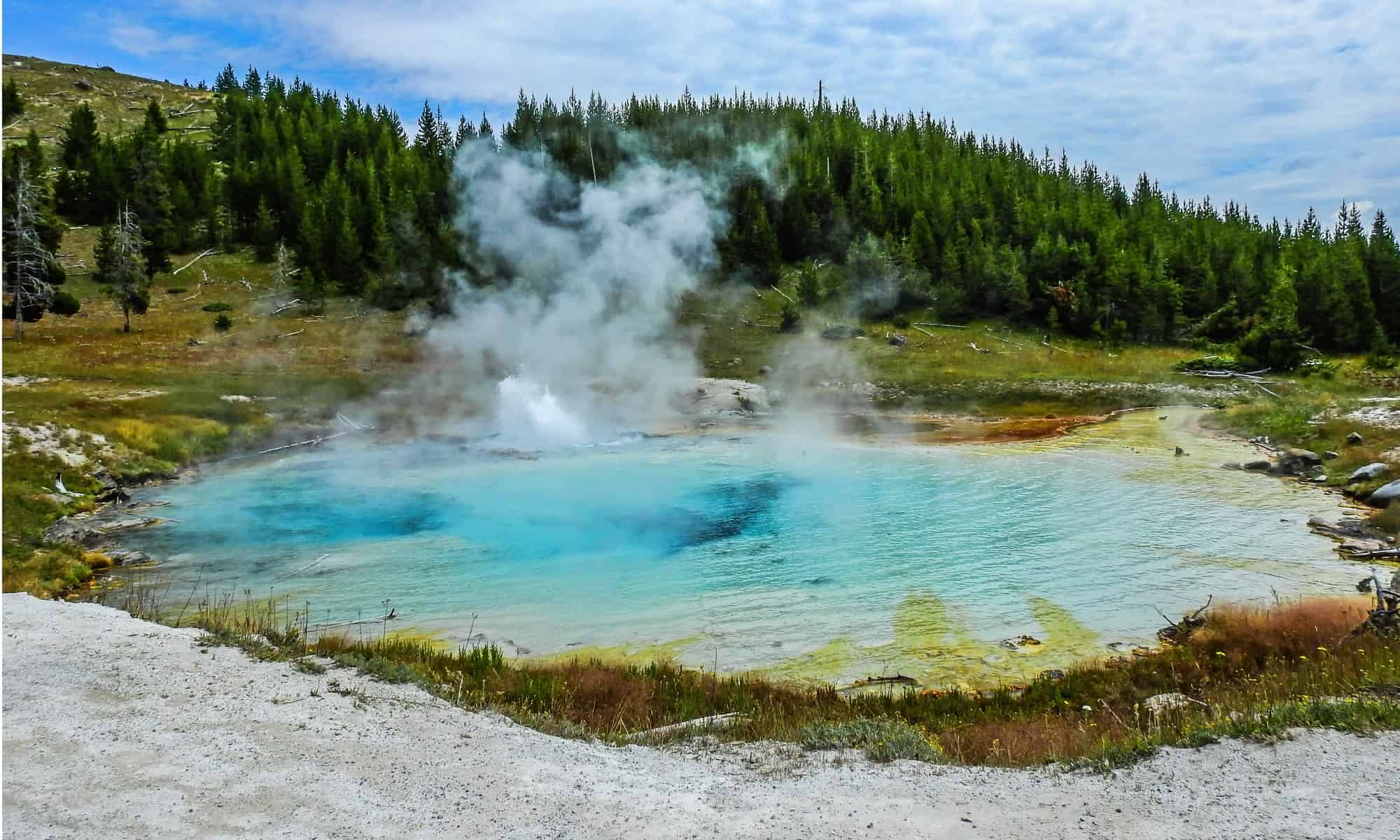
There is a smaller, much more realistic "blast" we should actually worry about: hydrothermal explosions. These happen when water trapped underground flashes to steam.
In July 2024, a small hydrothermal explosion occurred at Biscuit Basin. It sent rocks and boiling water flying, destroying a boardwalk. This happens frequently on a geological scale. You don't need a magma chamber breach for this. You just need a clogged pipe in the world’s biggest plumbing system. These events have a "blast radius" of a few hundred yards, but they are the most likely danger to actual humans visiting the park today.
Modern Monitoring: No Surprises
We aren't going to wake up tomorrow and be surprised by an eruption. Yellowstone is the most monitored volcano on Earth. GPS sensors can detect the ground rising by millimeters. Seismographs catch the "harmonic tremors" that indicate magma—not just water—is moving.
Currently, the ground is actually sinking in some parts of the caldera. The magmatic system is mostly solid (or "mushy"), not a giant lake of liquid fire waiting to pop. To get a supereruption, you need a massive amount of liquid magma to accumulate and then experience a massive failure of the overlying rock. We just don't see that happening right now.
Realistic Preparedness
So, what do you actually do with this information? If you live in the Pacific Northwest or the Mountain West, your "Yellowstone" kit is basically just a "Tuesday" kit.
- Air Filtration: High-quality N95 masks are essential. Volcanic ash destroys lungs.
- Water Security: Ash ruins open reservoirs. Having a weeks-long supply of bottled water is smarter than worrying about the "blast."
- Gutter Maintenance: If ash starts falling, you have to get it off your roof before the first rain, or your house might collapse.
- Transportation: Don't drive. Ash will chew through your air filter and seize your engine in minutes.
The blast radius of Yellowstone is a fascinating scientific concept, but it's often used as a doom-scrolling tool. The reality is a story of ash and climate, not a Hollywood fireball.
If you want to stay updated on the actual state of the volcano, stop following TikTok "experts." Bookmark the USGS Yellowstone Volcano Observatory monthly updates. They tell you exactly how many earthquakes happened and whether the ground moved. Knowledge is the best way to shrink that scary blast radius back down to a manageable size.
What to Watch for Next
- Check the USGS Monthly Reports: This is the only way to get unfiltered, non-sensationalized data on seismic activity.
- Evaluate Your Local Hazard Map: If you live in a volcanic region (like the Cascades), look at "lahar" maps—these are much more likely threats than a Yellowstone supereruption.
- Invest in HEPA Filtration: Whether it's wildfire smoke or a freak ash event, keeping your indoor air clean is the single best health move you can make in the West.
***