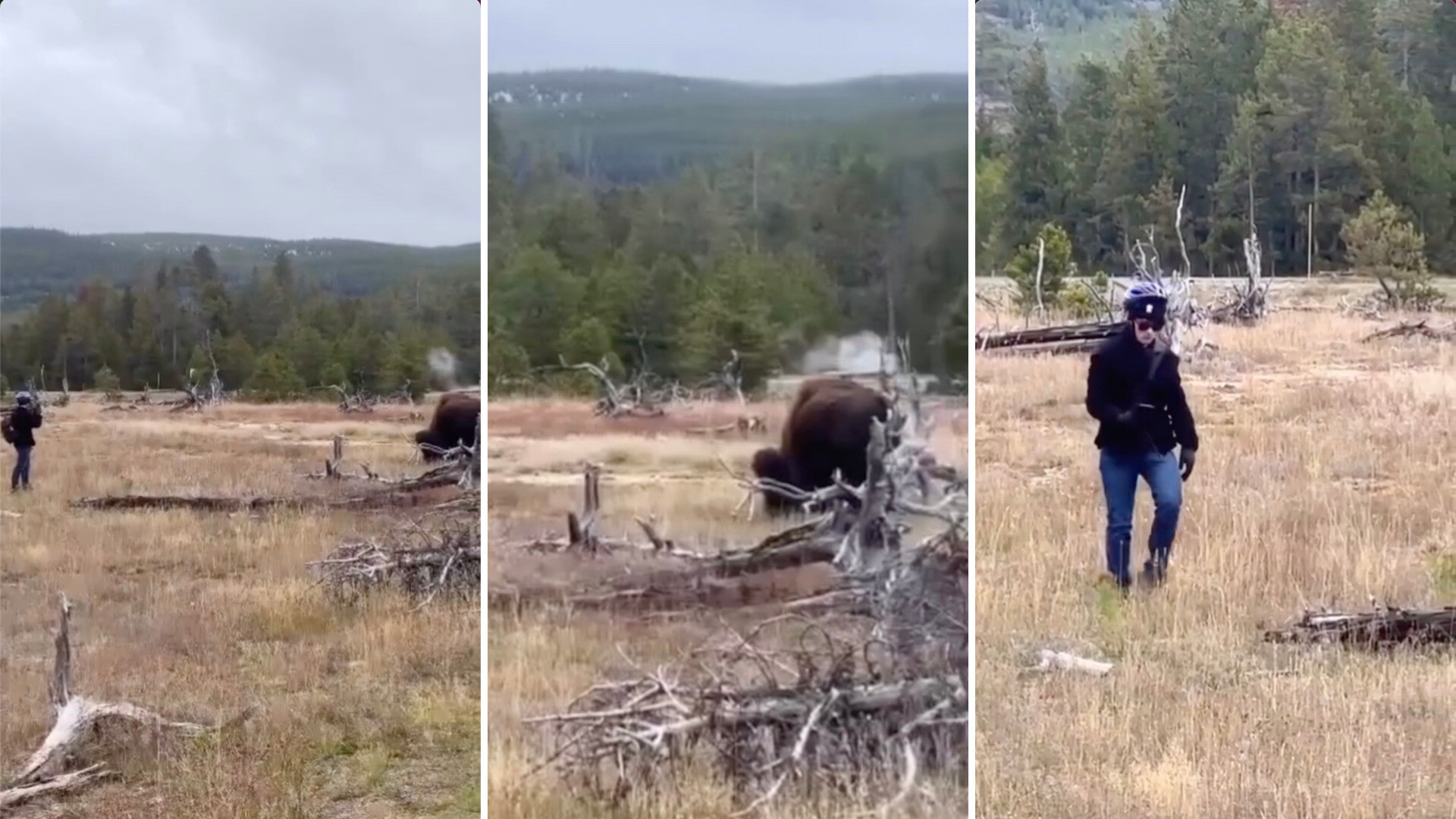
It happens every summer. A video goes viral showing a person, often clutching a smartphone, tiptoeing toward a two-thousand-pound wall of muscle and fur. The animal looks calm. It's just grazing, right? Then, in a split second, the head drops, the tail goes up, and someone is being tossed like a ragdoll. A Yellowstone bison tourist encounter isn't just a freak accident; it's a predictable consequence of how humans misjudge the wild.
Most people don't realize that bison are the most dangerous animals in Yellowstone National Park. Not grizzly bears. Not wolves. Bison. They injure more people in the park than any other creature. Why? Because they look like cows. They look slow. They look like they’re part of the scenery. But these animals are unpredictable, incredibly fast, and very protective of their personal space. Honestly, if you're within twenty-five yards, you're already in the "danger zone," even if the bison seems to be ignoring you.
The Psychology of the Encounter
Why do people get so close? It’s basically a mix of "Disney-fication" and the desire for the perfect social media shot. We’ve grown up seeing animals as characters or pets. When you see a massive herd of bison at Hayden Valley or Lamar Valley, it feels like a movie set. You've paid your entrance fee, you're on vacation, and you want that close-up. But a Yellowstone bison tourist encounter usually starts because a visitor ignores the "Rule of Thumb."
The Rule of Thumb is simple: Stretch your arm out, give a thumbs up, and try to cover the bison with your thumb. If you can still see the bison around the edges of your thumb, you are too close. Period.
Understanding Bison Body Language
Bison aren't trying to be mean. They’re just being bison. They have a very specific set of warning signs that most tourists completely miss because they’re looking through a viewfinder. If a bison stops eating and looks at you, that’s strike one. If it starts pawing at the ground or huffing, that’s strike two. The big one? The tail. If that tail is hanging down normally, the animal is relaxed. If it’s standing straight up like a flagpole? You need to run. Or rather, back away slowly while keeping your eyes on it.
A bull bison can weigh up to 2,000 pounds. They can run 35 miles per hour. Think about that. That is three times faster than you can run. They can jump over fences and are surprisingly agile for something that looks like a furry boulder. When a Yellowstone bison tourist encounter turns physical, it’s rarely a "nudge." It’s a goring or a toss that results in broken bones, internal bleeding, or worse.
Real Incidents and the Toll of "The Selfie"
The National Park Service (NPS) keeps records of these events, and the data is pretty sobering. In 2022, a 34-year-old man from Colorado was gored while walking with his family on a boardwalk near Old Faithful. A bison charged the group, and the man was injured while trying to protect his children. In another well-known case, a woman was gored while she had her back turned to the animal to take a photo.
These aren't just statistics. They are traumatic events that often lead to life-altering injuries. The "encounters" often happen in high-traffic areas like the Mammoth Hot Springs or near the various geyser basins. Bison love the boardwalks. They're flat and easy to walk on. The problem is that tourists think the boardwalk is a "safe zone." It isn't. If a bison is on the boardwalk, the bison owns the boardwalk. You have to turn around and go the other way.
Why Park Rangers Are Frustrated
If you talk to any Yellowstone ranger, they'll tell you the same thing: they’re exhausted. They spend half their day yelling at people to move back. It’s not because they want to ruin your fun. It's because when a bison attacks a human, the human gets hurt, and sometimes the animal has to be managed or moved, which isn't fair to the wildlife.
The park is 2.2 million acres. There is plenty of room for everyone, but humans tend to cluster. We see a crowd of people looking at something, and we join in. This "herd mentality" in humans is ironically what leads to the most dangerous interactions. People think, "Well, that guy is ten feet away, so I can be ten feet away." In reality, both of you are in extreme danger.
The Legal and Ethical Reality
Getting too close to wildlife in Yellowstone isn't just stupid; it's illegal. Federal regulations require you to stay at least 25 yards (23 meters) away from all large animals—bison, elk, bighorn sheep, deer, moose, and coyotes—and at least 100 yards (91 meters) away from bears and wolves.
If you're caught violating these distances during a Yellowstone bison tourist encounter, you can face heavy fines, jail time, or a permanent ban from the park. In 2023, a man was charged after he harassed a bison calf that had been separated from its mother near the Lamar River. The calf was later rejected by the herd and had to be euthanized by park staff because it was creating a dangerous situation by approaching cars and people. That’s the side of these encounters people don't think about: the impact on the animals' survival.
How to Actually See Bison Safely
You can get incredible photos without risking your life. Use a telephoto lens. Even a decent zoom on a modern smartphone is better than walking up to the animal. If you want the best views, head to Lamar Valley at dawn or dusk. Bring binoculars or a spotting scope. You'll see the bison interacting naturally—rolling in the dirt (wallowing), head-butting, and nursing calves (red dogs).
It’s much more rewarding to watch an animal behave naturally from a distance than to see it stressed and agitated because you’re in its face.
Practical Safety Steps
- Always look around corners. Bison love to hang out behind buildings or near the edges of parking lots.
- Give them a wide berth. If a bison is near the trail, walk way out around it or wait for it to move.
- Stay in your car. If a "bison jam" happens on the road, stay inside your vehicle. Do not lean out the window or sunroof.
- Listen. You'll often hear them grunting or huffing before you see them if the brush is thick.
Actionable Next Steps for Your Yellowstone Trip
If you're planning a trip to the park, your goal should be to leave no trace and stay un-gored. It's pretty simple if you follow the rules.
- Download the NPS App. It has real-time alerts and safety information that can help you navigate the park's shifting conditions.
- Pack a Zoom Lens. If you’re serious about photography, rent a 100-400mm lens. It’ll give you those "national geographic" shots without the emergency room visit.
- Check the "Red Dog" Schedule. Bison calves are born in April and May. They are incredibly cute, but the mothers are ten times more aggressive during this time. Give them extra space.
- Report Harassment. If you see someone intentionally provoking a bison or getting dangerously close, don't just film it for TikTok. Notify a ranger. You might save a life—human or animal.
- Watch the Tail. Remember: Tail down is okay. Tail up is a warning. Tail arched and twitching? You’re about to have a very bad day.
Respect the power of the plains. A Yellowstone bison tourist encounter should be a memory of a majestic animal from a distance, not a blur of fur and a helicopter ride to the nearest trauma center. Keep your distance, use your zoom, and let the wildlife stay wild.