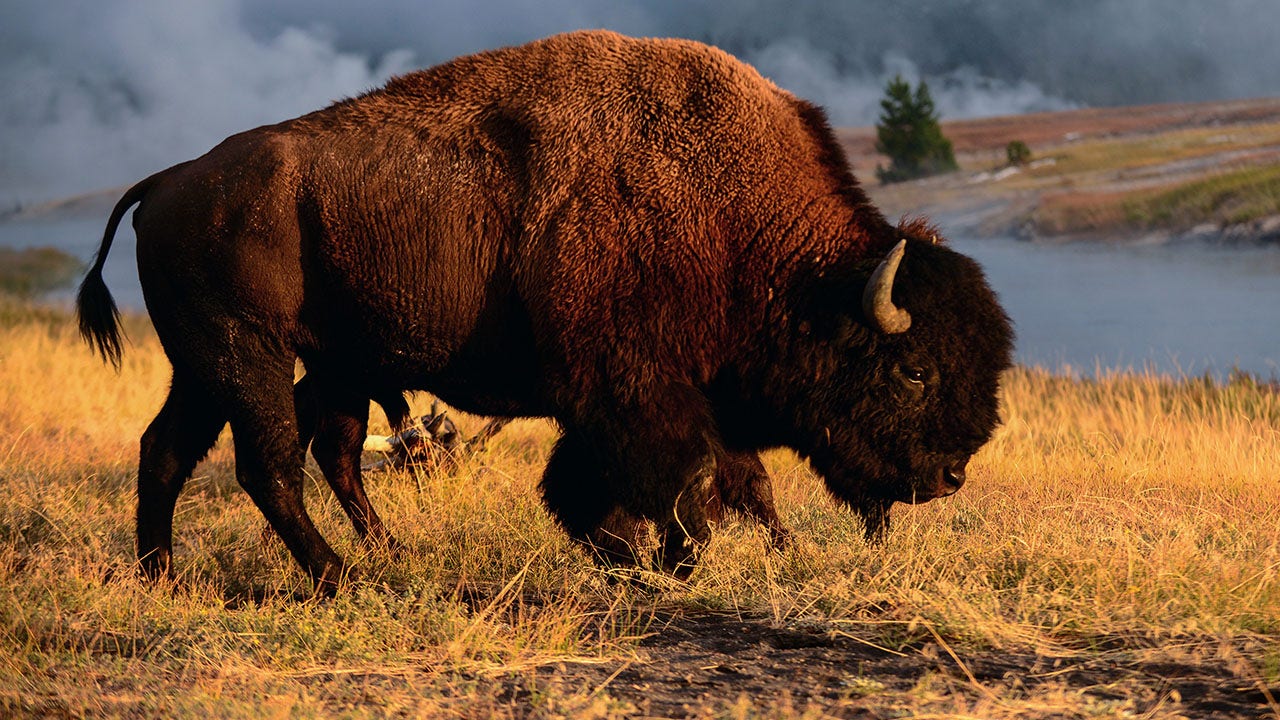
It happens every single summer. You’re driving through the Lamar Valley or maybe just pulling into a gravel turnout near Old Faithful, and there they are. Thousands of pounds of muscle, shaggy brown fur, and horns that look more like black hooks than anything found in nature. To a lot of people, they look like big, slow cows. They aren't. Not even close. When you hear about a bison goring Yellowstone tourist on the news, it’s usually because someone treated a wild animal like a photo prop.
It’s scary. One minute you’re zooming in on your iPhone, and the next, a 2,000-pound bull is charging at 30 miles per hour. You can't outrun that. Nobody can.
The National Park Service (NPS) is pretty blunt about it: bison have injured more people in Yellowstone than any other animal. That includes grizzly bears and wolves combined. Yet, every year, the videos surface on social media—people trying to pet them, families posing for selfies three feet away, or hikers trying to walk right through a herd. It’s a weird disconnect. We’ve become so used to seeing animals on screens that we forget they can actually blink, breathe, and decide they don't like us being in their space.
The Physics of a Bison Goring Yellowstone Tourist
Let’s be real about what actually happens during these encounters. A mature bull bison can weigh up to 2,000 pounds. To put that in perspective, that’s about the same as a subcompact car, but this car has horns and an attitude. When a bison decides to charge, it doesn't just bump you. It uses its massive neck muscles to lift and toss.
There was a high-profile case a couple of years ago where a 25-year-old woman from Ohio was tossed 10 feet into the air. She was within 10 feet of the animal. Think about that for a second. Ten feet. That’s roughly the length of a king-sized bed. The bison gored her, causing significant puncture wounds. This isn't just "getting hit." It’s a violent, traumatic event that usually requires a medevac flight to a Level 1 trauma center in Billings or Salt Lake City.
The physics are brutal. These animals are surprisingly agile. They can jump over fences that are six feet tall. They can pivot on a dime. Most tourists see them standing still, chewing cud, and assume they’re lethargic. Honestly, that’s the trap. They’re "peaceful" until they aren't.
Why Do They Charge?
It isn't usually "aggression" in the way humans think of it. It’s defense. Bison have a very specific "personal space" bubble. In Yellowstone, the legal requirement is to stay at least 25 yards (75 feet) away. That’s roughly the length of two large school buses. If you’re closer than that, you’re in their "threat zone."
During the "rut"—the mating season which usually runs from mid-July through August—the bulls are especially cranky. They’re full of testosterone, fighting each other for dominance, and they have zero patience for a guy in cargo shorts trying to get a portrait. If you see a bison pawing the ground, wallowing in the dirt, or letting out those deep, vibrating bellows, you need to leave. Fast.
Real Stories and Hard Lessons from the Park
The history of Yellowstone is littered with these incidents. Back in 2023, an 85-year-old woman was gored near the shore of Yellowstone Lake. She didn't even see the animal coming; it came out of the brush. In another instance, a visitor was gored because they were walking on a boardwalk—a place people assume is "safe"—but a bison was using the boardwalk too.
The park isn't a zoo. There are no cages. The boardwalks are for protecting the fragile thermal crust of the earth, not for protecting you from the wildlife.
People often ask, "Why didn't the rangers move the bison?" Well, it’s their home. You’re the visitor. If a bison is on the trail, you wait. Or you turn around. You don't try to "shoo" it. I’ve seen people throw rocks to get an animal to move or look at the camera. That is, quite literally, asking for a trip to the ER.
The "Selfie" Culture Problem
Social media has made this worse. We’re all chasing that one "epic" shot for the feed. But the lens on your phone is wide-angle. To get a bison to look big in a phone photo, you have to be dangerously close. Professional wildlife photographers use 600mm lenses that cost $12,000 so they can stay 100 yards away and still see the hair on the bison’s nose.
If you're using your thumb to zoom in on your screen, and the bison still looks small, that’s actually a good sign. It means you’re safe. If you can see the texture of its eyes without zooming? You are in the strike zone.
What the Experts Say: Biological Triggers
Biologists like Chris Geremia, who has studied the Yellowstone herds for years, point out that bison behavior is predictable if you know what to look for. A bison’s tail is the ultimate mood ring.
- Tail hanging down: Generally relaxed or just hanging out.
- Tail twitching or standing straight up: This is the red alert. It means the animal is agitated and likely about to charge or discharge (use the bathroom). Either way, you don't want to be there.
Most tourists who end up as a headline about a bison goring Yellowstone tourist missed these signs. They were too busy looking at their screens. They didn't notice the head drop or the heavy breathing.
There’s also a common misconception that if you’re in a group, you’re safe. Wrong. Bison don't care about numbers. In fact, a crowd of people surrounding an animal makes it feel trapped, which almost guarantees a defensive strike. The "circle of death" is what rangers call it—when tourists surround a bison on all sides to take photos. The bison picks the weakest point and blasts through it.
Survival is Not a Guarantee
People die from these encounters. It’s rare, but it happens. Most of the time, the injuries are life-altering. Broken ribs, collapsed lungs, internal bleeding, and massive skin tears from the horns. The recovery time for a goring is months, if not years.
And then there’s the legal side. Getting gored isn't just a medical disaster; it can be a legal one. It is a federal crime to disturb wildlife in a National Park. People have been cited and fined thousands of dollars after being released from the hospital because their own video evidence showed they were harassing the animal before it attacked.
Practical Steps for Your Next Visit
If you’re heading to Wyoming or Montana, you’re going to see bison. They’re everywhere. They’re the national mammal for a reason—they’re majestic and a symbol of the American West. But you have to be smart.
First, download the NPS app and actually read the safety warnings. They aren't just fine print. Use binoculars or a spotting scope. If you want a great photo, go to the pullouts in Hayden Valley where the bison are often hundreds of yards away but the landscape is wide open. You’ll get a better shot of the "wildness" of the park anyway.
If you find yourself accidentally close—say, you round a corner on a trail and there’s a bull standing there—do not run. Running triggers a chase instinct. Back away slowly. Keep your eyes on the animal but don't stare it down (which can be seen as a challenge). Look for a large object like a tree or a vehicle to put between you and the bison.
Most importantly, if you see someone else being reckless, don't follow them. Just because a "line" of people is 10 feet away doesn't mean it’s safe. It just means there are more targets. Be the person who stays in their car and uses the zoom lens. You’ll have the better story to tell at dinner, mostly because you’ll actually be at the dinner table instead of in a hospital bed.
The reality of a bison goring Yellowstone tourist is that it’s almost 100% preventable. It’s about respect. Respect for the animal’s power, respect for the park’s rules, and respect for the fact that we are not at the top of the food chain when we’re standing in the middle of a wilderness area.
Take the photo from the car. Give them the 25 yards. Let the bison be wild, and you’ll stay safe.
Actionable Safety Checklist
- The Rule of Thumb: Stretch your arm out and give a "thumbs up." If your thumb can completely cover the bison from your line of sight, you’re likely at a safe distance. If the bison is bigger than your thumb, you’re too close.
- Carry Bear Spray: While designed for bears, many rangers carry it for all large mammals. It can deter a charging bison, though your best bet is never needing it.
- Watch the Tail: If that tail goes up like a flagpole, drop everything and move away immediately.
- Never Block an Exit: If a bison is moving along a path or road, give it a wide berth. Don't stand in its way or "trap" it between your car and a hill.
- Report Reckless Behavior: If you see someone harassing wildlife, tell a ranger. You might be saving that person's life, or at least saving the bison from having to be managed or moved because of human stupidity.