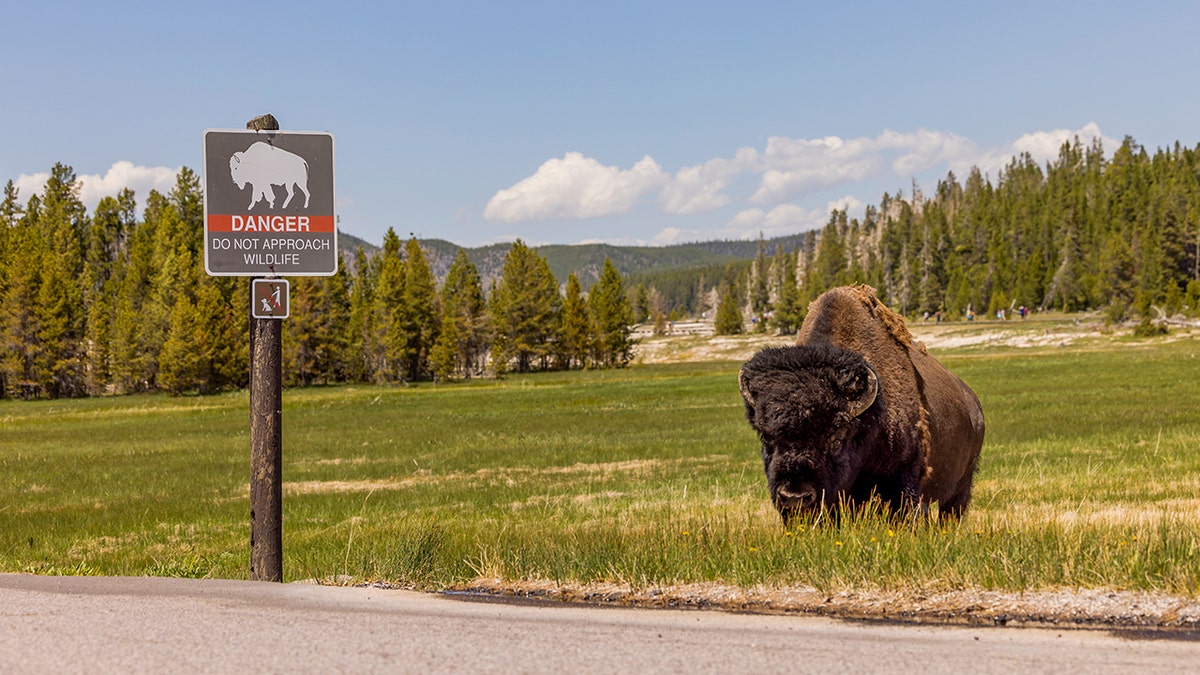
You’re standing on a boardwalk in the Hayden Valley or maybe near the Grand Prismatic, and the smell hits you before the sight does. It isn't just the rotten-egg sulfur of the thermal basins. It's something heavier. Something organic. Then you see it: a massive, dark shape bobbing in a pool of water so blue it looks like glass. Except the water is 180 degrees, and that shape used to be a two-thousand-pound bull.
It’s called a bison boil.
It sounds like a weird backcountry stew, but it’s one of the most jarring, violent, and perfectly natural parts of the Yellowstone ecosystem. People come to the park expecting a Disney-fied version of nature, but the thermal features don't care about your vacation photos. Every year, several of these massive animals—the icons of the American West—accidentally wander or fall into the hydrothermal vents, hot springs, and mud pots that define the park’s landscape. They don’t survive.
The Brutal Reality of a Bison Boil in Yellowstone
Why does this happen so often? Yellowstone sits on a supervolcano. The ground is literally a thin crust over a plumbing system of boiling water and steam. Bison are heavy. Really heavy. A mature bull can weigh 2,000 pounds. When you’re that big, thin crusts of sinter—the mineral deposits that form around geysers—can’t always hold you up.
Bison aren't stupid, but they are cold. In the brutal winters of Wyoming and Montana, these animals flock to the thermal basins because the ground is warm and the snow melts faster. It’s a survival strategy that backfires. They huddle around the heat to save energy, and sometimes, the ground just gives way. Or, a younger bull gets aggressive, starts a shoving match, and pushes a rival into a pool like the Celestine Pool or the Firehole River’s various hot spots.
When a bison falls in, it’s over fast. The water in many of these springs is well above the boiling point at this altitude. We're talking $198^{\circ}F$ ($92^{\circ}C$) or higher. The shock to the nervous system is immediate. They don't struggle for long. What follows is the "boil" part. The carcass remains in the water, essentially being slow-cooked by the earth itself.
Why Rangers Won't "Rescue" the Body
People get upset. They call the Ranger stations. They post on social media wondering why the Park Service isn't out there with a crane and a hazmat suit to pull the animal out.
Honestly? It’s too dangerous.
The ground around these pools is treacherous. Sending a crew of humans and heavy equipment onto a fragile thermal crust to retrieve a dead animal is a recipe for a human fatality. Yellowstone’s policy is almost always "let nature take its course." The park isn't a zoo; it’s a wild ecosystem. A bison boil provides an incredible, albeit disgusting, nutrient windfall for the park.
The Chemistry of Decay in Scalding Water
The biology of a bison boil is actually fascinating if you can get past the smell. Most bacteria that rot a carcass in the woods can’t survive in the extreme heat of a hot spring. Instead, specialized organisms called thermophiles take over. These are the same "heat-lovers" that give the Morning Glory Pool its vibrant colors.
They break down the bison’s tissues in a way that’s different from normal decomposition. The water often turns a murky, greasy gray. You’ll see "fat rafts" floating on the surface—liquefied bison tallow that separates from the muscle and bone. Eventually, the skeleton is all that's left. Over months or years, the calcium in the bones reacts with the mineral-rich water, sometimes even becoming "petrified" or coated in silica.
Scavengers and the Thermal Buffet
It isn't just the microbes getting a meal. Grizzly bears and wolves are smart. They know that a bison boil is essentially a free, high-calorie soup. There are famous sightings—like those documented by park biologists near the Gibbon River—where grizzlies have been seen reaching into the edges of thermal runoff to pull out chunks of cooked meat.
Imagine a 600-pound grizzly bear risking its own paws to grab a piece of bison that’s been simmering for three days. It happens. It’s one of the few times you’ll see predators and scavengers hanging around the geyser basins for reasons other than warmth. They are there for the buffet.
The Impact on Water Chemistry
You might think a rotting bison would ruin the geyser, but the park’s plumbing is massive. While a bison boil might cause a temporary spike in nitrogen or phosphorus in a specific pool, the sheer volume of water moving through the subterranean system usually flushes it out over time.
However, in smaller, "closed" pools, the carcass can change the pH level. This can temporarily kill off the colorful bacterial mats that tourists love to photograph. The park service monitors these sites, but they rarely intervene unless the carcass is directly threatening a high-traffic boardwalk or a drinking water source.
What to Do if You Spot a Bison Boil
If you’re hiking in the backcountry or walking the boardwalks in the Lower Geyser Basin and you see a bison boil, there are a few things you need to remember. First, stay back. The smell is one thing, but the presence of a carcass attracts the kind of wildlife you don't want to meet at close range.
Bears are extremely protective of "found" food. If a grizzly is nearby, it will view you as a competitor for that bison.
- Don't leave the boardwalk. The ground near a boil is even more unstable than usual because of the localized moisture and heat.
- Report it, but don't expect a "cleanup." Tell a ranger so they can put up "Bear Frequency" signs or warn other hikers.
- Watch the birds. Usually, ravens and magpies are the first ones on the scene. If you see a lot of bird activity around a steaming pool, there’s a good chance something is in there.
It’s easy to look at a bison boil and feel like something went wrong. But in the grand scheme of Yellowstone’s history, this has been happening for thousands of years. It’s a brutal cycle. The park gives life with its warmth and grass, and it takes it back with its boiling water.
Actionable Steps for Your Next Trip
If you want to see the "wilder" side of the park without the crowds, keep an eye on the park’s official "backcountry situation reports." While they won't explicitly list "bison boils" as a tourist attraction, they will mention trail closures due to carcass activity.
For those interested in the science, check out the resources provided by the Yellowstone Volcano Observatory (YVO). They often discuss how organic matter affects thermal features. If you happen to witness a carcass in a pool, keep your distance—at least 100 yards if bears are present—and use a telephoto lens. This is raw nature. It isn't pretty, it isn't "clean," and it definitely doesn't smell like a postcard, but it’s the reality of the American West.
Check the wind direction before you stop to look. Trust me on that one. The scent of a week-old bison boil is something that stays in your jacket for the rest of the trip. Pack an extra layer you don't mind getting "earthy," and always carry bear spray, even in the geyser basins. You never know who else is coming to dinner.