You’re cruising through Hayden Valley, humming along to a playlist, when the brake lights ahead start glowing like a string of Christmas lights. Then, the engine noise stops. Doors creak open. People start scurrying toward the shoulder with tripods that look like heavy artillery. You’ve just hit a "bear jam." It’s the quintessential Yellowstone experience, and honestly, it's usually a chaotic mess. Bears blocking the road in Yellowstone isn't just a quirky photo op; it’s a high-stakes logistical puzzle that the National Park Service (NPS) has to solve every single day during the peak season.
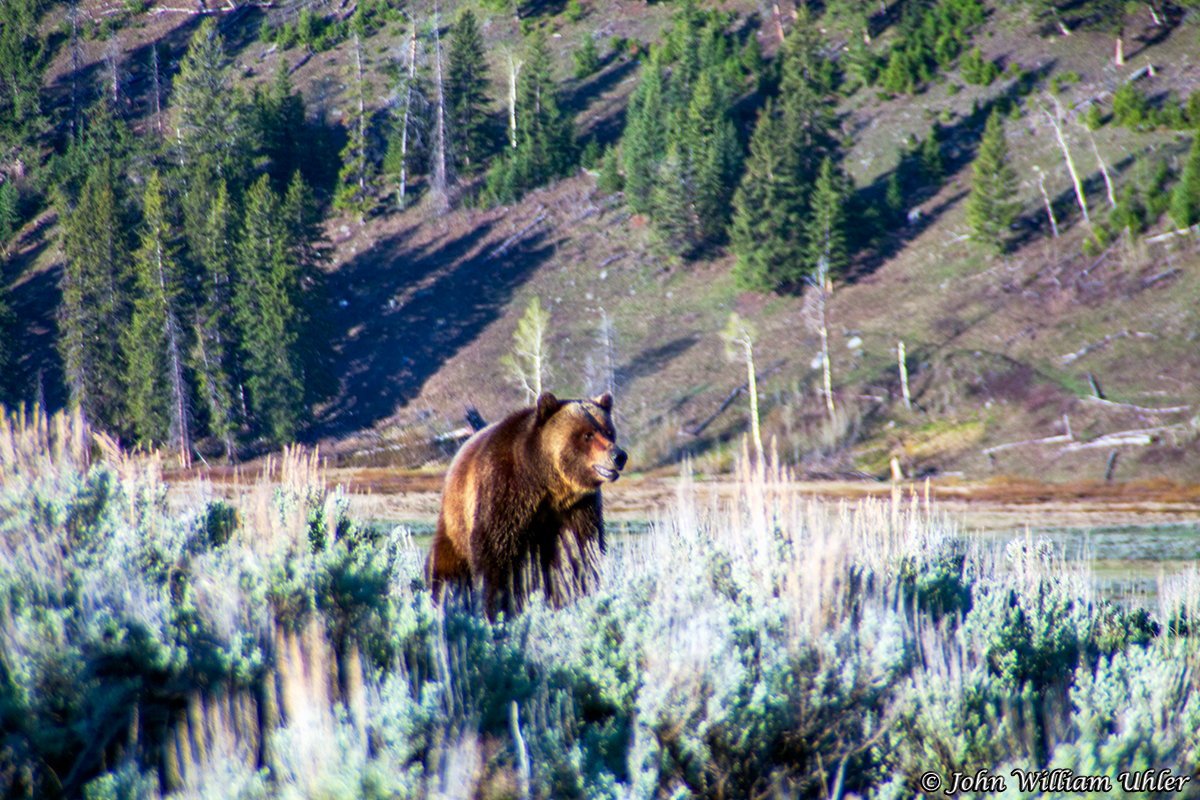
Most people think these traffic stops are just about a bear crossing the street. It’s rarely that simple. Sometimes a grizzly is just napping in the tall grass twenty feet from the asphalt, and other times, a mama black bear is trying to coax three cubs across a line of idling SUVs. It’s loud. It’s tense. And if you don't know the "unwritten" rules of the road, you're probably going to end up with a hefty fine or a very angry park ranger shouting through a megaphone.
Why Bears Love the Pavement
Bears don't care about your itinerary. To a grizzly or a black bear, the road is just a convenient, flat clearing in a very dense forest. In the spring, the "green-up" happens first along the roadsides because the asphalt retains heat, melting the snow faster and encouraging the growth of succulent clover and dandelions. These are high-calorie snacks for a bear that just woke up from a six-month nap.
Wildlife biologists like Kerry Gunther, who has headed Yellowstone’s bear management program for decades, often point out that bears are masters of caloric math. If the easiest food is next to a Corolla, that’s where the bear is going to be. Roads also act as travel corridors. Why push through thick downfall and lodgepole pine when you can just trot down the Grand Loop Road? It’s basic physics.
But there’s a darker side to this proximity. When bears block the road in Yellowstone, they are often being "habituated." This doesn't mean they are tame. Far from it. It means they’ve lost their natural fear of humans. A habituated bear is a bear that might eventually get too close to a campsite or a hiker, and as the saying goes, "a fed bear is a dead bear." While the bears aren't necessarily being fed by hand anymore—thanks to strict 1970s-era regulations—they are getting used to the "circus" of human noise.
The Anatomy of a Bear Jam
It starts with one car. Someone spots a flash of cinnamon fur in the brush. They slam on the brakes—often right in the middle of the lane—and jump out. Within ninety seconds, there are ten cars. Within ten minutes, there are fifty.
The "Bear Management Volunteer" (BMV) teams are usually the first on the scene. These are often retirees who spend their summers wearing orange vests and trying to prevent "human-bear interactions." They have a thankless job. They aren't there to be your tour guide; they are there to make sure you stay at least 100 yards (91 meters) away from that bear.
You’ll see them pacing the white line, waving traffic through. They use phrases like "Keep it moving!" and "No stopping in the road!" It feels bossy, but it’s literally for your life. A grizzly can cover 40 yards in a few seconds. If you're standing by your open car door taking a selfie and that bear decides it’s bored of the dandelions and wants to see what’s in your pockets, you are in deep trouble.
The 100-Yard Rule is Not a Suggestion
Yellowstone regulations are incredibly specific: you must stay at least 100 yards away from bears and wolves. For everything else, like bison or elk, it’s 25 yards.
Think about a football field. That’s the distance you need.
When bears block the road in Yellowstone, people tend to lose their minds and forget basic geometry. They see someone else getting closer, so they creep forward too. It’s a "herd mentality" that puts the animal at risk. If a bear feels crowded, it might "bluff charge." This is a terrifying display where the bear gallops toward the crowd, huffing and slapping the ground, only to veer off at the last second. It's a warning. If the bear is forced to do this repeatedly, the park may have to relocate the animal or, in extreme cases of aggression, euthanize it.
The Economics of Roadside Grizzlies
Believe it or not, there's a specific group of bears that are "famous" for causing these jams. For years, a sow grizzly known as "Raspberry" and her cubs were the stars of the northern range. These bears became so used to the road that they would nurse their cubs within sight of hundreds of tourists.
This creates a weird conflict. On one hand, seeing a bear from your car is the safest way for a tourist to experience Yellowstone’s megafauna. It’s accessible for people with disabilities, the elderly, and families with small kids. On the other hand, it turns a wilderness area into a parking lot.
The Park Service actually tracks the "cost" of these bear jams in man-hours. Every time a bear hangs out near the road, it pulls rangers away from other duties like backcountry patrols or emergency medical services. In a busy July, there can be a dozen major bear jams happening simultaneously across the 2.2 million acres of the park. It’s a massive drain on resources just to make sure people don’t try to pet the 600-pound apex predator.
What to Actually Do When You See a Bear on the Road
First off, don't stop in the middle of the road. It sounds obvious, but you'd be surprised how many people just park their minivans in the lane of travel. Find a "pullout." These are designated paved areas where you can safely get your vehicle off the road.
If there is no pullout nearby, honestly? Just keep driving.
I know it’s hard. You spent $4,000 on this trip and you want that photo. But if the road is blocked and there’s nowhere to pull over, adding your car to the clog just makes the situation more dangerous for the bear. If you do find a spot to park, stay in your car. Use your vehicle as a "hard-sided" blind. You get a better view anyway because the bear isn't as stressed by your presence if you're behind glass.
Common Mistakes to Avoid:
- Running toward the bear: You are not a Disney prince. You are a slow-moving snack.
- Whistling or shouting to get its attention: You want the bear to stay calm. Making noise to get a "better look" for your camera is harassment.
- Leaving your car door open: If the bear approaches, you need to be able to seal your environment instantly.
- Turning your engine off if you're in the front of the line: Rangers might need you to move right now to create a gap for the bear to cross.
The Science of Bear Behavior Near Traffic
Research published in journals like The Journal of Wildlife Management suggests that bears actually use humans as "shields." This is a fascinating bit of animal psychology. A sub-adult bear or a female with cubs might hang out near the road because they know that big, dominant male grizzlies—who might kill the cubs—tend to avoid the noisy, crowded roads.
So, the bear isn't there because it likes you. It’s there because you are a giant, noisy deterrent for its own predators. When you understand that, the dynamic changes. You realize you’re participating in a complex survival strategy.
But this "shield" effect only works if the humans stay predictable. When people start surrounding a bear or cutting off its exit route, the bear feels trapped. A trapped bear is an unpredictable bear. Most of the "attacks" that happen near roads aren't predatory; they are defensive. The bear just wants space, and it will use its claws to get it.
The Future of the Yellowstone Bear Jam
With record-breaking visitor numbers hitting the park—often over 4 million people a year—the NPS is struggling. There have been talks of shuttle systems or "restricted zones" during the peak of the grizzly season. For now, the strategy is mostly education and "hazing."
Hazing involves rangers using "cracker shells" (loud blanks) or bean-bag rounds to push a bear away from the road. It looks mean, but it's a "teaching moment" for the bear. The goal is to make the road a scary, unpleasant place so the bear stays in the woods where it’s safe.
If you see a ranger firing a loud gun near a bear, don't scream. They are trying to save that bear's life by teaching it that the road is a bad neighborhood.
Practical Steps for Your Trip
If you want to see bears without the stress of a 200-car pileup, you need to change your timing. Most bears blocking the road in Yellowstone appear during the "crepuscular" hours—dawn and dusk.
- Get a high-quality optic: Don't rely on your phone's digital zoom. It will look like a grainy brown potato. Invest in a pair of 8x42 or 10x42 binoculars. You can see the bear's eyelashes from a safe distance.
- Check the sightings board: Most visitor centers, like the one at Canyon Village or Grant Village, have a "wildlife sightings" board. It’s usually a day or two behind, but it gives you an idea of where the activity is concentrated.
- Drive the "Northern Range": The stretch between Mammoth Hot Springs and the Lamar Valley is prime bear territory. The roads are narrower, and the pullouts are smaller, so be extra cautious here.
- Carry bear spray—even in the car: If you get out to look at a bear that is 100 yards away, carry your spray on your belt. Bears move fast. If the bear decides to cross the road right where you are standing, you need that deterrent ready.
- Listen to the Rangers: If a ranger tells you to move, don't argue about your "right" to be there. They are managing a wildlife corridor, not a theme park.
The reality of Yellowstone is that the animals have the right of way. Whether it’s a 2,000-pound bison licking the salt off your bumper or a grizzly bear taking a nap in the lane of travel, you are a guest in their living room.
When you encounter bears blocking the road in Yellowstone, take a breath. Put the phone down for a second. Look at the animal with your own eyes, not through a screen. Just make sure you’re doing it from a distance that keeps the bear "wild" and you "un-chewed." The best bear encounter is the one where the bear barely notices you were there at all.
Be patient, stay in your car if it's close, and always leave an exit path for the animal. That’s how we keep Yellowstone looking like Yellowstone instead of a zoo.