You’re looking at a map of North America, and your finger drifts upward, past the familiar clusters of Toronto and Vancouver, past the sprawling prairies of Alberta, until it hits a massive blue patch—Great Slave Lake. Right there, perched on the northern shore like a sentinel of the Canadian Shield, is Yellowknife.
Honestly, most people assume it’s basically at the North Pole. It isn't. But it’s close enough that the sun barely sleeps in June and the sky turns into a neon-green lava lamp for half the year. If you found value in this article, you should read: this related article.
Where Exactly is Yellowknife on the Canada Map?
To find Yellowknife, you have to look at the Northwest Territories (NWT). It sits at 62°27′ North latitude and 114°22′ West longitude. If you’re a visual person, imagine a vertical line drawn straight up from the border between Alberta and Saskatchewan. Keep going north until you hit the deep water of Great Slave Lake. That’s the spot.
It’s roughly 400 kilometers (about 250 miles) south of the Arctic Circle. This is a crucial distinction. Being near the circle but not inside it means Yellowknife gets the best of both worlds: extreme northern phenomena without being completely shrouded in 24-hour pitch blackness during the winter. For another perspective on this story, see the recent update from National Geographic Travel.
The Geography of the "Money Place"
The local Tlicho (Dene) people call it Somba K'e, which literally translates to "money place." This isn't just a metaphor. The city was built on gold in the 1930s and later reinvented itself as the "Diamond Capital of North America."
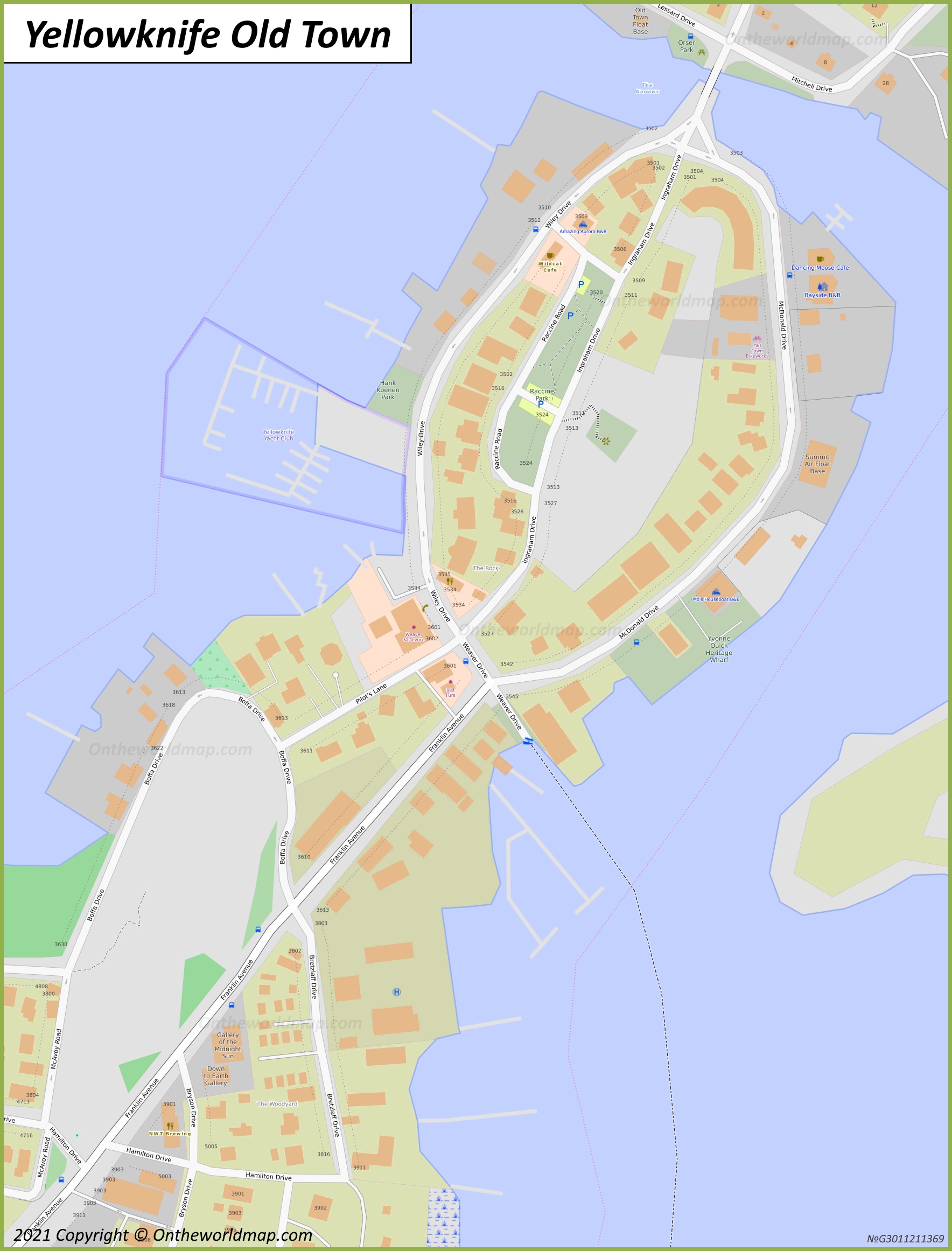
Geologically, you’re standing on the Canadian Shield. This is some of the oldest rock on the planet. It’s rugged, peppered with jack pine, and stubborn. In the Old Town district, houses are literally bolted to the Precambrian rock because digging a basement is a fool's errand.
How Far is it Really?
Distance in the North is measured in hours, not kilometers.
- From Edmonton: It’s a 1,500 km (930 mile) trek. If you drive, you’re looking at about 15 to 19 hours of asphalt, bison sightings, and very few gas stations.
- From the Arctic Circle: About 400 km north.
- From the North Pole: Roughly 3,000 km. You've still got a way to go.
Most people just fly. It's a two-hour jump from Edmonton or Calgary. When you land, you aren't in a frozen wasteland; you’re in a city of 20,000+ people with a surprisingly bustling downtown, high-rise buildings (unusual for the North), and an Ethiopian restaurant that locals swear by.
The "Yellowknife on Canada Map" Misconception
One of the biggest mistakes travelers make is thinking Yellowknife is just a "winter destination."
Because of its position on the map, it gets more summer sunshine than almost any other city in Canada—averaging over 1,000 hours. In July, the sun sets around midnight and rises again at 3:00 AM. It never truly gets dark. You can literally play a round of golf at 1:00 AM at the Midnight Sun Golf Tournament.
The Aurora Oval Sweet Spot
The reason Yellowknife dominates the "Northern Lights" searches isn't just because it's north. It’s because it sits directly under the Auroral Oval.
The Earth’s magnetic field funnels solar particles into this specific ring. While places like Whitehorse or Churchill are great, Yellowknife has a "flat" landscape and a semi-arid climate. Low moisture means fewer clouds. Fewer clouds mean you actually see the lights instead of just gray fog. Statistically, if you stay for three nights in the winter, you have a 90% chance of seeing the Aurora.
Living at 62 Degrees North
Life here is... different. In 2026, the city is still navigating the balance between its mining roots and a massive push toward Indigenous-led tourism.
You've got the Dettah Ice Road in the winter—a highway literally plowed over the frozen lake that connects the city to the First Nations community of Dettah. Then there’s the Snowking Winter Festival, where they build a massive castle out of snow blocks harvested from the lake.
But it’s not all "Ice Pilots" drama.
- The Cold: It hits -40°C. At that temperature, exposed skin freezes in minutes, and your car tires get "flat spots" from sitting too long.
- The Community: It's incredibly diverse. You’ll find a massive Filipino population, a thriving Vietnamese community, and vibrant Francophone circles.
- The Cost: Yes, milk is more expensive. Shipping takes longer. But the "Northern Allowance" (a tax break/salary bump for living up here) helps take the sting out of a $9 head of lettuce.
Practical Steps for Your Map-Chasing Adventure
If you’re planning to put yourself on the map in Yellowknife, don't just wing it.
- Timing is Everything: If you want lights, go between September and March. If you want the "Midnight Sun" and 24-hour hiking, June is your window. Avoid May and October; that's "shoulder season" where the ice is either melting or freezing, and many outdoor activities are paused for safety.
- Rent the Gear: Don't buy a $1,000 parka for a three-day trip. Local outfitters like North Star Adventures or Aurora Village rent "Arctic-spec" gear that actually works at -35°C. Your southern winter coat will not suffice.
- Explore Old Town: Most people stay in the New Town hotels. Don't. Head down the hill to Old Town. Eat at Bullock’s Bistro (get the pan-fried whitefish) and walk up to the Bush Pilot’s Monument for a 360-degree view of the city, the houseboats, and the lake.
- Check the Road Conditions: If you’re driving the Mackenzie Highway (Highway 3), check the GNWT (Government of Northwest Territories) road reports. In the winter, you need a survival kit in your trunk. No joke.
Yellowknife is more than just a dot on a map. It’s a place where the infrastructure of a capital city meets the raw, unyielding power of the Subarctic. Whether you're there for the diamonds, the Dene culture, or the lights, just remember: it's further than you think, but worth the effort.