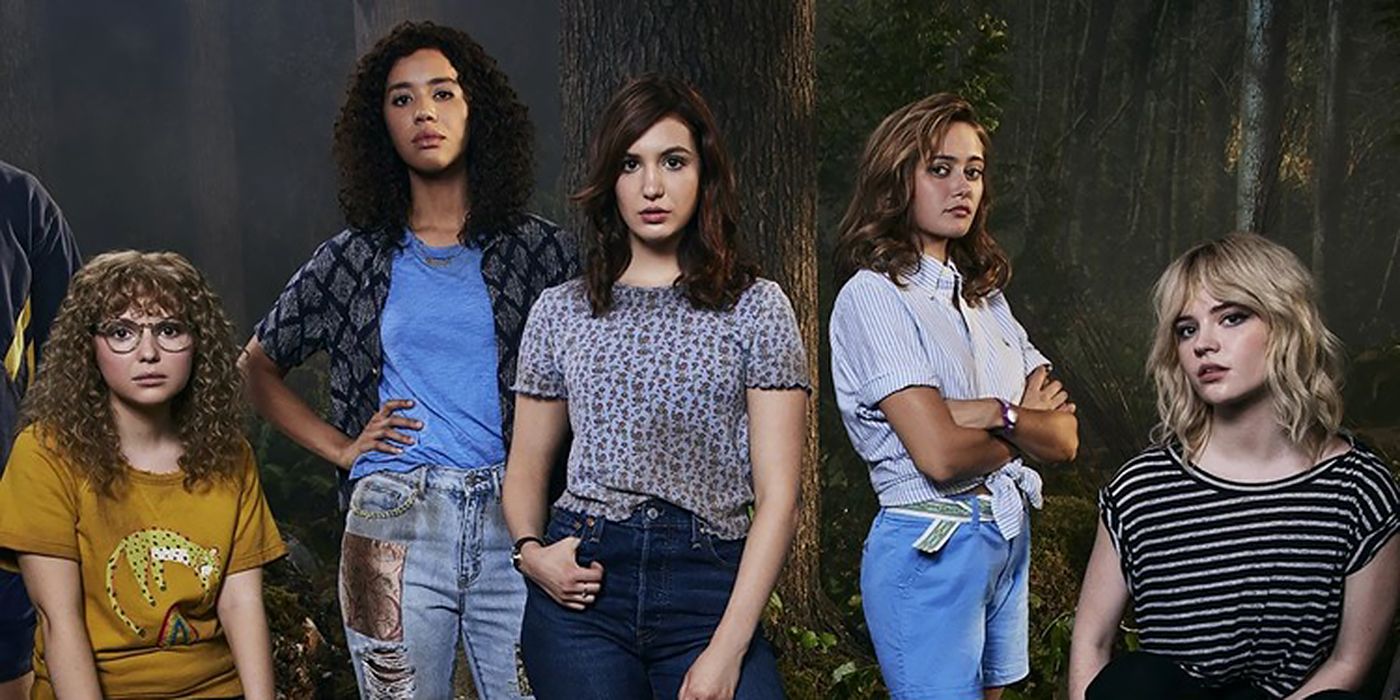
Honestly, it’s rare for a show to just land perfectly. Most TV these days feels like it was written by a committee of people staring at a spreadsheet of "what Gen Z likes," but Yellowjackets season 1 was different. It was mean. It was messy. It felt like something that actually had teeth, which is probably why everyone lost their collective minds when it debuted on Showtime back in late 2021. If you haven't seen it, the premise sounds like a standard Lord of the Flies riff: a high school girls' soccer team crashes in the wilderness in 1996 and survives for 19 months. But that’s barely scratching the surface of what makes this show work.
The show jumps between two timelines. We see the 1996 crash and the immediate, brutal aftermath, and then we skip forward 25 years to see the adult survivors dealing with the trauma—or, more accurately, failing to deal with it.
What Actually Happens in Yellowjackets Season 1
It starts with a girl running through the snow. She’s wearing nothing but a nightgown and some jewelry. She falls into a pit of spikes. Then, people in furs eat her.
That’s the hook. That’s how the pilot begins, and it sets a standard for "Yellowjackets season 1" that the rest of the episodes have to live up to. We spend the rest of the season trying to figure out who was under those masks and how a group of normal, suburban teenagers turned into a ritualistic cannibalistic cult. It’s not just about the hunger. It’s about the breakdown of social structures. When the plane goes down, the hierarchy of the soccer field—captains, benchwarmers, stars—starts to dissolve. Jackie, the team captain played by Ella Purnell, finds out real fast that being popular in New Jersey doesn’t mean much when you’re trying to gut a deer in the Ontario wilderness.
Natalie is the "burnout," but she’s the one who knows how to use a gun. Shauna is the quiet best friend, but she’s the one with the most dangerous internal life. The show plays with these tropes and then violently subverts them.
The Two Timelines Are Everything
The 1996 cast is incredible, but the 2021 cast is legendary. You’ve got Melanie Lynskey as adult Shauna, Juliette Lewis as adult Natalie, Christina Ricci as Misty, and Tawny Cypress as Taissa. These women are carrying so much baggage it’s a wonder they can stand up straight.
Shauna is a bored housewife who kills rabbits in her garden. Natalie is fresh out of rehab. Taissa is running for state senate while her sleepwalking habit turns terrifying. Misty... well, Misty is a nurse who might be a serial killer.
The mystery of Yellowjackets season 1 isn’t just "how did they survive?" It’s "what did they do that they’re so afraid of people finding out?" Someone starts blackmailing them with a symbol from the woods, and that’s the engine that drives the modern-day plot. It’s a noir thriller mixed with a survival horror story. It shouldn't work. It really shouldn't. But the tonal shifts are handled with so much confidence that you just go along for the ride.
The Mystery of the Antler Queen
The "Antler Queen" became the central obsession for fans during the original run. Who is the figure in the center of the ritual? For a long time, people thought it was Jackie because she was the leader. Then people thought it was Lottie because she started having visions.
Lottie Matthews is a fascinating character. She’s the girl who ran out of her medication after the crash. Is she actually psychic? Or is she just having a psychotic break fueled by starvation and trauma? The show refuses to give you a straight answer. By the time we get to the finale of Yellowjackets season 1, Lottie has become a sort of spiritual figurehead for the group. She’s the one who finds "the bear." She’s the one who seems to commune with whatever dark force is—or isn't—in those woods.
Whether the supernatural elements are real or just a shared delusion is the question that keeps the show grounded. If it was just ghosts, it would be a different show. Because it might just be teen girls losing their minds, it's way scarier.
The Music and the Vibe
You can't talk about this season without mentioning the soundtrack. It’s a 90s time capsule. We’re talking Hole, PJ Harvey, Liz Phair, and Portishead. It’s not just "90s hits" for the sake of nostalgia; the music feels like it’s pulled directly from the girls' internal states. When "Down by the Water" kicks in, you feel the swampy, claustrophobic heat of that summer.
The costume design does a lot of heavy lifting too. Seeing the evolution from pristine soccer jerseys to scavenged furs and dirt-caked flannel tells the story of their descent better than any dialogue could.
Why the Finale Still Stings
The ending of the first season, "Sic Transit Gloria Mundi," is a gut punch. Most people expected some huge revelation about the cannibalism. Instead, we got something much more intimate and tragic.
The death of Jackie is the turning point for the whole series. It wasn't a murder. It wasn't a ritual. It was a stupid, stubborn argument between two best friends that ended with one of them sleeping outside in the snow. When the frost hit, it was over. The guilt Shauna carries into her adult life isn't just about eating her friends—it's about the fact that she let her best friend die because she was angry.
And then there's the 2021 cliffhanger. Natalie gets kidnapped by a cult wearing the same symbols from the woods, and we find out that Lottie Matthews might still be alive. It’s a perfect "wait, what?" moment that paved the way for the second season.
Common Misconceptions About Season 1
A lot of people think the show is just Lost but with girls. That’s a lazy comparison. Lost was obsessed with the "island" as a puzzle box. Yellowjackets season 1 is obsessed with the "wilderness" as a mirror. The girls aren't trying to solve the mystery of the woods; they’re trying to survive their own changing natures.
Another big misconception is that the cannibalism is the "point." It's actually the least interesting thing about the show. The point is the social hierarchy. It's the way these girls navigate power when the rules of society are stripped away.
- The Symbol: It’s not just a random drawing. Some fans have pointed out it looks like a hook or a mathematical equation, but its true origin remains one of the show's biggest secrets.
- The Man with No Eyes: This figure appears to Taissa and her grandmother. Is he a reaper? A hallucination? He represents the "darkness" Taissa carries, but he’s easily the most unsettling part of the 2021 timeline.
- Misty Quigley: Everyone loves a villain you can't help but root for. Misty is the one who destroyed the flight recorder because she finally felt needed. She is the ultimate "competent person" who uses her skills for absolute chaos.
Navigating the Trauma of Yellowjackets
If you’re looking for a show that handles trauma with nuance, this is it. It doesn't pretend that people "get over" things. Adult Shauna is a mess. Adult Natalie is a mess. They are all frozen in time, stuck in that 19-month window where they were at their most powerful and their most vulnerable.
The show suggests that for some of them, the wilderness was the only place they ever truly felt alive. That’s a dark thought, but it’s what makes the writing so sharp.
Actionable Insights for Your Rewatch
If you're heading back into the woods to rewatch Yellowjackets season 1, or if you're jumping in for the first time, keep an eye on these specific details that people often miss on a first pass:
- Watch the background during the 1996 scenes. The show loves to hide things in the trees. There are shots where you can see figures or symbols that aren't mentioned in the dialogue.
- Pay attention to the jewelry. The heart necklace travels between characters. Following who is wearing it at any given time is a major clue for the "pit girl" scene in the pilot.
- Listen to the "visions." Lottie’s early French outbursts and her warnings about "red smoke" actually come true in very literal ways later in the season.
- Analyze Shauna's journals. The adult Shauna spends a lot of time looking at her old diaries. The show uses these to hint at events we haven't seen yet, particularly regarding her pregnancy in the woods.
- Look at the political posters. In the 2021 timeline, Taissa’s campaign ads are everywhere. The slogans often mirror the themes of survival and "doing what's necessary" that the girls faced in 1996.
The brilliance of the first season lies in its structure. It gives you just enough answers to keep you satisfied but leaves enough questions to keep you obsessed. It’s a masterclass in tension, and it reminds us that the most dangerous thing in the woods isn't a bear or a ghost—it's the person standing next to you.



