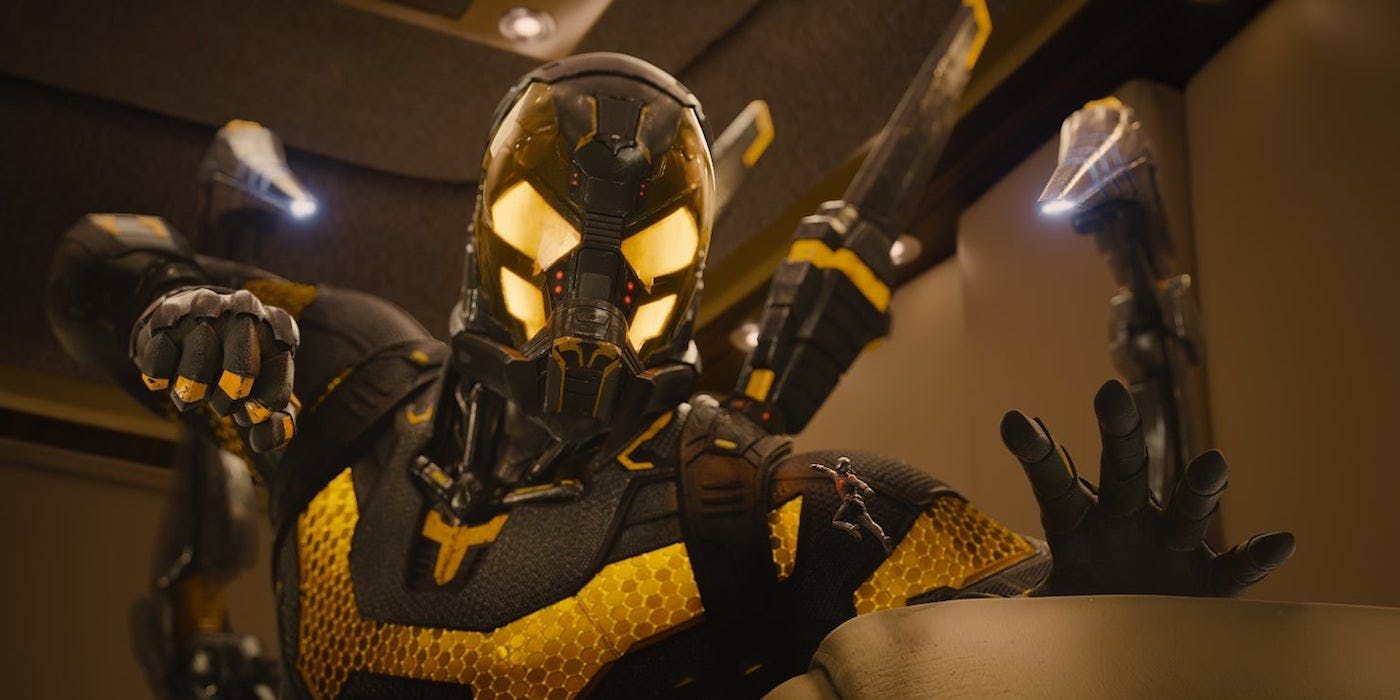
Darren Cross was a mess. Let’s be real. When we first meet the guy in the original 2015 Ant-Man, he seems like your standard corporate-ladder climber with a massive chip on his shoulder and a serious father-figure complex. He’s the protégé turned rival, the guy who felt snubbed by Hank Pym and decided to recreate the Pym Particle out of pure spite. But if you look closer at Yellowjacket in Ant-Man, he isn’t just a generic "evil version of the hero" trope. He’s a tragic case study in what happens when groundbreaking physics meets a complete lack of mental health safeguards.
He almost won.
People forget how close Cross came to fundamentally breaking the power balance of the MCU. While the Avengers were busy fighting robots in Sokovia, this guy was in a basement perfecting a weaponized shrink suit that could bypass any security system on the planet. It wasn't just about the suit; it was about the formula. And that formula was literally eating his brain.
The Science of the Yellowjacket Suit and Why it Broke Darren Cross
Here is something the movie mentions but doesn't hand-hold you through: Pym Particles are incredibly dangerous to the human psyche. Hank Pym spent decades perfecting the "regulator" and the helmet systems because he knew that shrinking without proper shielding messes with the chemistry of the brain. Darren Cross didn't have that luxury. He was rushing. He was desperate.
When we see the Yellowjacket in Ant-Man finally take shape, it’s a masterpiece of engineering but a failure of biological safety. Cross was testing unstable versions of his "Cross Particles" on himself and organic matter—remember the "protein flakes" incident with the lamb? Yeah, that was gruesome. Because he didn't have the specialized helmet tech that Pym spent a lifetime hiding, Cross was essentially bathing his neurons in reality-warping particles.
It turned him into a sociopath. Or, at the very least, it dialed his existing insecurities up to eleven.
You can see the progression. At the start of the film, he’s just an arrogant CEO. By the end, he’s trying to kill a child in a suitcase. That isn't just "movie villain" logic; it's the specific narrative byproduct of the Yellowjacket tech. The suit itself is a powerhouse, though. It’s got those mechanical stingers (the "appendages") that fire plasma bolts, it’s flight-capable, and it’s arguably much more durable than Scott Lang’s recycled 1960s gear.
Why the Yellowjacket in Ant-Man Was More Than a "Mini-Iron Man"
Critics back in 2015 loved to say that Marvel had a "villain problem," where every bad guy was just a dark reflection of the hero. Iron Man fought Iron Monger. Hulk fought Abomination. So, naturally, Ant-Man fought a bigger, meaner Ant-Man. But the Yellowjacket in Ant-Man represented something much more cynical: the military-industrial complex's hunger for subatomic warfare.
- The Lack of a Moral Compass: Scott Lang uses the suit to steal stuff and help his daughter. Darren Cross wanted to sell it to HYDRA and the Ten Rings.
- The Weaponization: Pym saw shrinking as a tool for discovery; Cross saw it as the ultimate assassination tool. The "stingers" on the back of the Yellowjacket suit weren't for show—they were designed for high-yield tactical strikes.
- The Tech Gap: While Scott was learning to talk to ants, Cross was perfecting a suit that didn't need an army of insects to be effective. It was self-contained. It was "efficient."
Honestly, the fight on the Thomas the Tank Engine set is one of the best choreographed scenes in the MCU because it highlights the sheer power difference. Scott is constantly on the defensive. The Yellowjacket suit is faster, more aggressive, and has better range. If Scott hadn't gone subatomic—effectively a suicide mission—he would have lost. Period.
The Quantum Realm Twist: From Yellowjacket to M.O.D.O.K.
For years, fans assumed Darren Cross was dead. When Scott sabotaged the Yellowjacket suit, we saw Cross shrink uncontrollably and "implode." It looked final. But in the MCU, if you don't see a body, they aren't dead. Even if you do see a body, they might still be back.
The legacy of the Yellowjacket in Ant-Man took a weird, polarizing turn in Ant-Man and the Wasp: Quantumania. We found out that Cross didn't die; he was deformed by the erratic shrinking and ended up in the Quantum Realm. Kang the Conqueror found him, slapped some cybernetics on him, and turned him into M.O.D.O.K. (Mechanized Organism Designed Only for Killing).
It’s a bizarre ending for a character that started as a slick tech mogul. Some fans hated the comedic shift, but it actually fits the "broken" nature of the character. Cross was always a tool for someone else—first Pym, then the board of directors, then Kang. The Yellowjacket suit was his peak, but it was also his cage.
The Real-World Physics (Sorta)
If we're being pedantic, the "square-cube law" says the Yellowjacket shouldn't exist. As you shrink, your surface area and volume change at different rates. If you kept your mass but became the size of an insect, you’d exert so much pressure on the ground that you’d sink through the floor like a hot needle through butter. Marvel ignores this, obviously. They swap "mass" and "density" whenever it’s convenient for the plot. But the threat Cross posed was real because of the sheer kinetic energy a tiny, fast-moving object carries.
Think about a bullet. Now imagine a bullet that can think, fly, and fire its own lasers. That’s what the world was facing.
How to Value the Yellowjacket Today
If you’re a collector or a lore nerd, the Yellowjacket remains a top-tier design. Even though the character shifted into M.O.D.O.K., the original 2015 suit is still one of the most visually distinct "bad guy" outfits in the franchise. It’s industrial. It’s yellow and black (obviously). It looks like it was built in a lab, not forged in a star or conjured with magic.
What you should do next to understand the lore better:
- Rewatch the "Innocent Lamb" scene: Pay close attention to Cross’s face. You can see the exact moment the Pym Particles start affecting his empathy. It’s subtle acting by Corey Stoll.
- Compare the HUDs: Look at the heads-up display in Scott’s helmet versus Darren’s. Scott’s is analog and warm; Cross’s is sharp, red, and predatory. It’s a great piece of visual storytelling.
- Trace the HYDRA connection: The buyer Cross was dealing with was Mitchell Carson, a former SHIELD official turned HYDRA sleeper. This links the events of Ant-Man directly to the fallout of Captain America: The Winter Soldier.
The Yellowjacket in Ant-Man wasn't just a villain of the week. He was the warning shot for everything that went wrong with the Pym legacy. He proved that the smallest things can indeed cause the biggest disasters. If you want to dive deeper into the tech, look into the "Tales to Astonish" comics from the 60s, though be warned: the comic version of Yellowjacket is actually Hank Pym himself during a mental breakdown, which makes the movie’s choice to make it a separate villain even more interesting.



