If you’ve ever gone down a rabbit hole of creepy urban legends, you’ve probably heard of Friar, New Hampshire. It’s that tiny town where, back in 1940, all 572 residents supposedly just up and walked into the woods after a screening of The Wizard of Oz. They left their dinners on the table. They left their dogs tied up in the yards. They just... left.
Except Friar doesn't exist. It's the fictional foundation for YellowBrickRoad, a 2010 indie horror movie that has become a bit of a cult obsession.
Honestly, it's one of those films that people either absolutely adore for its atmosphere or despise because of its ending. There is no middle ground here. But if you’re looking for a "group of people get lost in the woods" flick that actually tries to do something different with your psyche, this is the one. It isn't just a Blair Witch clone. It's a loud, abrasive, and deeply nihilistic look at what happens when the "escapism" we crave turns into a literal prison.
What Actually Happens in YellowBrickRoad?
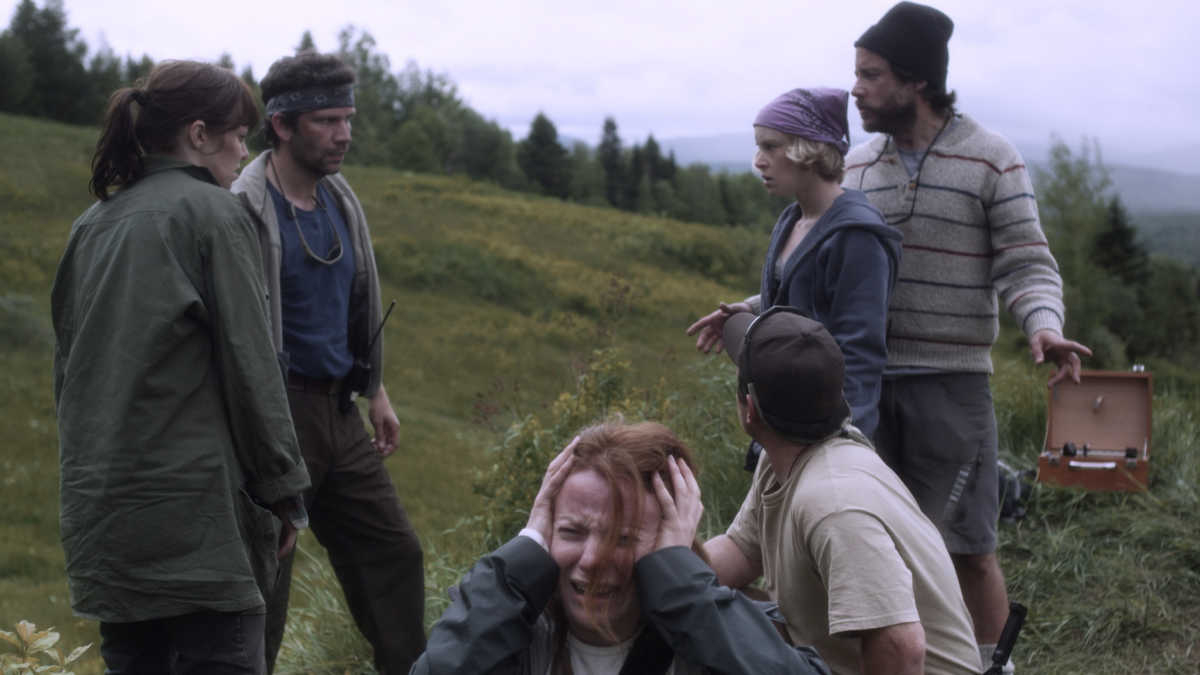
The story kicks off decades after the disappearance. Teddy Barnes, played by Michael Laurino, is an author who finally gets his hands on declassified coordinates for the trailhead the townspeople took. He drags his wife, a couple of cartographers, a forestry expert, and a local theater usher into the New England wilderness to find out what happened.
At first, it’s just a hike. The sun is out. The trees are green.
But then the music starts.
This isn't a spooky orchestral score. It’s actual 1930s big band and orchestral music—stuff like "Goodnight My Love"—blaring from the sky. It’s coming from everywhere and nowhere. It’s distorted, screeching, and constant. Imagine being stuck in the middle of nowhere with Al Bowlly screaming in your ears at 100 decibels for three days straight. You’d lose your mind too.
The group starts to fracture in ways that are genuinely hard to watch. We aren't talking about "who has the map" arguments. We're talking about Daryl, one of the cartographers, deciding that the best way to deal with the stress is to slowly and methodically pull his sister's leg off. It’s a scene that relies on some pretty gnarly practical effects, and because it happens in broad daylight, there’s nowhere for the gore to hide.
The Robert Eggers Connection
Here’s a fun piece of trivia: the costume designer for this micro-budget indie was none other than Robert Eggers.
Yeah, the guy who went on to direct The Witch, The Lighthouse, and Nosferatu. You can actually see some of his early DNA in the period-accurate clothing found abandoned in the woods. There’s this one scene where they find a 1940s hat just sitting on a rock, perfectly preserved. It’s a small detail, but it makes the "uncanny" feeling of the woods hit way harder. Directors Jesse Holland and Andy Mitton clearly knew how to use their limited resources to build dread rather than just relying on jump scares.
Why the Sound Design is the Real Villain
Most horror movies use silence to build tension. YellowBrickRoad does the opposite.
The sound design is used as a weapon against the audience. As the characters get deeper into the woods, the music becomes more erratic. It speeds up, slows down, and eventually dissolves into pure white noise and tectonic rumbling.
It’s meant to be physically uncomfortable. If you’re watching this with headphones, there are parts where you’ll probably want to rip them off. That’s the point. It simulates the sensory overload that’s driving the characters into a homicidal frenzy.
Why the Ending Divides Everyone
We have to talk about that ending. Without spoiling the very last shot, it shifts from a survivalist horror movie into something much more "cosmic."
Teddy eventually finds the end of the road. It isn't a clearing or a cabin; it’s a theater.
A lot of viewers felt cheated by this. They wanted a concrete explanation—aliens, a government experiment, a cult. Instead, the movie suggests that the "Yellow Brick Road" is a cycle of eternal, televised suffering. The townspeople didn't leave to find a better world; they left because they were obsessed with the escapism of the silver screen, and the woods basically said, "Fine, stay in the movie forever."
It’s a bleak, meta-commentary on our own need to "get away from it all."
Is It Based on a True Story?
Short answer: No.
Longer answer: It’s inspired by the feeling of legends like the Lost Colony of Roanoke or the Dyatlov Pass incident, but the town of Friar and the "Yellow Brick Road" trail are completely made up. The filmmakers wanted it to feel like "New England backwoods folklore," and they succeeded so well that some people still search for the coordinates on Google Maps.
The "based on true events" vibe was a marketing tactic, much like The Blair Witch Project. But while Blair Witch focused on the mythology of a witch, this movie focuses on the mythology of The Wizard of Oz and the dark side of American nostalgia.
How to Watch It Today
If you’re a fan of "slow burn" horror or movies like Midsommar and The Ritual, you’ll probably find something to love here. It’s currently available on several streaming platforms, including:
- CrankedUpTV
- Tubi (usually)
- Amazon Prime (Rental/Purchase)
Just a heads-up: the 2022 Blu-ray release is the version you want. It fixed a lot of the color grading issues from the original 2010 DVD and includes some great interviews with the cast and directors.
Final Thoughts for the Horror Fan
YellowBrickRoad isn't a perfect movie. The pacing drags in the middle, and some of the acting from the secondary characters is a bit "community theater." But its core idea—that sound can be a physical manifestation of madness—is brilliant.
If you decide to take the trip, pay attention to the background. Some of the creepiest stuff happens in the corners of the frame while the characters are arguing. And for the love of everything, don't watch it with the volume turned down. The noise is part of the experience.
If you’ve already seen it and it left you feeling more confused than scared, go back and watch the end credits. There are series of "archival" photos that actually fill in some of the blanks about what happened to the original townspeople of Friar. It won't give you a happy ending, but it might help the pieces click into place.



