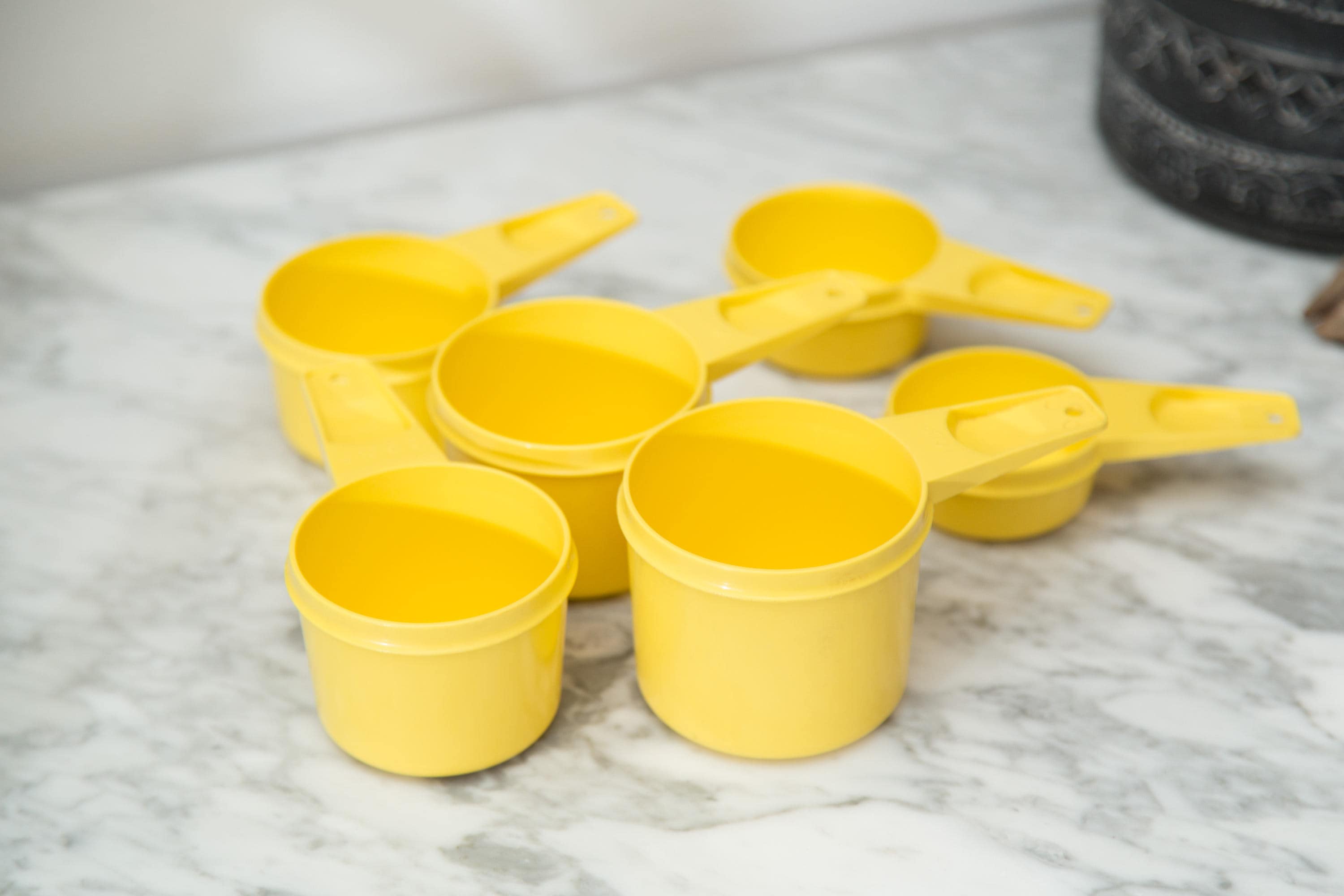
You probably have a memory of them. Maybe they were buried in the back of your grandmother’s "junk drawer," or perhaps they were the first thing you reached for when making boxed brownies on a Saturday afternoon. Yellow Tupperware measuring cups aren't just plastic junk. They are design icons. Honestly, if you find a set at a garage sale for five bucks, you should grab them immediately because modern versions often don't even come close to the durability of the vintage 1970s and 80s sets.
They lasted. That’s the thing.
Most modern measuring cups are flimsy. The handles snap off when you try to scoop packed brown sugar, or the painted-on numbers vanish after three trips through the dishwasher. But the vintage Harvest Gold and Sunbeam Yellow sets from Tupperware? Those things are tanks.
The Weird History of Tupperware’s Iconic Yellow
Tupperware didn't just pick "Yellow" out of a hat. During the mid-20th century, Earl Tupper’s company was obsessed with polyolefin—a flexible, durable plastic that changed how Americans stored food. By the time the 1970s rolled around, the color palette shifted toward what we now call "Earth Tones."
You know the ones. Avocado Green. Burnt Orange. And, of course, that specific, buttery yellow.
It was part of the "Harvest" line. While the color screams "disco era," the engineering was surprisingly sophisticated. These cups featured a "nesting" design that actually stayed nested. Unlike the chaotic mess in most people's baking cabinets today, the Tupperware sets used a specific friction-fit or a small snap-hole on the handle to keep them organized.
They weren't just for show. They were a status symbol for the suburban "Tupperware Party" era. Brownie Wise, the marketing genius who actually made Tupperware a household name, knew that housewives wanted tools that felt professional but looked friendly. The yellow hue was meant to be cheery—a bit of sunshine in a kitchen that might otherwise be full of heavy cast iron and drab wood.
Why the 1970s Plastic Is Different
There is a lot of talk about "vintage plastic," and some of it is honestly a bit scary. People worry about BPA. It is important to be real here: Tupperware didn't officially go BPA-free until around 2010. However, the older measuring cups were largely made of polyethylene, which generally doesn't contain BPA.
Still, if your old yellow cups are peeling, flaking, or feel "sticky," it’s time to retire them to the sandbox.
Plastic degrades. It's a fact. But if they are smooth and intact, they are likely safer than the cheap dollar-store cups you bought last week that leach chemicals nobody can even pronounce yet. The weight of the vintage yellow Tupperware measuring cups is what usually surprises people. They have a heft. They don't feel like a disposable yogurt container.
Spotting the Real Deal vs. The Knockoffs
Not every yellow measuring cup is Tupperware.
Look at the handle. A genuine vintage Tupperware cup will have the classic "sheer" look or a matte finish with the logo embossed—not printed—on the bottom or the handle. This is key. Embossed measurements mean you can still read "1/2 Cup" even fifty years later. If the measurement is just ink, it’s probably a generic brand from the same era, like Lustro Ware or Rubbermaid. Those are fine, but they don't have the same collector value or the "straight-sided" design that makes the Tupperware versions so good for leveling off flour.
The set usually came in four or six sizes:
- 1 Cup
- 1/2 Cup
- 1/3 Cup
- 1/4 Cup
- And sometimes the elusive 2/3 and 3/4 cups in the expanded sets.
If you find a 2/3 cup in the wild, you’ve hit the jackpot. Most modern sets skip those, forcing you to do "cup math" while you're trying to bake a cake. It’s annoying. Having a dedicated 2/3 cup is a small luxury that only vintage enthusiasts truly understand.
The "Pouring" Problem and the D-Handle Design
Let's get technical for a second. Most measuring cups use a "spoon" shape. They are rounded. Tupperware went with a more cylindrical, flat-bottomed design.
Why does this matter? Accuracy.
When you’re measuring dry ingredients—flour, sugar, cocoa powder—you want to "spoon and level." The straight walls of the yellow Tupperware measuring cups allow you to run a knife across the top with zero interference. You get a perfect level every single time. Rounded cups often leave a "hump" of flour in the middle, which can actually throw off a delicate recipe by several grams.
Then there’s the handle. The "D-handle" design on the older models allows you to hook your finger through it. It sounds like a small thing until your hands are covered in butter and you’re trying to scoop flour without dropping the cup into the bag. It’s ergonomic before ergonomics was a buzzword.
Collecting and Care: Don't Kill Your Vintage Set
If you own these, please, stop putting them in the bottom rack of the dishwasher.
Even though they are tough, the high-heat drying cycle in modern dishwashers is way hotter than what existed in 1974. It will eventually make the plastic brittle. Hand wash them. It takes ten seconds.
If you're looking to buy a set, eBay and Etsy are the obvious spots, but the prices are getting a bit silly. I've seen "pristine" yellow sets go for $40. Honestly? Check your local thrift stores or estate sales first. People often throw these in the "50 cent" bin because they think they’re just old plastic. They don’t realize they’re holding onto the gold standard of baking tools.
The Surprising Value of Nostalgia
Why are we so obsessed with these specific cups? It isn't just about the flour.
Psychologically, these objects are "tether items." They connect us to a time when things were built to last a lifetime rather than be replaced every two years. When you hold that specific shade of yellow, you aren't just measuring sugar; you're standing in your mom’s kitchen again.
But beyond the "feels," they actually work.
I’ve talked to professional bakers who keep a set of vintage Tupperware cups specifically for "home-style" recipes. They argue that modern "precision" cups are often calibrated differently. If a recipe was written in 1975, using the tools from 1975 actually gives you a more authentic result. Is that scientifically proven? Maybe not. But baking is as much about vibe as it is about chemistry.
Actionable Steps for Owners and Hunters
If you have a set of yellow Tupperware measuring cups or you're looking for some, here is the move:
- The Scratch Test: Run your fingernail over the inside bottom. If it catches on deep scratches or "fuzziness" in the plastic, use them for non-food items. They make great scoops for dog food or potting soil.
- Verify the Logo: Check the underside of the handle. You’re looking for the "Tupperware" script. If it’s block letters, it might be a later reproduction.
- Check the "Nest": Ensure the handles still click together. If they are warped and won't stay organized, you can sometimes gently dip the handle in warm (not boiling) water to slightly reshape the plastic, though this is risky.
- Complete the Set: If you’re missing the 1/3 cup (the one that always disappears), don't buy a whole new set. Look for "replacement singles" on secondary markets. Sellers often break up sets to help people complete their childhood collections.
- Use for Dry Only: While you can measure liquids in these, they are designed for dry volume. Use a glass Pyrex for your milk and oil to ensure you're seeing the meniscus properly.
These yellow relics are a testament to a time when plastic was a promise of a better, easier future. They aren't just kitchenware; they are a piece of industrial history that still happens to be the best way to measure a cup of flour. Keep them clean, keep them out of the high-heat wash, and they will likely outlast the kitchen they’re sitting in right now.



