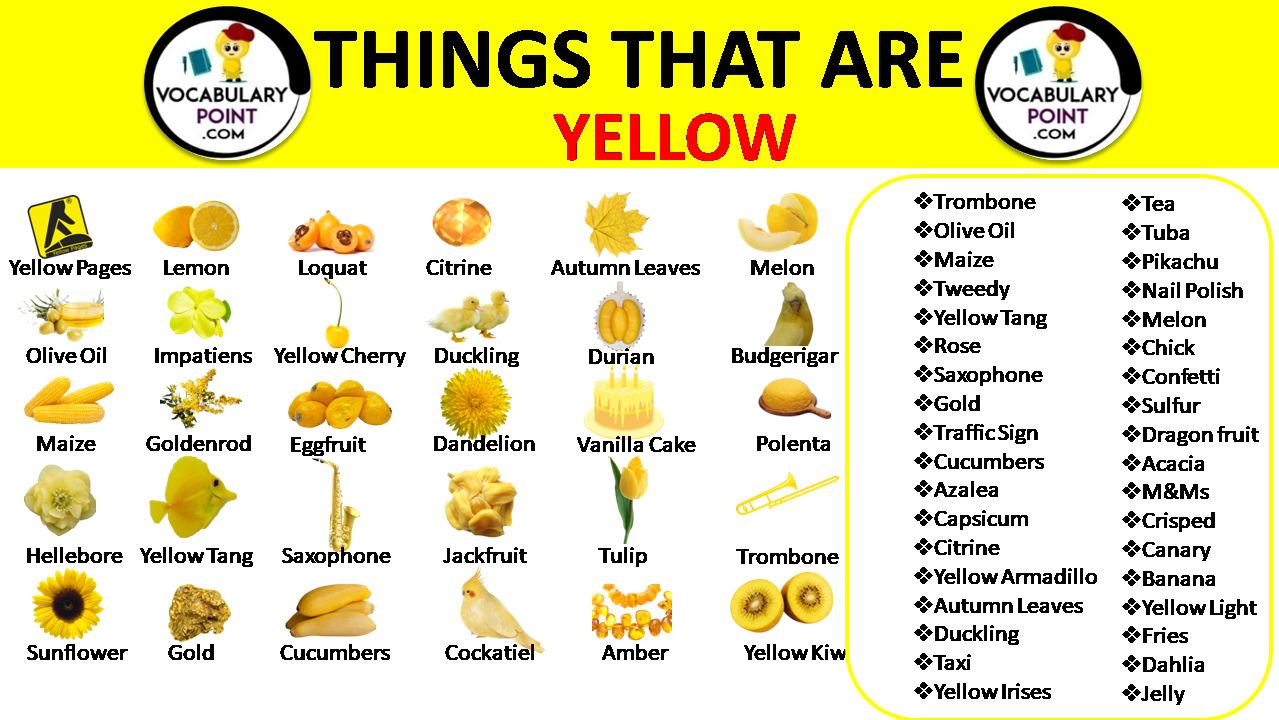
Yellow is tricky. It’s the brightest color on the visible spectrum, yet it’s often the hardest to master on paper. Most people think grabbing a lemon-yellow pencil and scribbling a circle is enough. It’s not. When you start looking for yellow things to draw, you quickly realize that yellow isn't just one "thing." It’s a range of emotions, from the neon glow of a highlighter to the deep, almost brownish ochre of a dying sunflower.
You’ve probably been there. You try to draw a sun, and it looks like a flat, boring yolk. That's because yellow has a very low "value" range. In art terms, it gets muddy the second you try to add shadows. If you add black, it turns a weird, sickly green. If you add purple—its complementary color—you get a neutral gray that can look totally out of place if you aren't careful.
The Psychology of Sketching with Yellow
Why even bother with yellow things to draw? Because yellow demands attention. It’s the first color the human eye processes. This is why school buses and caution signs use it. When you put a yellow subject in your sketchbook, you’re telling the viewer exactly where to look.
But it's also a high-pressure color. Vincent van Gogh famously obsessed over it. His house in Arles was yellow. His sunflowers are iconic. He once wrote to his brother Theo about how yellow represented "a sun, a light that, for want of a better word, I can only call yellow, pale sulphur yellow, pale lemon gold." Van Gogh didn't just see a color; he saw an emotional state. He used chrome yellow, a pigment that—interestingly enough—actually darkens over time due to chemical reactions. So, the "yellow things" he drew in 1888 don't even look the same today.
Natural Subjects That Aren't Just Sunflowers
Let's skip the obvious stuff for a second. Everyone says "draw a banana." Okay, sure. But have you ever actually looked at a bruised banana? The way the yellow transitions into those dark, starchy brown spots is a masterclass in texture.
Try drawing these instead:
- A Yellow Tang: If you're into marine life, this fish is basically a swimming neon sign. The challenge here isn't the color, but the translucency of the fins.
- Withered Autumn Leaves: Not the red ones. Find the Aspen or Ginkgo leaves that turn that brilliant, buttery gold. The veins are usually a slightly different shade, which gives you a chance to practice fine line work.
- Sulfur Crystals: This is a deep cut. Sulfur in its raw form has this jagged, crystalline structure. It’s not smooth. It’s sharp and bright.
- A Rubber Ducky: Don't laugh. This is actually a classic industrial design exercise. The curves of the duck's head and the way light bounces off the matte plastic help you understand how "yellow" behaves under a lamp.
Yellow Things to Draw When You’re Feeling Uninspired
Sometimes the brain just shuts off. You’re staring at a blank white page, and everything feels too hard. When that happens, I usually tell people to go for "man-made" yellow. It’s less intimidating than nature because man-made objects have predictable shapes.
Think about a common No. 2 pencil. It’s iconic. You’ve got the yellow wooden barrel, the green metal ferrule, and the pink eraser. Drawing a pencil with a pencil is meta and surprisingly fun. You have to capture the hexagonal shape, which means three different shades of yellow depending on how the light hits those flat planes.
What about a New York City taxi? Or a raincoat? A bright yellow raincoat against a dark, rainy background creates what artists call "color brilliance." The contrast makes the yellow look like it’s glowing. This is a great way to practice using a limited palette. You don't need sixty markers. You need one good yellow and a few shades of gray or dark blue for the environment.
The Problem with Shadows in Yellow Subjects
This is where most beginners mess up. They see a yellow lemon and think the shadow should be dark yellow. But "dark yellow" usually just looks like mustard or tan.
Real-world observation: look at a lemon sitting on a white table. The shadow isn't yellow. The shadow is often a pale violet or a cool blue-gray. Because yellow is so bright, it reflects onto the surfaces around it. This is called "color spill." If you’re drawing a yellow object, you have to draw the yellow light it’s casting onto the floor, too. If you don't, the object looks like it's floating in space rather than sitting on a surface.
Food Photography as a Reference
If you're stuck for references, look at high-end food photography. Egg yolks are a nightmare to draw but so rewarding when you get them right. You have that translucent, gelatinous look and a tiny white "specular highlight" where the light hits the curve.
Macaroni and cheese is another one. It’s a texture nightmare—all those soft, curved shapes and the gooey "cheese" reflect light in a very specific way. It’s basically a study in highlights. If you can draw a bowl of Mac and Cheese and make it look appetizing, you’ve officially mastered yellow things to draw.
Honestly, even a simple stick of butter can be a great subject. It’s a perfect cuboid. It has slightly translucent edges. It’s a very pale, creamy yellow that’s vastly different from the aggressive yellow of a dandelion.
Why Dandelions Are Actually Hard
You’d think a weed would be easy. Nope. A dandelion is a collection of hundreds of tiny florets. If you try to draw every single one, you’ll lose your mind. The trick to drawing complex yellow things like flowers is to see them as "masses."
Start with a blurry shape of yellow. Then, only define the petals where the light hits the edges. The rest can stay as a suggestion of color. This is how the Impressionists did it. They didn't draw "a flower"; they drew the "light reflecting off a flower."
Essential Tools for Yellow Mastery
You can’t just use a standard crayon and expect masterpiece results. Yellow is a weak pigment.
- Lightfastness matters: Yellow fades faster than almost any other color. If you’re using cheap markers, your drawing will be beige in six months. Look for "lightfast" ratings on your pencils or paints.
- Layering: Since yellow is transparent, you can see what’s underneath it. If you draw a blue line and try to put yellow over it, you get green. You have to plan your yellow areas from the start.
- Toned Paper: Try drawing with yellow on tan or gray paper. It pops way more than it does on white. On white paper, the yellow has to compete with the brightness of the page. On gray paper, the yellow becomes the light source.
Strange Yellow Things You Haven't Thought Of
Think outside the box. A block of Swiss cheese with those big, irregular holes (Oils, if we’re being technical). A construction crane. A warning light on a car dashboard. A legal pad. A classic smiley face button from the 70s.
There’s also the world of insects. A Bumblebee is the perfect "yellow and black" study. The fuzziness of the yellow hair on its thorax is a great way to practice "soft" textures versus the "hard" texture of its wings. Or a Swallowtail butterfly. The yellow on their wings is patterned with black, which gives you a built-in guide for proportions.
Moving Forward with Your Art
Yellow is a bold choice. It’s optimistic, but it can also be sickly or alarming. When you choose yellow things to draw, you’re making a statement about the mood of your piece.
Don't be afraid to fail. Your first few yellow drawings might look like blobs of mustard. That’s fine. The goal is to start seeing the "warm" yellows (leaning toward orange) and the "cool" yellows (leaning toward green). Once you can see the difference between a banana and a lime-yellow leaf, you’re halfway there.
Actionable Next Steps
- The 3-Tone Exercise: Grab a yellow object—a lemon is best. Try to draw it using only three colors: a pale yellow, a medium gold, and a light purple for the shadows. Do not use black.
- The Reflection Test: Place a yellow object on a white sheet of paper. Draw the object, but focus 50% of your effort on the yellow "glow" that appears on the white paper around the base.
- Swatch Your Greys: Find every gray marker or pencil you own. Stroke a yellow marker over them. See which ones turn green and which ones stay neutral. This will tell you which grays to use for your shadows in the future.
- Limit Your Palette: Try a drawing where yellow is the only color. Use black ink for the lines and different pressures of one yellow pencil for everything else. This forces you to think about value rather than just hue.
Yellow isn't just a color on the wheel; it’s a tool for lighting. Use it to create warmth or to warn the viewer. The more you practice these specific subjects, the more you'll realize that the "brightest" color actually requires the most sophisticated technique.