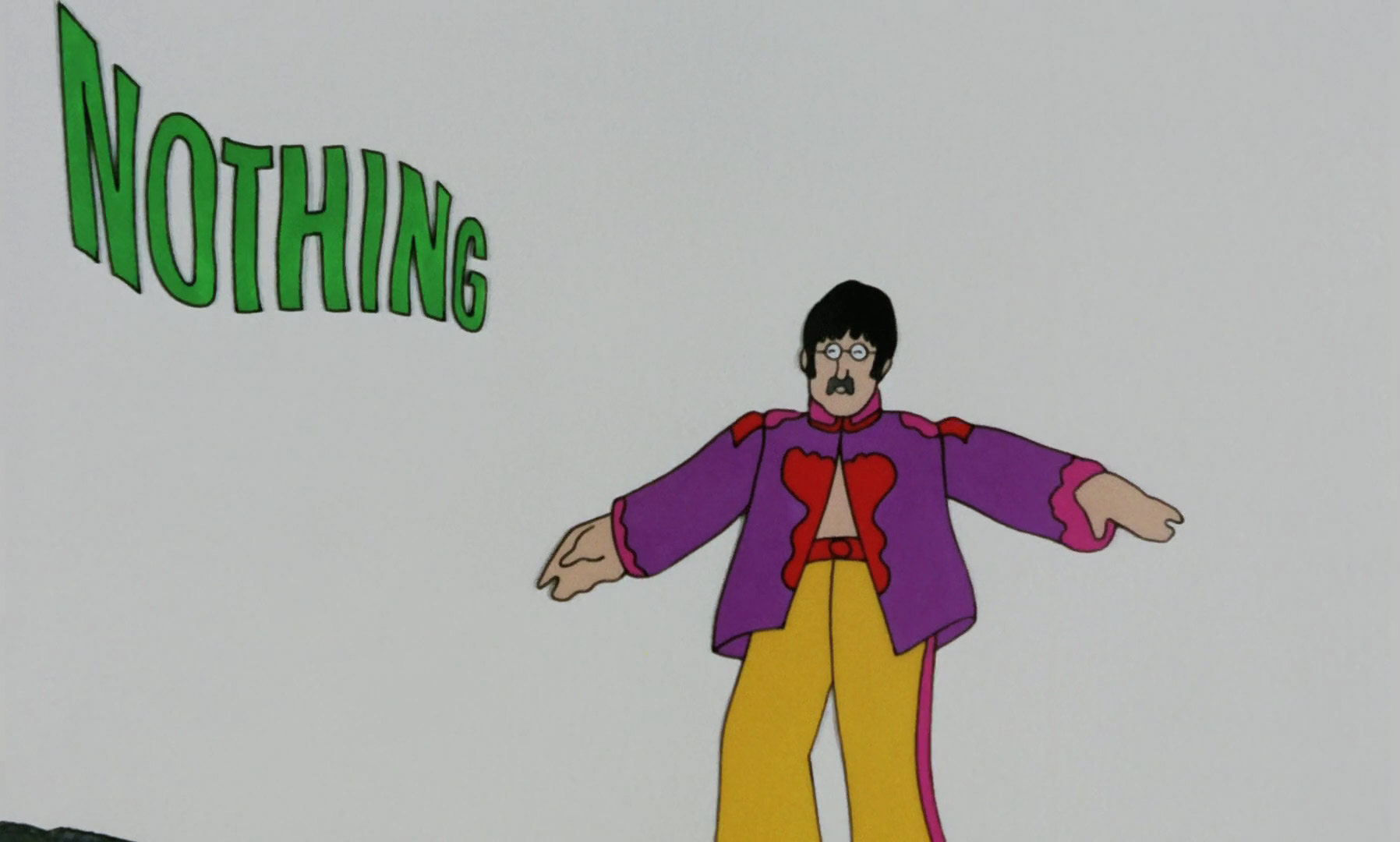
If you’re hunting for the yellow submarine full movie, you aren’t just looking for a cartoon. You’re looking for a time machine. It’s 1968. The Beatles are basically the center of the cultural universe, but they’re also kind of exhausted. They owe United Artists one more film. They don't really want to do it. So, they hand off the heavy lifting to a team of animators and a young designer named Heinz Edelmann. What happened next shouldn't have worked. It was a weird, sprawling, neon-soaked fever dream that changed animation forever.
Honestly, the Beatles themselves weren't even that involved at first. They didn't even provide their own voices! That’s usually the first thing that shocks people. Those witty, Liverpudlian quips? All voice actors like Paul Angelis and John Clive. The Fab Four only showed up for a live-action cameo at the very end because, frankly, they were blown away by how good the rough cuts looked. They realized this wasn't just some cheap Saturday morning cereal commercial. It was art.
The Struggle to Find the Yellow Submarine Full Movie Today
Finding the film can be a bit of a headache depending on where you live. Because of complex music licensing—remember, this thing is packed with hits like "Eleanor Rigby," "Lucy in the Sky with Diamonds," and "All You Need Is Love"—it isn't always sitting on every streaming platform. You might find it for rent on Apple TV or Amazon, but it pops in and out of libraries.
In 2012, the film underwent a massive restoration. This wasn't some lazy digital filter. They did it by hand. Specialists spent months cleaning up every single frame, frame by frame, to ensure the colors popped exactly like the original cels. If you're watching a grainy, low-res version on a random video-sharing site, you're missing the point. You need to see those blues and yellows in 4K to really feel the "Pepperland" vibes.
Why the Animation Style Broke the Disney Mold
Before this movie, feature-length animation was mostly the Disney way. Clean lines. Symmetrical characters. Realistic-ish movements. Yellow Submarine threw all that out the window. It embraced Pop Art, Surrealism, and even a bit of Dadaism.
Heinz Edelmann, the art director, didn't want to make a "Beatles movie." He wanted to make a visual experience. He used "limited animation," which sounds like a bad thing, but it actually allowed for more complex, trippy backgrounds. Think about the Sea of Holes. Or the Sea of Monsters. These weren't meant to look like real places. They were meant to look like thoughts.
- The Blue Meanies: These weren't just villains; they represented the "anti-music" and "anti-color" establishment.
- The Glove: A giant, flying, sentient glove that giggles? That’s pure 60s avant-garde.
- Rotoscoping: The "Lucy in the Sky" sequence used rotoscoping—tracing over live-action footage—long before it became a common digital shortcut.
It was bold. It was loud. It was kind of scary for kids but mesmerizing for adults.
The Plot That Barely Matters (But Is Actually Great)
The story is basically a fairy tale on acid. Pepperland is an underwater paradise protected by Sgt. Pepper's Lonely Hearts Club Band. The Blue Meanies attack, turn everyone into statues, and drain the color out of the world. Old Fred, the conductor, escapes in the Yellow Submarine and travels to Liverpool to recruit John, Paul, George, and Ringo.
They travel through various "seas." The Sea of Time is a standout, where the characters age and de-age in seconds. It’s a bit of a philosophical nod to the fleeting nature of the 1960s. Eventually, they get to Pepperland, dress up as the actual band, and defeat the Meanies with the power of music.
It sounds simple. It is simple. But the dialogue is packed with puns and linguistic gymnastics. John Lennon’s character is portrayed as a sort of wandering Frankenstein-philosopher. Ringo is the lovable, bumbling heart of the group. It captures the essence of the Beatles better than a literal documentary ever could.
Historical Impact and the "Missing" Songs
There’s a lot of lore about the soundtrack. George Martin, the "Fifth Beatle," composed a brilliant orchestral score for the film. But did you know that the band initially gave the producers "leftover" songs? "Hey Bulldog" was recorded during the Lady Madonna sessions and was almost an afterthought. Today, it’s considered one of their grittiest, best rockers.
Interestingly, for a long time, the "Hey Bulldog" sequence was cut from the American theatrical version. If you saw the yellow submarine full movie in a US theater in the 70s or 80s, you probably missed it entirely. It wasn't until the 1999 restoration that the song was fully integrated back into the film worldwide.
E-E-A-T: Why This Film is a Masterclass in Creative Risk
If you look at modern animation—think Spider-Man: Into the Spider-Verse or anything by Terry Gilliam (who was heavily influenced by this era)—you can see the DNA of Yellow Submarine. It proved that animation didn't have to be cute. It could be sophisticated. It could be political. It could be weird.
Critics at the time, like those at The New York Times, were surprisingly kind. They recognized that while the Beatles didn't write the script (that was Lee Minoff, Al Brodax, Jack Mendelsohn, and Erich Segal), the spirit was authentically theirs. It was a bridge between the "mop-top" era and the experimental, late-period Beatles.
How to Experience Yellow Submarine Today
Don't just watch it on a tiny phone screen. This is a movie that demands a bit of ceremony.
- Seek out the 2012 Restoration: Look for the Blu-ray or the high-definition digital versions. The colors are significantly more vibrant.
- Listen to the Score: Pay attention to George Martin's orchestral tracks, not just the Beatles songs. "Sea of Monsters" is a masterclass in atmospheric composition.
- Watch the "Hey Bulldog" Scene: If your version doesn't have it, find the standalone clip. It’s the peak of the movie's energy.
- Read the Credits: Look at the names of the animators from the TVC London studio. These people worked insane hours to hand-paint the psychedelic sequences.
The film remains a testament to what happens when artists are given a bit of a long leash. It’s a "full movie" in every sense—full of life, full of color, and full of the weird, wonderful logic of the greatest band to ever do it.
Practical Steps for Collectors
If you're looking to dive deeper into the world of Pepperland, there are a few things you can actually do right now. First, check the official Beatles store or reputable vinyl retailers for the Yellow Submarine Songtrack (released in 1999), which features better mixes of the songs than the original 1969 soundtrack album. Second, if you're a fan of the art style, look for the work of Heinz Edelmann; his influence extends far beyond this one film. Finally, for those who want the physical experience, the Lego Yellow Submarine set (though retired) is a massive favorite on the secondary market and perfectly captures the 3D geometry of the animated vessel.
There is no "hidden meaning" you need to decode to enjoy this. You don't need to be a musicologist or an art historian. You just need to sit down, turn up the volume, and let the Sea of Science wash over you. It's one of the few pieces of 60s media that doesn't feel like a relic; it feels like a blueprint.