Honestly, if you sit down to watch Yellow Submarine for the first time, you’re probably going to be a little confused. It’s a trip. The 1968 animated classic is famously associated with The Beatles, but here’s the kicker: the actual Beatles didn't even voice themselves. They showed up for a live-action cameo at the end because they were contractually obligated, but the characters in Yellow Submarine were actually brought to life by a group of voice actors who had to mimic those iconic Liverpudlian accents. It’s one of those weird bits of trivia that changes how you view the movie. Paul Grangel, John Clive, Geoffrey Hughes, and Peter Batten were the ones doing the heavy lifting behind the mic.
The movie is more than just a psychedelic music video. It’s a battle between the colorful, music-loving inhabitants of Pepperland and the miserable, music-hating Blue Meanies. It’s basically a 90-minute metaphor for the counterculture movement of the late sixties.
The Fab Four (Or the Animated Versions of Them)
The animated versions of John, Paul, George, and Ringo aren't just carbon copies of the real guys. They’re caricatures. John is the "smart" one, often depicted as a bit of a wizard or a scientific philosopher. He first appears in the movie as a sort of Frankenstein’s monster figure in a dark room, which is a pretty bold way to introduce the world’s biggest rock star.
Paul is the dandy. He’s poised, tidy, and always seems to have a bit of a theatrical flair. Then you have George, who is wrapped in mysticism. His introduction involves him appearing out of a cloud of incense, driving a car that seems to defy the laws of physics. It’s a direct nod to his real-life fascination with Indian culture and Transcendental Meditation.
Ringo is the heart of the group. He’s the one who finds the "hole" in his pocket and the one who stumbles into the plot first. He’s portrayed as a bit of a lonely wanderer before the others join him. This characterization actually mirrors a lot of the public's perception of Ringo at the time—the Everyman who just happened to be in the greatest band on earth.
The Voices Behind the Icons
It’s worth mentioning that Peter Batten, who voiced George Harrison, was actually a deserter from the British Army. He was arrested before he could finish his lines, so another actor had to step in and finish the job. You can’t make this stuff up. It adds a layer of grit to a movie that looks like it was painted with neon sugar.
Jeremy Hillary Boob, Ph.D.
If there is one character who defines the intellectual weirdness of the film, it’s Jeremy Hillary Boob, Ph.D. He’s a "Nowhere Man." He’s a small, brown-furred creature with a pink tail and a blue face who speaks entirely in rhyme—at least at first.
He’s a polymath. A scholar. A bit of a narcissist.
Jeremy is the personification of the song "Nowhere Man." He spends his time writing books that no one reads and studying things that don't matter, all while standing in the middle of a literal void. The Beatles eventually take pity on him and invite him onto the submarine. His arc is actually the most complete in the movie; he goes from a lonely, pretentious "nowhere" creature to a hero who helps defeat the Chief Blue Meanie using nothing but poetry and flower power.
The Villains: Blue Meanies and Their Henchmen
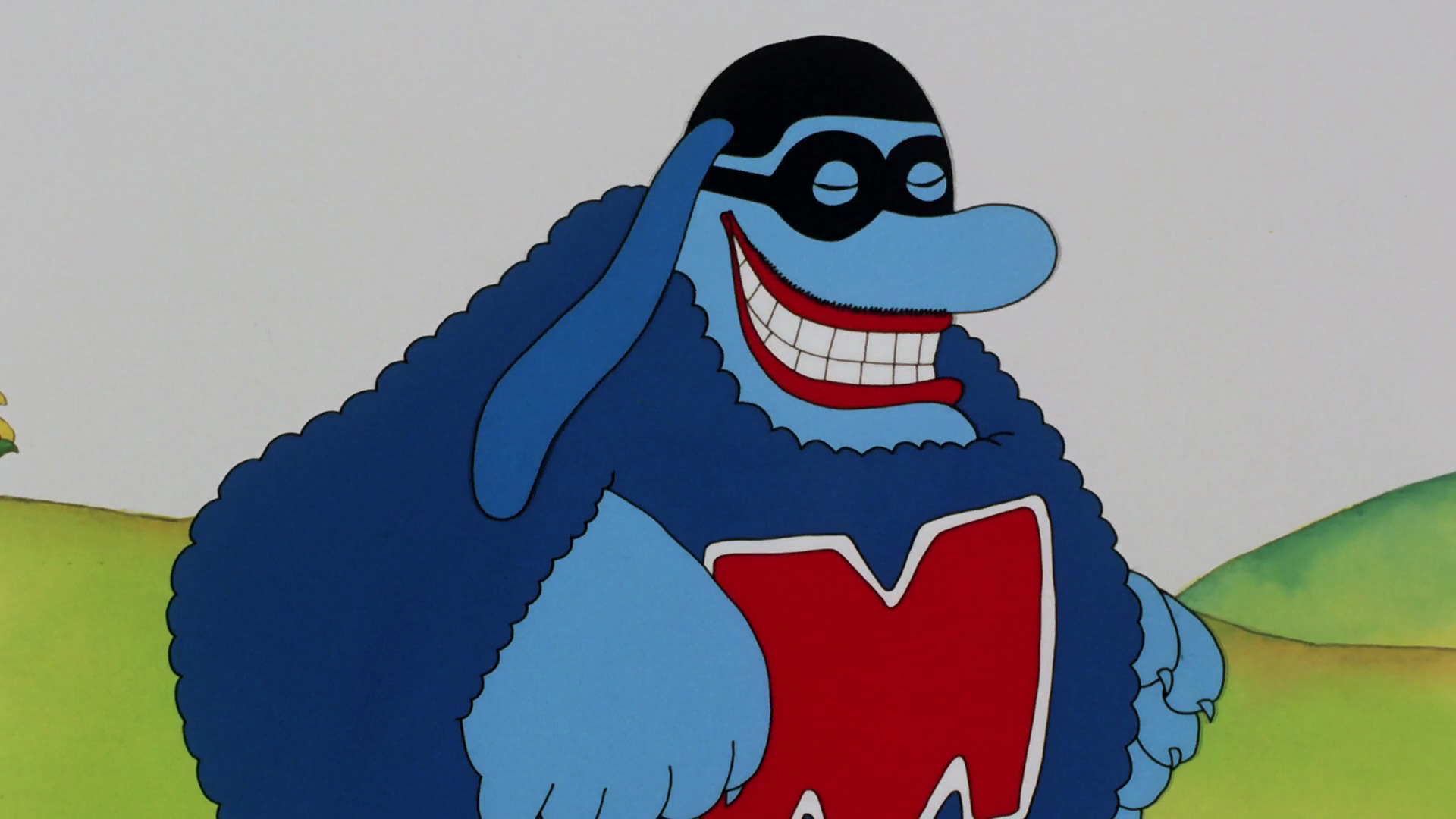
The Blue Meanies are the reason we have a plot. Led by the Chief Blue Meanie—who is voiced with a frantic, high-pitched energy by Paul Angelis—they represent everything boring, stagnant, and oppressive. They hate music. They hate color. They literally turn people into grey statues.
The Chief Blue Meanie isn't your typical Disney villain. He’s neurotic. He’s prone to temper tantrums where he beats his own head. He’s surrounded by a bizarre army of specialized monsters that look like they crawled out of a fever dream:
- The Apple Bonkers: Tall, thin guys in 18th-century outfits who drop giant green apples on people’s heads to knock them out.
- The Hidden-Persuaders: Men who look like cigars and have extra hands inside their shoes. They’re a subtle jab at the advertising industry of the 1960s.
- The Snapping Turtle Turks: Guys with turtle shells on their bellies that are actually carnivorous mouths.
- The Butterfly Knights: They’re exactly what they sound like, but way more menacing than you’d expect.
- The Dreadful Flying Glove: This is arguably the most famous henchman. It’s a giant, floating, sentient white glove that crushes anything that shows a hint of joy. It’s terrifying in a way that only 60s animation can achieve.
The Blue Meanies aren't just "bad guys." They are a critique of the "establishment." When the movie came out, the world was in the middle of the Cold War and the Vietnam War. The idea of a "force of blue" coming in to stop the music was a very real feeling for the youth of 1968.
Old Fred and the People of Pepperland
Old Fred is the guy who starts the whole adventure. He’s the captain of the Yellow Submarine and the one who flies to Liverpool to recruit the Beatles. He’s frantic and older, acting as the bridge between the "real" world and the fantasy of Pepperland.
Pepperland itself is populated by characters like the Lord Mayor, who is essentially a symbol of the old world that has been overwhelmed by the Meanies. He’s helpless until the Beatles arrive with their "New Music."
Why the Art Style Matters for the Characters
We can't talk about these characters without talking about Heinz Edelmann. He was the art director, and he’s the reason the characters look the way they do. Before Yellow Submarine, most animation followed the Disney "round" style. Everything was soft and bouncy.
Edelmann went the opposite way. He used high-contrast colors, sharp lines, and surrealist imagery inspired by Pop Art and Art Nouveau. This is why the characters in Yellow Submarine feel so distinct. They don't look like they belong in a cartoon; they look like they belong on a psychedelic poster pinned to a dorm room wall.
The character designs were so influential that they basically paved the way for everything from Monty Python's animations to SpongeBob SquarePants.
The Submarine as a Character
Is the submarine a character? Honestly, yeah. It has a personality. It responds to the music, it navigates "Seas" that are actually metaphysical states of being (like the Sea of Time or the Sea of Holes), and it acts as a protective womb for our heroes.
In the Sea of Monsters, the submarine is just one of many weird things floating around. It encounters the "Vacuum Cleaner Beast," a creature that literally sucks up the entire landscape, including the background and eventually itself. This kind of meta-humor was way ahead of its time.
Addressing the "Beatles Didn't Like It" Rumor
There’s a long-standing story that the Beatles hated the idea of the movie. That’s mostly true—initially. They had a bad experience with their previous film, Help!, and they weren't crazy about the Saturday morning cartoon series that bore their name. They thought the movie would be cheap and tacky.
However, once they saw the finished product and realized how sophisticated the animation was, they changed their tune. They loved it. That’s why they agreed to film the live-action segment at the end. They realized that these animated versions of themselves captured the "spirit" of the band better than a standard biopic ever could.
Actionable Takeaways for Fans and Collectors
If you're looking to dive deeper into the world of Pepperland, there are a few things you should actually do rather than just reading about it:
- Watch the 4K Restoration: Don't watch an old VHS rip. The 2012 restoration (released for the 50th anniversary) cleaned up the hand-drawn cells. The colors in the "Lucy in the Sky with Diamonds" sequence are literally eye-popping.
- Check out the "Nothing Is Real" Podcast: They have some of the most granular breakdowns of the production of the film, including the legal battles over the voices.
- Read "Inside the Yellow Submarine" by Robert Hieronimus: This is the definitive book on the film’s symbolism and the secret history of the animators who worked on it.
- Look for the McFarlane Toys figures: If you want a physical piece of this history, the action figures released in the late 90s/early 2000s are surprisingly high-quality and capture Edelmann’s art style perfectly.
The characters in Yellow Submarine endure because they represent a specific moment in time when we actually believed that "All You Need Is Love" was a viable political strategy. Whether it’s Jeremy Hillary Boob or the Dreadful Flying Glove, these figures remain some of the most imaginative creations in cinema history.
To truly understand the impact, you have to look past the bright colors. Look at the way the characters interact with their environment. The film suggests that the world is something you can change just by changing your perspective—or your soundtrack. That's a message that doesn't age, regardless of how many decades pass since the summer of '68.



