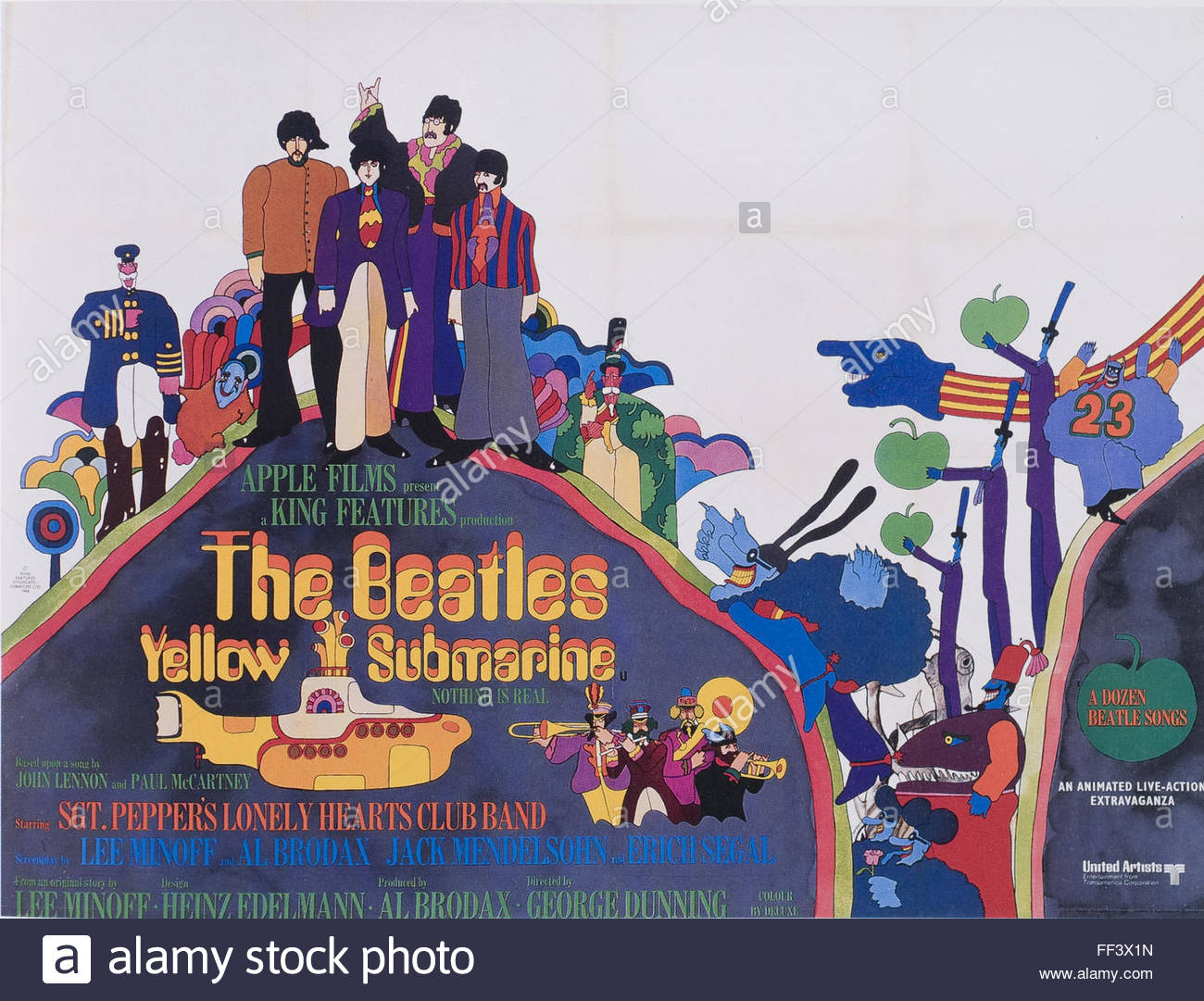
Honestly, the Beatles didn't even want to do it. That’s the big secret behind the yellow submarine beatles movie. When United Artists came knocking to collect on a three-picture deal, John, Paul, George, and Ringo were kind of over the whole "moptop" cinema thing. They’d done A Hard Day’s Night. They’d survived the chaotic, tropical mess of Help!. By 1967, they were deep into the experimental weeds of Sgt. Pepper, and the idea of starring in a cartoon felt, well, a bit juvenile.
They barely participated.
It’s one of those weird historical ironies. The movie that arguably defined the visual aesthetic of the late sixties—a film so saturated in color it feels like it might stain your eyeballs—was something the actual band members initially viewed as a contractual obligation they could hand off to someone else. They didn’t even provide the voices. If you listen closely, those aren't the Fab Four. They are actors (Paul Angelis, John Clive, Geoffrey Hughes, and Peter Batten) doing their best Scouse impressions. And yet, somehow, Yellow Submarine became a masterpiece of avant-garde animation that saved the medium from the sugary clutches of Disney’s then-stagnant formula.
The Weird Genius of Heinz Edelmann
Most people think Peter Max designed the yellow submarine beatles movie. He didn't. That’s a massive misconception that’s persisted for years. The actual look—the Pop Art vibrancy, the surreal landscapes of the Sea of Holes, the terrifyingly imaginative Blue Meanies—came from the brain of German illustrator Heinz Edelmann.
Edelmann was a visionary. He wasn't trying to make a kids' movie. He was trying to translate the psychedelic experience into a visual language that didn't rely on the clichéd "swirly" patterns of the era. He used everything: watercolor, ink, rotoscoping, and even collage.
Think about the "Eleanor Rigby" sequence. It’s haunting. It’s depressing. It uses stark, high-contrast photography of real Liverpool streets blended with animated figures to evoke a sense of urban loneliness that feels more like a French New Wave film than a Saturday morning cartoon. It was a radical departure from the "bouncing ball" animation style.
The production was a nightmare, though. The team at TVC London had less than a year to finish it. They were literally inventing techniques on the fly. Director George Dunning pushed the animators to think outside the box, resulting in a film that feels less like a narrative and more like a fever dream. It’s basically a series of music videos strung together by a thin plot about Pepperland, a paradise under attack by music-hating Blue Meanies.
Why the Music Wasn't Just "Leftovers"
Because the Beatles were skeptical, they didn't exactly hand over their "A-grade" material at first. They gave the producers a handful of songs they hadn't used for other projects. But because this was the Beatles in the late sixties, even their "leftovers" were better than almost anyone else's hits.
George Harrison’s "Only a Northern Song" is a perfect example. It’s a cynical, meta-commentary on the band's publishing deal, full of dissonant trumpets and weird sound effects. It fits the movie’s bizarre vibe perfectly. Then you have "It's All Too Much," a sprawling, feedback-heavy psychedelic anthem that remains one of the most underrated tracks in their entire catalog.
Eventually, the band saw what the animators were doing. They saw the rough cuts. And they loved it.
They realized this wasn't some cheap cash-in. It was art. That’s why the real Beatles actually show up at the very end for a live-action cameo. They were so impressed by the final product that they wanted to be a part of it, even if it was just for a few minutes to tell everyone to "start singing."
The Blue Meanies and the War on Boredom
We need to talk about the villains. The Blue Meanies aren't just bad guys; they are symbols of repression. They hate music. They hate color. They have teeth that look like piano keys and henchmen called "Apple Bonkers" who drop giant fruit on people's heads.
It’s easy to dismiss this as "hippie stuff." But look deeper. The film was released in 1968, a year of global unrest, protests, and the Vietnam War. In that context, a movie about defeating "the blues" through the power of song and "All You Need Is Love" wasn't just whimsical. It was a political statement.
The Apple Bonkers, the Hidden Persuaders (who have cigars for fingers and hats that hide their faces), and the Dreadful Flying Glove—these are all metaphors for the various ways authority tries to crush the human spirit. The yellow submarine beatles movie suggests that the only way to fight back is through creativity and absurdism. It’s a very Lennon-esque philosophy.
Honestly, the dialogue is also surprisingly sharp. It’s full of puns and wordplay that go way over most kids' heads. When Ringo finds a "hole" in the Sea of Holes and puts it in his pocket, he later uses it to help the group escape. It’s surrealist logic at its finest.
Technical Innovations That Changed Animation Forever
Before Yellow Submarine, feature-length animation was mostly the domain of Disney. It was all about "The Illusion of Life," smooth movements, and realistic proportions.
This movie blew that apart.
- Rotoscoping: The "Lucy in the Sky with Diamonds" sequence used rotoscoping—tracing over live-action footage—but in a way that felt painterly and fluid, rather than stiff.
- Mixed Media: Integrating photographs of the Beatles into the "A Day in the Life" style montages.
- Typography: The way words were used as physical objects within the frames.
If you look at modern animation—everything from Spider-Man: Into the Spider-Verse to the trippier episodes of Adventure Time—the DNA of the yellow submarine beatles movie is right there. It gave animators permission to be weird. It proved that you didn't need to follow the laws of physics or anatomy to tell a compelling story.
The 4K Restoration: Seeing the Colors for Real
For a long time, the only way to watch this movie was on grainy VHS tapes or beat-up TV broadcasts. The colors looked washed out. The sound was thin.
In 2012, and again for the 50th anniversary in 2018, the film underwent a massive digital restoration. This wasn't some automated AI upscale. A team of specialists spent months hand-cleaning every single frame. They didn't want to lose the texture of the original cells.
If you haven't seen the restored version, you haven't really seen the movie. The oranges pop. The purples are deep and velvety. The sound mix was also overhauled at Abbey Road Studios, making the 5.1 surround sound experience feel like you’re sitting in the middle of a Beatles recording session.
It’s worth noting that the film has different versions. The U.S. theatrical release famously cut the "Hey Bulldog" sequence to keep the runtime down. For years, American audiences missed out on one of the best scenes in the film—a frantic, high-energy battle against a multi-headed mechanical dog. Thankfully, modern releases have restored this, and it’s arguably the highlight of the whole journey.
Legacy: More Than Just a Trip
The movie didn't just influence animators. It influenced fashion, graphic design, and even how we think about the Beatles' "brand." It solidified their transition from the "Moptops" to the "Mystics."
Even today, you can find Yellow Submarine LEGO sets, socks, and high-end art prints. But the real legacy is the feeling it leaves you with. It’s a movie that celebrates the idea that "nothing is real" (as John sang in "Strawberry Fields Forever") and that's okay. It’s a world where you can lose yourself in the Sea of Green and come out the other side a little bit more enlightened.
It’s also surprisingly short. Clocking in at around 90 minutes, it doesn't overstay its welcome. It hits you with a barrage of imagery and music and then exits stage left, leaving you blinking in the sunlight.
Making the Most of the Experience
If you’re looking to revisit this classic or share it with someone who’s never seen it, here are the best ways to actually engage with it:
- Watch the 4K Restoration: Don't settle for an old DVD or a low-res stream. The visual fidelity is half the point of the movie.
- Listen to the Songtrack, Not the Soundtrack: This is a crucial distinction. The original 1969 Yellow Submarine album only had six Beatles songs and a bunch of orchestral score by George Martin. In 1999, they released the Yellow Submarine Songtrack, which features all 15 songs used in the movie, fully remixed. It sounds infinitely better.
- Look for the Easter Eggs: Keep an eye out for the various "Beatles" references in the background—everything from the "64" on the submarine's side (referencing "When I'm Sixty-Four") to the blink-and-you'll-miss-it appearances of other 60s icons.
- Pay Attention to Jeremy Hillary Boob, Ph.D.: The "Nowhere Man" character is more than just a joke. He represents the academic ivory tower—full of facts but empty of spirit—until the Beatles give him a reason to belong.
The yellow submarine beatles movie remains a singular achievement. It’s a rare moment where commerce, contract obligations, and pure, unadulterated avant-garde art collided to create something that shouldn't work, but absolutely does. It’s vibrant, it’s confusing, and it’s unapologetically loud. Just like the band that inspired it.



