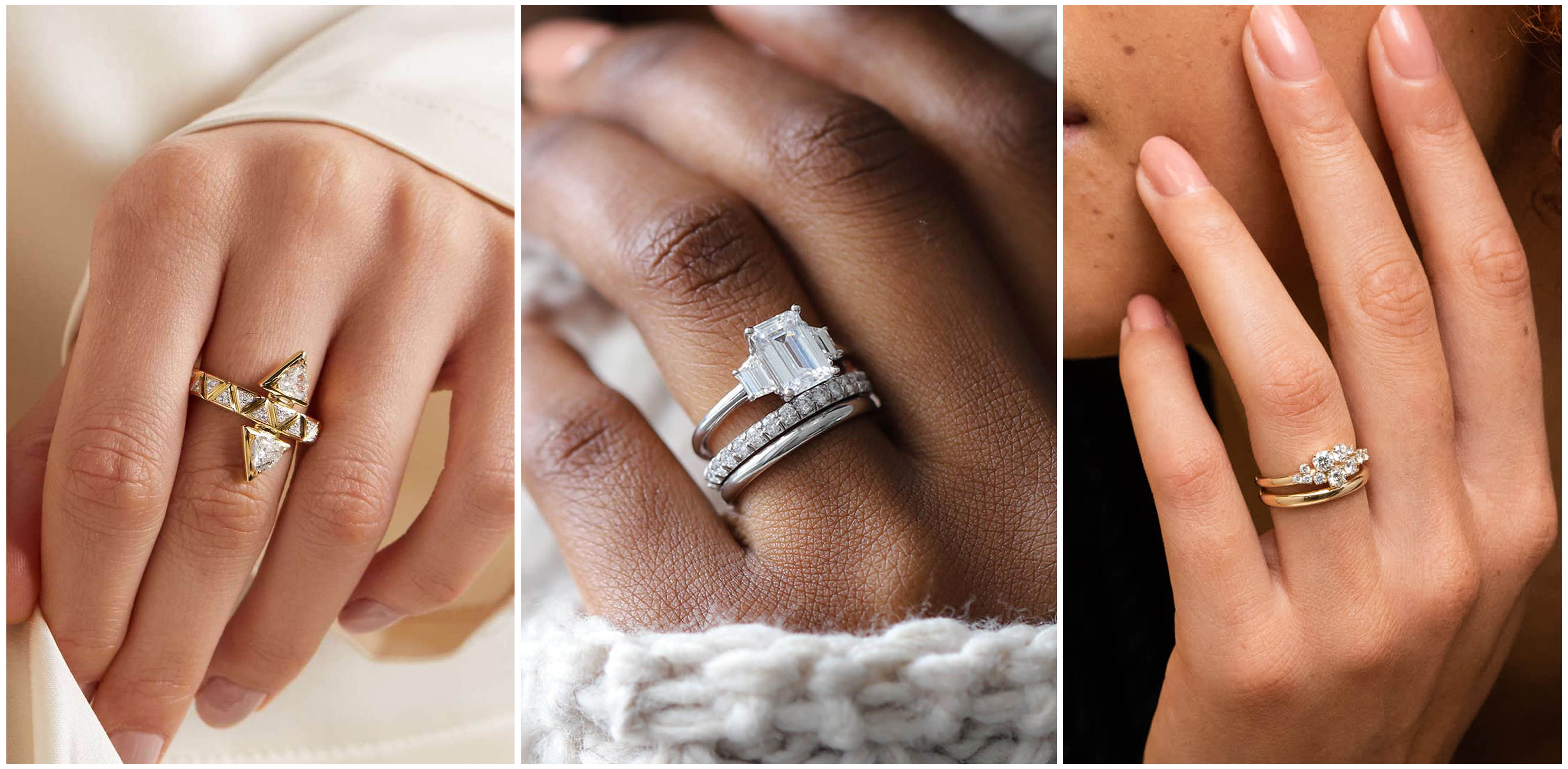
You’ve probably noticed them on your Instagram feed or seen a flash of canary-yellow on a celebrity’s hand recently. Yellow stone engagement rings aren't exactly new, but the way we talk about them has changed. It's no longer just about wanting something "different." People are genuinely moving away from the icy, colorless look that has dominated the bridal industry since De Beers launched their massive marketing campaigns in the mid-20th century. Honestly, the traditional diamond market is feeling a bit stale for a lot of couples.
There’s a warmth to yellow. It feels like sunshine captured in a setting. Whether it’s a high-end fancy vivid yellow diamond or a more accessible lemon quartz, these stones carry a personality that a standard round-cut white diamond just can’t replicate. But choosing one isn't as simple as picking a color. You have to navigate a world of "saturation levels," "hue modifiers," and the very real difference between a naturally colored diamond and a gemstone that’s been treated in a lab to look that way.
Why the shift to yellow stone engagement rings is actually happening
For decades, the "D-to-Z" grading scale was the bible for engagement rings. Everyone wanted a "D" (colorless). Anything near the "Z" end was considered low quality because it looked "dingy." But then something interesting happened. Once you cross past "Z," you enter the world of "Fancy" colors. Suddenly, that yellow tint isn't a flaw anymore; it’s a feature.
The GIA (Gemological Institute of America) has very specific criteria for this. To be a "Fancy" yellow, the stone has to have more color than a Z-graded diamond.
Celebrity influence plays a huge role here, obviously. When Jennifer Lopez received a green-yellow diamond or when Carrie Underwood showed off her canary yellow halo ring, the search volume for yellow stone engagement rings skyrocketed. It’s about prestige, sure, but it’s also about warmth. A yellow stone looks incredible against gold bands—it blends and glows in a way that white stones, which often look "cold" or "blueish" against yellow gold, simply don't.
The Diamond vs. Gemstone Debate
Let’s be real: not everyone has the budget for a 3-carat Fancy Vivid Yellow diamond. Those can easily cost more than a small house in the suburbs.
If you want the look without the diamond price tag, you’re looking at sapphires. Most people think "blue" when they hear sapphire, but yellow sapphires are stunning, durable, and significantly more affordable. They rank a 9 on the Mohs scale of mineral hardness. That's important. If you're wearing this every day for the next fifty years, you don't want a stone that’s going to scratch when you accidentally bang your hand against a granite countertop.
Then there’s Citrine. It’s beautiful. It’s affordable. But—and this is a big "but"—it’s only a 7 on the Mohs scale. If you choose a citrine for your yellow stone engagement ring, you’re going to see abrasions on the facets over time. It’s just the nature of the mineral. For a "forever" ring, a sapphire or a diamond is usually the smarter play.
Understanding the "Fancy" Scale
If you go the diamond route, you're going to hear words like "Fancy Light," "Fancy Intense," and "Fancy Vivid."
Basically, the more saturated the color, the higher the price. A "Fancy Light" yellow diamond has a soft, buttery glow. It’s subtle. Some people actually prefer this because it doesn't look like a piece of costume jewelry. On the other end, "Fancy Vivid" is that deep, electric yellow that looks almost synthetic because it's so bright.
Nature is rarely perfect.
Many yellow diamonds have secondary hues. You might see a "brownish-yellow" or a "greenish-yellow." Generally, "orangey-yellow" stones are highly prized, while "brownish" tints tend to drop the market value. However, some people love the "Champagne" or "Cognac" look of a brownish-yellow stone. It’s earthy. It feels less like a trophy and more like a piece of history.
Setting the Stone
The metal you choose for yellow stone engagement rings changes everything.
If you put a yellow diamond in a platinum or white gold setting, the contrast makes the yellow pop. It looks modern. It looks crisp. But if you put that same stone in 18k yellow gold, the color of the metal actually reflects through the stone, making the yellow look even deeper and richer than it actually is. Jewelers often use a "yellow gold basket" even if the rest of the ring is platinum. It’s a clever trick to maximize the color of the stone without paying for a higher color grade.
The Ethics of the Glow
We have to talk about lab-grown options.
In 2026, the stigma around lab-grown stones is basically gone. If you want a yellow stone engagement ring that is ethically clear and significantly cheaper, lab-grown yellow diamonds are a miracle of modern technology. They are chemically, physically, and optically identical to mined diamonds. The only difference is they were grown in a plasma chamber over a few weeks instead of in the earth's crust over billions of years.
Some purists hate this. They want the "story" of the earth. But for many, the story of "I saved $10,000 and we can put a down payment on a house" is a much better narrative.
Popular Styles Right Now
- The Hidden Halo: A circle of tiny white diamonds tucked under the main yellow stone. It adds sparkle without distracting from the main color.
- The Three-Stone (Trio): A central yellow stone flanked by two white clear diamonds (often trapezoid or pear-shaped). This is the "classic" look. It screams high-end.
- East-West Settings: Turning an oval or emerald-cut yellow stone sideways. It’s quirky. It feels very "Brooklyn" or "East London."
What most people get wrong about maintenance
Yellow stones—especially diamonds—are magnets for oil. Your skin produces oil. Your hand lotion is full of it. When oil sticks to the bottom of a yellow stone, it kills the light refraction and makes the stone look dull and "milky."
You have to clean these rings. Often.
A simple soak in warm water with a bit of degreasing dish soap (like Dawn) and a very soft toothbrush will do wonders. If you aren't willing to clean your ring once a week, don't get a yellow stone. The buildup shows much faster than it does on a traditional white diamond.
The Investment Angle
Don't buy an engagement ring as an investment. Just don't.
Unless you are buying a 10-carat "Graff" quality stone, the resale value is never going to match what you paid at retail. Buy a yellow stone engagement ring because you love the way it looks on your finger, not because you think it’s a hedge against inflation. The market for colored diamonds is more volatile than the market for white diamonds. Trends shift.
Real-world pricing expectations
To give you a ballpark, a 1-carat, naturally mined Fancy Yellow diamond might set you back anywhere from $4,500 to $8,000 depending on the clarity and cut. A lab-grown version of that same stone? You’re probably looking at $1,200 to $2,000.
Yellow sapphires fall somewhere in the middle, often ranging from $1,000 to $3,000 for a high-quality 1-carat stone.
Price isn't just about the stone. The craftsmanship of the setting matters. Yellow stones are notoriously difficult to set because the prongs can cast shadows that change the perceived color of the gem. You want a jeweler who has experience specifically with colored stones. Ask them how they plan to "house" the stone to maximize its "face-up" color.
Final thoughts on the "Trend"
Is it a fad? Maybe. But yellow has been a staple in royal jewelry for centuries. It’s not "trendy" in the way that rose gold was trendy five years ago. It’s a return to a more classic, maximalist aesthetic. People are tired of the "minimalist" look that feels like it was designed in a tech office. They want color. They want warmth.
When you look down at your hand, you want to see something that feels like you. If your personality is bright, loud, or just generally sunny, a white diamond might feel a bit too "standard issue."
Actionable Steps for the Buyer
- Decide on the "Why": Are you buying for the durability of a diamond or the hue of a sapphire? If you're active or work with your hands, stick to diamonds or sapphires. Avoid softer stones like citrine or yellow topaz for a daily-wear ring.
- View in Natural Light: Jewelry store lighting is designed to make everything look amazing. It’s aggressive. Ask the jeweler to let you walk to a window or step outside with the stone. See how that yellow stone engagement ring looks under a grey sky. That’s the "real" color.
- Check the Certificate: Ensure the GIA (or IGI for lab-grown) certificate explicitly states "Natural Color" if you are paying the premium for a mined stone. Some stones are "Color Enhanced" through HPHT (High Pressure High Temperature) treatments. This should be disclosed and should result in a lower price.
- Prioritize Cut Over Clarity: With yellow stones, the cut is what "traps" the light and intensifies the color. You can get away with lower clarity (SI1 or SI2) because the color of the stone helps hide small inclusions that would be obvious in a white diamond.
- Choose Your Metal Wisely: Use 18k yellow gold prongs to enhance the yellow, even if the band is a different metal. This "cheats" the color up a notch and provides a more seamless look.
Buying an engagement ring is stressful enough without trying to decode the entire world of gemology. Focus on the saturation you like, find a durable mineral, and make sure you aren't overpaying for a "vivid" tag if a "fancy" looks just as good to your naked eye.



