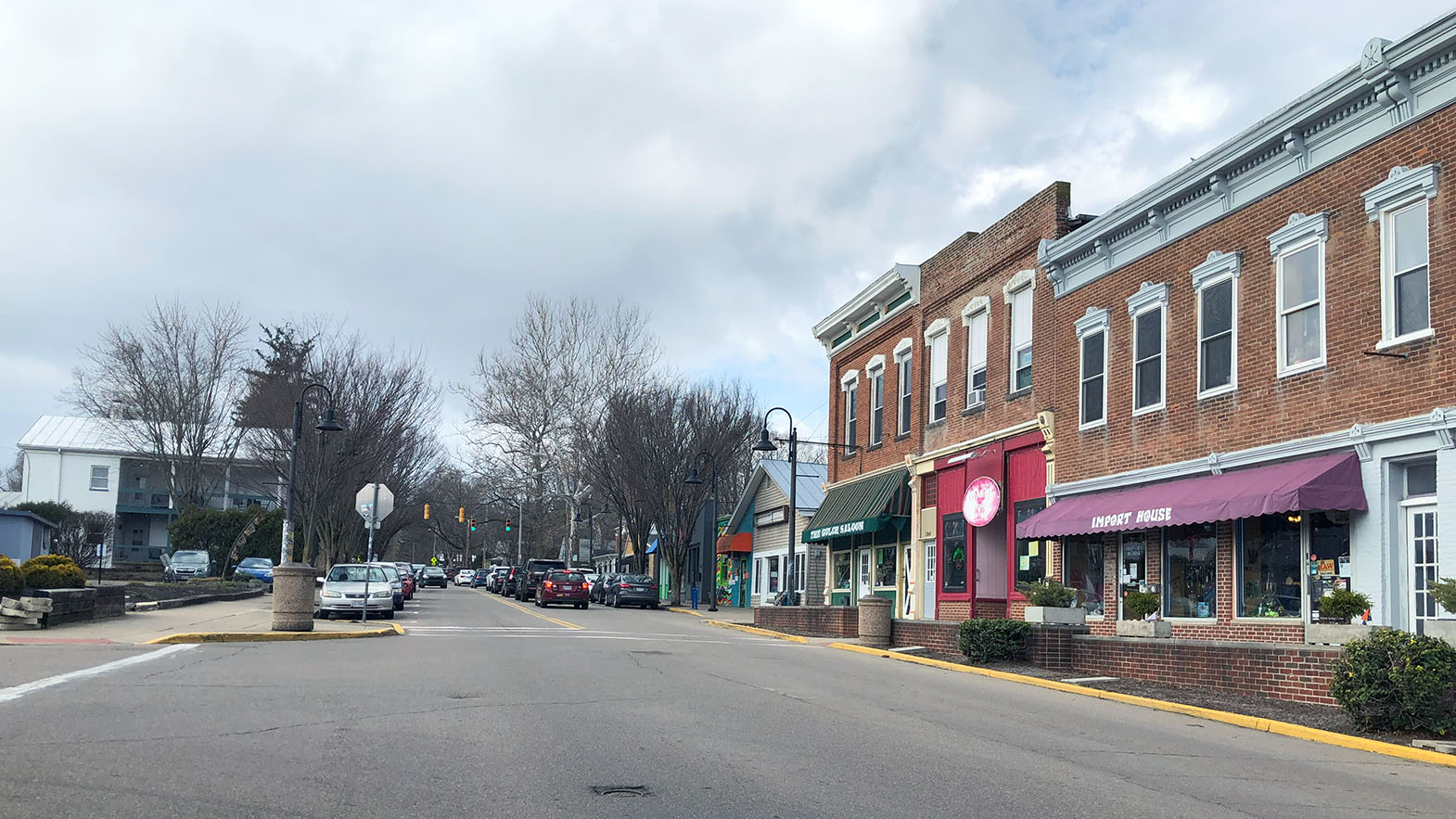
You’re driving through the rolling cornfields of Southwest Ohio, passing tractors and weathered barns, and then suddenly, the vibe shifts. The air feels different. You see a rainbow-painted utility pole, a shop selling crystals next to a high-end lithography studio, and a guy riding a unicycle past a line of people waiting for homemade ice cream. This is Yellow Springs Greene County. It’s a place that shouldn't exist in the middle of a red-leaning agricultural belt, yet it’s been thriving here for over a century.
Honestly, people get Yellow Springs wrong all the time. They think it's just a tourist trap for people who miss the sixties. Or they think it’s just a college town. It’s actually a complex, sometimes prickly, and deeply historical village tucked into the northern part of Greene County, about 20 minutes outside of Dayton. If you want to understand why this tiny spot of land—barely two square miles—exerts such a massive gravitational pull on the region, you have to look past the tie-dye.
The Greene County Connection: More Than Just a Map Point
Yellow Springs sits in the heart of Greene County, Ohio. Now, if you look at a map of the county, you’ll see suburban hubs like Beavercreek and Fairborn, or the quiet, conservative streets of Xenia. Yellow Springs is the outlier. It’s the "People's Republic of Yellow Springs," as some locals jokingly (or not so jokingly) call it.
The village got its name from the medicinal springs located in what is now the Glen Helen Nature Preserve. These springs are rich in iron, leaving a yellowish-orange residue on the rocks. Back in the early 1800s, people actually traveled across the state to soak in these waters, believing they could cure everything from gout to "the vapors." It was the original wellness retreat long before that was a marketing buzzword.
Geologically, this part of Greene County is fascinating. While much of Ohio was flattened by glaciers, the area around Yellow Springs features dramatic limestone cliffs and deep ravines carved out by the Little Miami River. This geography defines the town. You aren't just visiting a village; you're visiting a geological anomaly. The limestone outcroppings in Clifton Gorge and John Bryan State Park are world-class, offering a ruggedness you simply don't find elsewhere in the Miami Valley.
Antioch College and the Radical Soul of the Village
You can’t talk about Yellow Springs Greene County without talking about Antioch College. Founded in 1850 with Horace Mann as its first president, the college basically injected a DNA of radicalism into the town. Mann’s famous quote—"Be ashamed to die until you have won some victory for humanity"—is literally etched into the town’s psyche.
Antioch was one of the first colleges in the U.S. to admit both women and African Americans on equal footing with white men. This wasn't just a policy; it created a culture. During the Civil Rights movement, Yellow Springs was a hotbed of activism. In the 1960s, local protests against a segregated barbershop became a landmark moment in Ohio's civil rights history.
But here is the reality check: Antioch has struggled. It closed in 2008 due to financial mismanagement and a dwindling student body, only to be reopened by alumni a few years later. Today, it’s smaller and leaner, but its presence still dictates the town’s rhythm. The town-gown relationship here is tight. When the college hurts, the town hurts. When the college experiments with new social theories, the town is the laboratory.
The Dave Chappelle Factor
Lately, if you mention Yellow Springs to someone from outside Ohio, they immediately think of Dave Chappelle. He lives on a farm just outside the village limits. His father was a professor at Antioch, and Dave spent summers here as a kid.
He's not just a celebrity neighbor; he’s a major economic and social force. During the pandemic, he hosted "Summer Camp" comedy shows in a cornfield (Wirrig Pavilion), bringing in massive names like Chris Rock, David Letterman, and Jon Stewart. It saved local businesses that were drowning during the lockdowns. However, it also sparked a bit of a local identity crisis. There was a very public zoning dispute regarding a housing development where Chappelle’s opposition made national headlines. It highlighted a tension common in many Greene County pockets: how do you grow without losing the "soul" that made people move there in the first place?
Nature as a Religion
In Yellow Springs, the outdoors isn't a hobby. It’s a way of life.
Glen Helen Nature Preserve is the crown jewel. It’s 1,000 acres of private wilderness gifted to the college and protected for the public. If you go, you have to see the Cascades—a series of waterfalls that feel like they belong in the Pacific Northwest, not the Midwest.
Then there’s the Little Miami Scenic Trail. This is a massive "rail-to-trail" project that runs right through the center of town. You’ll see hardcore cyclists in spandex kits parked next to families on cruisers. The trail connects Yellow Springs to Xenia and eventually all the way down to Cincinnati. It’s probably the most successful piece of infrastructure in the county. It brings in thousands of visitors every weekend who just want to bike, eat a burger at Dino’s Cappuccinos or the Winds Café, and bike back.
- John Bryan State Park: Best for camping and rock climbing.
- Clifton Gorge State Nature Preserve: High-quality hiking with dramatic views of the river. This is a "registered natural landmark."
- Young's Jersey Dairy: Technically just north of the village, it’s a Greene County institution. You can pet goats and eat ice cream made from the cows standing 50 feet away.
The Economy of the Unusual
How does a town of 3,700 people support so many high-end restaurants and galleries? It's a mix of local loyalty and regional tourism.
The Winds Café is a great example. It started as a collective in the 70s and evolved into one of the best farm-to-table restaurants in Ohio. They were doing seasonal menus before it was cool. Then you have places like Sunrise Cafe, where the food is incredible but the wait on a Sunday morning is legendary.
But it’s not all food. There’s a strange amount of industry here. Yellow Springs Instruments (YSI) is a global leader in water monitoring sensors. Vernay Laboratories was a mainstay for decades. This is a "working" village. People often mistake it for a playground, but the tax base is built on high-tech manufacturing and professional services. Many residents commute to Wright-Patterson Air Force Base, which is just a short drive down I-675. This creates a fascinating demographic mix: peace activists living next door to Air Force colonels. They argue at town hall meetings, but they both shop at Tom’s Market.
What Most People Get Wrong About the "Hippie" Vibe
If you come here looking for a 1967 Woodstock reenactment, you might be disappointed. Yes, there are head shops. Yes, there is a lot of tie-dye. But the "hippie" vibe is underpinned by a very serious, very intentional commitment to social justice and environmentalism.
It’s not just about aesthetics. It’s about the fact that the village has its own municipal power utility and aggressively pursues renewable energy. It’s about the fact that the community land trust works to keep housing affordable in a county where property values are skyrocketing.
Is it perfect? No. The village is significantly less diverse than it was forty years ago. Gentrification is a real, biting issue. As the town becomes more "desirable," the very artists and activists who made it cool are being priced out. This is the central conflict of Yellow Springs today. It’s a struggle to remain an inclusive utopia while becoming an expensive boutique destination.
Planning Your Visit to Yellow Springs Greene County
If you’re coming for a day trip, park your car and leave it. The village is incredibly walkable.
Start at the Yellow Springs Station. It’s a replica of the old train station and serves as a visitor center right on the bike path. Grab a map.
Walk down Xenia Avenue. This is the main drag. Don’t miss Dark Star Books if you like used books and a resident cat. If you want something weird and wonderful, check out the House of Aum for yoga or some of the local pottery studios.
For lunch, if you want something fast, Ha Ha Pizza is a local staple. Their crust is distinct—whole wheat and dense. If you want something more "Yellow Springs," hit up the Ye Olde Trail Tavern. It’s the oldest tavern in Ohio (built in 1827) and has a fireplace that’s been burning for a long time.
Expert Tips for the Best Experience:
- Go on a Tuesday or Wednesday. Seriously. Saturday in Yellow Springs can be overwhelming. The crowds are thick, and the lines for food are long. During the week, you actually get to talk to the shop owners and feel the real pace of the town.
- Respect the Glen. Glen Helen is a fragile ecosystem. Stay on the trails. Don't pick the wildflowers. The locals take stewardship of this land very seriously.
- Check the Calendar. The Street Fair (held in June and October) is massive. It draws 25,000 people. It’s fun, but it’s a different beast than a regular visit. If you hate crowds, avoid those weekends at all costs.
- Explore the Outskirts. Drive ten minutes out to Peifer Orchards. Depending on the season, you can pick your own blackberries or apples. It gives you a sense of the agricultural richness of Greene County that surrounds the village bubble.
A Final Reality Check
Yellow Springs Greene County isn't a museum of the past. It’s a living, breathing, and sometimes arguing community. It’s a place where you can find a world-class documentary film festival (the Little Art Theatre is a gem) and a goat farm within a three-minute radius.
It’s easy to look at the colorful storefronts and think it’s all just for show. But if you sit on a bench outside the Emporium Wines and listen to the conversations around you, you’ll hear people discussing local politics, global climate shifts, and the best way to ferment sourdough. That intellectual curiosity is the real "Yellow Spring." It’s a refreshing change of pace from the cookie-cutter suburbs that dominate much of the Midwest.
Your Next Steps:
If you are actually planning a trip, your first move should be checking the Glen Helen website for trail conditions, as they can close after heavy rains. Next, look at the Little Art Theatre schedule; catching an indie film in that historic space is the quintessential evening activity. Finally, if you're a hiker, download the AllTrails map for the "John Bryan and Glen Helen Loop" to ensure you don't miss the hidden petroglyphs and rock formations that stay tucked away from the main tourist paths.