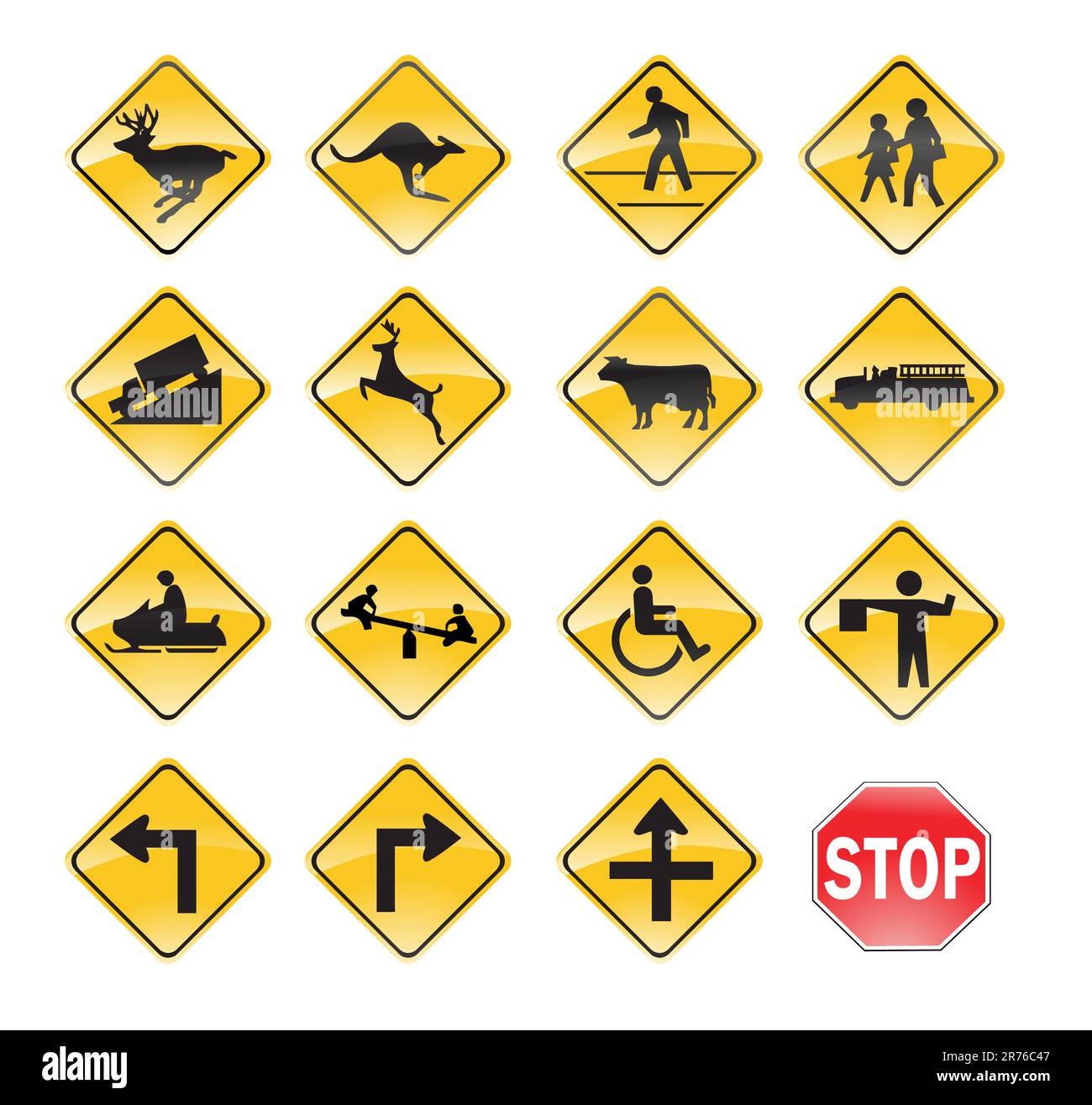
You're cruising at sixty. The sun is hitting the dashboard just right, and honestly, you're probably thinking about what’s for dinner or that weird email from your boss. Then, a splash of neon catches your eye. It’s a diamond-shaped yellow sign. You tap the brakes. You don't even think about it. It’s a reflex. We’ve been conditioned since driver’s ed to treat yellow signs on the road as the "pay attention" color, but most drivers actually misunderstand the legal weight behind them.
They aren't just suggestions. But they aren't exactly laws, either. It’s a weird middle ground that causes a lot of accidents and even more insurance headaches.
The Secret Language of the Diamond Shape
In the United States, the Federal Highway Administration (FHWA) maintains a massive, incredibly dry document called the Manual on Uniform Traffic Control Devices, or MUTCD. It’s the "bible" for road design. According to the MUTCD, yellow is reserved specifically for warning signs. Not "stop here" (red) or "look at this cool park" (brown). It’s the color of "heads up, something is about to change."
The shape matters too. Most yellow signs on the road are diamonds. This isn't just because diamonds look sharp. It’s a high-priority geometric warning. When you see that yellow diamond, the road is telling you that the environment is no longer a straight, predictable line. Maybe there’s a sharp curve. Maybe the lane is ending. Whatever it is, the sign is your only warning before physics takes over.
Sometimes you'll see a yellow pentagon. That’s specifically for school zones. Why a different shape? Because children are unpredictable, and the Department of Transportation figured out decades ago that a distinct shape helps drivers switch their brain into "extra cautious" mode faster than a standard diamond.
Advisory Speeds vs. Regulatory Speeds
This is where people get tickets. Or worse.
You’ve seen them: a yellow sign with a curved arrow and a smaller square sign underneath that says "35 MPH." Is that the speed limit? Technically, no. That is an "advisory speed." A white sign with black text is a regulatory sign—that’s the law. A yellow sign with black text is a warning.
But here’s the kicker. If you wipe out on a curve while going 50 MPH in a 35 MPH advisory zone, a cop can still cite you for "Failure to Maintain Control" or "Driving Too Fast for Conditions." Basically, even though the yellow sign isn't a hard speed limit, it’s a legal benchmark for what a "reasonable" person should be doing. Insurance companies love these signs. If you ignore a yellow warning sign and end up in a ditch, your adjuster is going to have a very easy time proving you were at fault.
It's about the friction of the tires. Engineers use something called a "ball bank indicator" to determine those yellow speeds. They drive a car around the curve and measure how much the car tilts. If the tilt is too high, they slap a yellow speed sign up. They aren't trying to slow you down to be annoying; they're trying to keep your car from sliding into the oncoming lane.
Why Some Yellow Signs Look "Greenish"
Have you noticed those super bright, almost neon yellow signs lately? They’re everywhere in pedestrian heavy areas. That color is officially called "Fluorescent Yellow-Green" (FYG).
Standard yellow is great during the day. But in the "grey hours"—dawn, dusk, and rainy afternoons—standard yellow can start to blend into the background. FYG pops. It is the most visible color to the human eye under low-light conditions. Because of this, the MUTCD now requires this specific neon hue for:
- Pedestrian crossings
- Bicycle crossings
- School zones
- Bus stops
If you see a neon-greenish sign, it means there is a high probability of a human being being in the road. Standard yellow is for objects (curves, hills, narrowing lanes). Neon yellow-green is for people. Pay attention to the difference. It literally saves lives.
The Evolution of the Deer Crossing
We’ve all seen the leaping deer. It’s iconic. But "Animal Crossing" signs are actually a point of huge debate among traffic safety experts.
Some experts, like those at the Insurance Institute for Highway Safety (IIHS), have pointed out that we’ve become "sign blind." We see so many yellow signs on the road that we stop seeing them at all. This is called habituation. When you drive the same route every day and see the same deer sign, your brain eventually deletes it from your conscious thought.
To combat this, some states are getting creative. You might see "High Collision Area" signs or even electronic yellow signs that flash only when sensors detect a large animal near the shoulder. These are much more effective because they break the visual monotony.
Non-Standard Signs and Why They Exist
Occasionally, you’ll see a yellow sign that looks a bit... off. Maybe it has a weird symbol or a custom message like "Blind Driveway" or "Hidden Entrance." These are often requested by local residents through their city council.
While the MUTCD tries to keep everything uniform, local engineers have some "engineering judgment" leeway. If a specific hill has caused three accidents in a year, they might put up a non-standard yellow sign to grab your attention. If it looks different, that’s usually on purpose. It’s meant to break your autopilot.
Heavy Duty Warnings: The "No Passing" Zone
Most yellow signs are on the right side of the road. There is one major exception: the "No Passing Zone" pennant.
This is a sideways triangle (a pennant shape) and it sits on the left side of the road. Why? Because if you are pulling out into the left lane to pass a slow truck, you might not be able to see the signs on the right side of the road. By putting a yellow pennant on the left, the road ensures that the person who needs the warning most—the person currently in the "wrong" lane—can see it clearly.
It’s a clever bit of psychological engineering. It’s also one of the few yellow signs that is almost always paired with a solid yellow line on the pavement, making it a very "hard" warning.
How to Actually Use This Information
Knowing the "why" behind the signs makes you a better driver, but it also helps you spot dangerous situations before they happen.
Next time you see a yellow sign, don't just register it as "caution." Look at the specific symbol. Is it a "Side Road" sign? That means someone is likely to pull out in front of you from the right. Is it a "Chevron" (those horizontal arrows on a curve)? That means the curve is sharp enough that you won't be able to see the end of it when you enter.
Immediate Action Steps:
- Audit your commute: Take note of the yellow signs you usually ignore. Which ones are you "blind" to?
- Trust the advisory speed: If the road is wet or it’s dark out, that yellow speed sign is your maximum safe speed, not a suggestion.
- Watch for the neon: When you see the fluorescent yellow-green, hover your foot over the brake. A person is nearby.
- Check your left: Look for those left-hand "No Passing" pennants before you commit to an overtake. They are often placed right before a dip in the road that hides oncoming cars.
Yellow is the color of transition. It's the buffer between safety and a very bad day. Respect the diamond.



