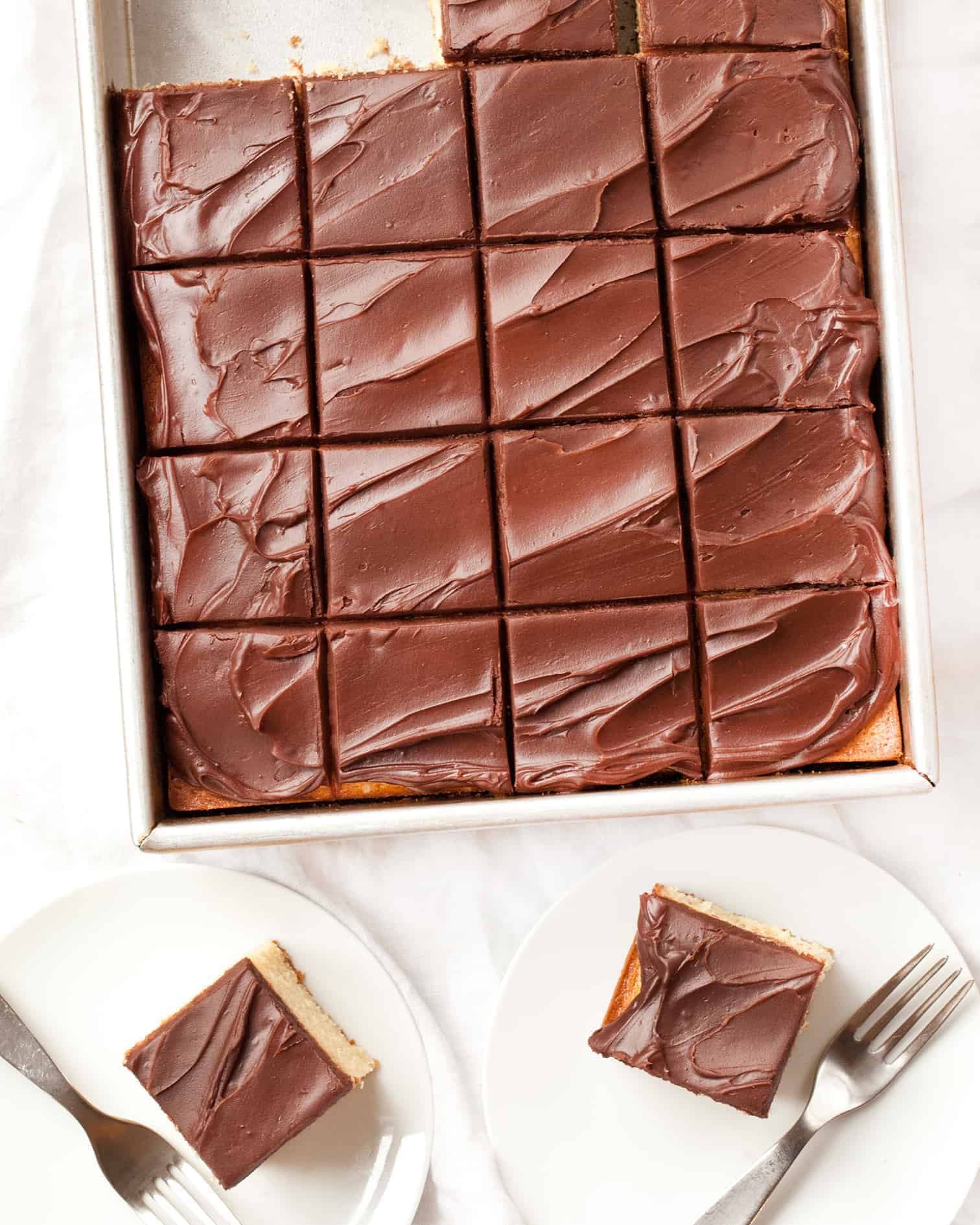
You know that specific smell. It’s a mix of vanilla extract, butter, and that slightly metallic tang of a large aluminum baking pan. It hits you at church potlucks, birthday parties in the park, and—if you’re lucky—on a random Tuesday when someone decides to bake. We’re talking about yellow sheet cake with chocolate frosting. It isn't fancy. It doesn't have a molten lava center or a matcha-infused crumb. Honestly? It doesn't need any of that.
The beauty is in the simplicity. A yellow sheet cake with chocolate frosting is the workhorse of the American dessert table. It’s sturdy. It’s reliable. It feeds twenty people without breaking a sweat. But here’s the thing: most people mess it up by overthinking the chemistry or using the wrong fat.
If you've ever bitten into a piece of yellow cake that felt like dry sawdust, you know the tragedy I’m talking about. A true, high-quality sheet cake should be "springy." If you poke it, it should bounce back like a sponge. Achieving that texture while maintaining a rich, buttery flavor is actually harder than it looks. Most boxed mixes rely on oil to stay moist, but if you want that nostalgic, bakery-style flavor, you need a specific balance of butter and eggs.
The actual science of a perfect crumb
Why does yellow cake taste "yellow"? It sounds like a dumb question, but it’s actually about the egg yolks. While a white cake uses only whites for a light, airy feel, a yellow sheet cake leans heavily on the yolks for color and a denser, richer mouthfeel. According to food scientists like Shirley Corriher, author of CookWise, the ratio of fat to flour determines whether your cake is a delicate cloud or a sturdy slab.
For a sheet cake, you want something in the middle. It has to be strong enough to hold a thick layer of chocolate fudge frosting without collapsing. Most experts recommend the "reverse creaming" method. Instead of beating the butter and sugar first, you mix the dry ingredients and then beat in the butter. This coats the flour particles in fat, which limits gluten development. Less gluten means a more tender bite. It's a game changer.
I’ve seen people try to get fancy with cake flour, but honestly, all-purpose flour works better for a sheet cake. It gives the cake the structural integrity it needs to be sliced into neat squares and lifted out of a pan. If you use cake flour, the thing might just crumble into a pile of yellow dust the second you try to serve it. Nobody wants to eat cake with a spoon.
Why the chocolate frosting has to be "fudgy"
We need to talk about the frosting. There are two camps here: the buttercream purists and the fudge fanatics. For a yellow sheet cake with chocolate frosting, the fudge camp wins every single time.
You want a frosting that’s slightly glossy. It should have that thin, crackly crust on top but remain soft and buttery underneath. This is usually achieved by using cocoa powder and boiling water (or coffee) to "bloom" the chocolate. Blooming releases the flavor trapped in the cocoa solids. If you just dump dry cocoa into butter, you're missing out on half the experience.
Specific brands matter too. Ask any professional baker, and they’ll tell you that Valrhona or Guittard cocoa powder will transform a basic frosting into something world-class. But if you’re at the grocery store, Hershey’s Special Dark is a solid, reliable choice for that deep, nostalgic color.
- The frosting shouldn't be too sweet.
- Salt is your best friend here. A heavy pinch of kosher salt cuts through the sugar and makes the chocolate taste "darker."
- Temperature is everything. If the cake is even slightly warm when you frost it, the frosting will soak in. Sometimes that's a good thing—it creates a "poke cake" vibe—but usually, you want a distinct layer of chocolate sitting on top of the yellow base.
Common myths about the sheet pan
People think a sheet pan is just a sheet pan. Wrong.
The standard "half sheet" pan is 18 by 13 inches. A "quarter sheet" is 9 by 13. If you try to bake a standard recipe in a pan that's too small, the center won't cook before the edges burn. It’s basic thermodynamics. Also, use light-colored aluminum pans. Dark pans absorb too much heat and will give you a "fried" bottom edge that’s tough and dark. You want a golden-brown bottom, not a charred one.
The "Texas Sheet Cake" is a specific variation of this. It’s usually thinner and the frosting is poured on while it's still hot. It’s delicious, but it’s a different beast than a classic, fluffy yellow sheet cake.
The buttermilk controversy
Is buttermilk necessary? Some people swear by it. Others think it makes the cake too tangy. Here’s the reality: buttermilk is an acid. When it hits the baking soda, it creates carbon dioxide bubbles. This makes the cake rise higher and stay softer. If you don't have buttermilk, don't just use regular milk. Add a tablespoon of lemon juice or vinegar to a cup of milk and let it sit. It’s not quite the same, but it’ll save your cake from being a leaden brick.
Honestly, the best yellow sheet cakes I’ve ever had used a combination of buttermilk and sour cream. The sour cream adds fat without making the batter too thin. It results in a "tight" crumb that feels incredibly professional.
How to store it without it going stale
Oxygen is the enemy of cake. Because a sheet cake has so much surface area, it dries out faster than a tiered round cake.
If you aren't eating it immediately, wrap the entire pan in plastic wrap. Do not just put a lid on it. You want the plastic touching the frosting (if the frosting has set) to create an airtight seal. If you put it in the fridge, the butter in the cake will solidify and make it taste dry. Always eat it at room temperature. Always.
If you have leftovers—though that’s rare—you can actually freeze individual squares. Wrap them tightly. When you have a midnight craving, 30 seconds in the microwave makes it taste like it just came out of the oven. The frosting gets a little melty, the cake gets soft, and everything is right with the world.
Why this cake is the ultimate "crowd-pleaser"
Think about it. There is almost no one who hates this combination. It’s the safe bet for a reason. It’s the "comfort food" of the dessert world.
In a world of deconstructed desserts and molecular gastronomy, the yellow sheet cake with chocolate frosting is a reminder that food doesn't have to be complicated to be "good." It’s about the ratio. It’s about the nostalgia. It’s about that one corner piece where the frosting is just a little bit thicker than everywhere else.
Practical steps for your next bake
If you're ready to make one, keep these tips in mind for a better result than 90% of what's out there:
- Room temperature ingredients: This isn't a suggestion; it's a requirement. If your eggs are cold, they won't emulsify with the butter, and your cake will have a greasy, uneven texture.
- Weigh your flour: A "cup" of flour can vary by 20 grams depending on how hard you pack it. Use a scale. 120-125 grams per cup is the standard.
- The "Crumb Coat" is a lie: For a sheet cake, you don't need a crumb coat. Just plop the frosting in the middle and work it to the edges. It’s supposed to look rustic.
- Add vanilla to the frosting: Even though it's chocolate, a teaspoon of high-quality vanilla extract rounds out the flavor.
- Don't overbake: Start checking the cake five minutes before the recipe says it’s done. A toothpick should come out with a few moist crumbs, not totally clean. If it’s totally clean, it’s already overcooked.
Go get a light-colored aluminum pan, some high-fat European butter, and a bag of good cocoa. Skip the complicated recipes with fifteen steps. Stick to the basics, respect the ratios, and don't forget the salt in the frosting. Your friends will thank you. Your family will thank you. And honestly, you’ll probably end up eating half the pan yourself.



