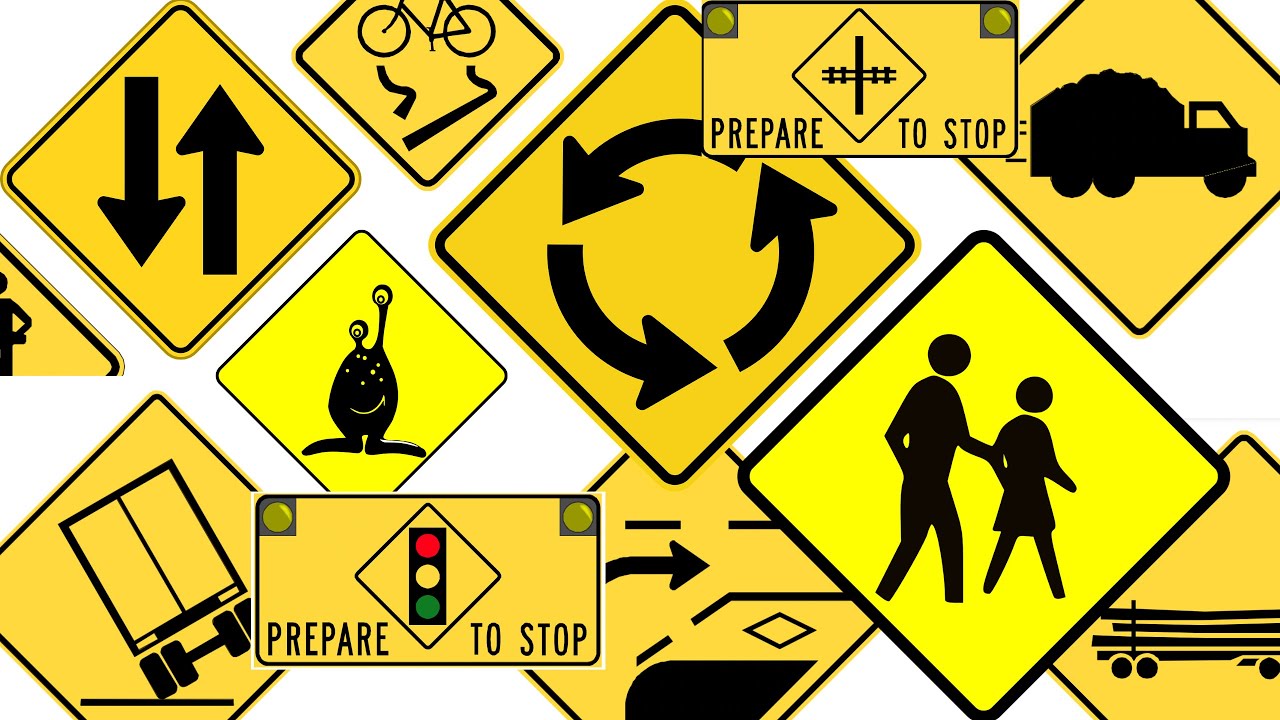
You're cruising down a backroad, maybe humming along to a podcast, when a bright flash of saffron catches your eye. It’s a diamond. Most of us don't even "see" them anymore. We just react. Your foot hovers over the brake because you instinctively know that yellow means pay attention. But honestly, do you actually know what every single one of those icons signifies? Most people think they do, yet the data from the National Highway Traffic Safety Administration (NHTSA) suggests otherwise. Misinterpreting a "Winding Road" sign versus a "Slippery When Wet" sign causes thousands of avoidable corrections every year.
Yellow road signs and meanings aren't just suggestions. They are the "Warning" category of the Manual on Uniform Traffic Control Devices (MUTCD). This massive tome, managed by the Federal Highway Administration (FHWA), dictates exactly how yellow these signs must be—specifically a color called "Fluorescent Yellow-Green" for school zones and standard yellow for everything else. It’s science. The human eye picks up this specific wavelength faster than almost any other color in a cluttered visual environment.
Why the Diamond Shape Matters More Than You Think
Ever wonder why they aren't circles? Or squares?
The diamond shape is reserved for warnings. It’s a universal language. Even if the paint peels off and the icon fades into a gray blob, that diamond silhouette tells you to scan the horizon for a hazard. It’s a "heads up" from the engineers who designed the road. They saw a problem—a sharp curve, a hidden driveway, or a deer crossing—and decided you needed a lead time of about five to ten seconds to adjust your speed.
Take the "Chevron" sign. You've seen them—the yellow rectangles with the black 'V' shape pointing left or right. These aren't just pretty decorations for the side of a mountain. They are technically "alignment signs." According to the FHWA, placing these in a series through a curve reduces crashes by up to 25%. They provide a visual "wall" that helps your brain calculate the actual radius of the turn when your headlights might be pointing into an empty abyss.
The Subtle Difference Between a Turn and a Curve
This is where people get tripped up on their DMV tests. There’s a specific yellow sign with a sharp 90-degree arrow. That’s a Turn sign (W1-1). Then there’s the one with a gentler, sweeping arrow. That’s a Curve sign (W1-2).
Why does it matter? Speed.
Basically, if the recommended speed is 30 mph or less, the engineers use the sharp Turn sign. If you can safely take it at more than 30 mph, you get the Curve sign. If you see a Turn sign and you’re doing 55, you’re about to have a very bad afternoon. The physics of centrifugal force don't care about your schedule. When that yellow sign has a small "Advisory Speed Plaque" underneath it—that little square saying 25 MPH—that isn't a legal speed limit you'll get a ticket for (usually), but it is the speed at which your car won't flip over or slide into a ditch. It’s based on "ball-bank indicator" tests where engineers literally drive the curve to see when the lateral G-forces become sketchy.
The Weird Ones: Pedestrians, Critters, and Low Clearances
We all know the deer crossing. But what about the "Low Clearance" sign? If you’re driving a standard sedan, you probably ignore the "12'-6"" yellow diamond. But for anyone in a moving truck or an RV, that sign is the difference between a successful trip and a "storrowing"—that painful sound of a roof being peeled off like a sardine can.
Then there’s the "Cattle Crossing" or "Farm Machinery" signs. In rural areas, these aren't just flavor text. They are legal shields for farmers. In many states, if you hit a cow in a zone marked with a yellow warning sign, you—not the farmer—might be liable for the damages. It’s a warning that the right-of-way is shared.
The Hierarchy of Yellow
- The Standard Warning: Your basic diamond. Crossroads, side roads, "T" intersections. They tell you someone might pull out in front of you.
- The School Zone: These are often that neon "Fluorescent Yellow-Green." Research shows this specific hue is more visible in twilight and rain. It’s the highest level of visual "shouting" the road can do.
- The Advisory: These are the small bits added to the bottom. "Blind Drive," "Hidden Entrance," or "Ice on Bridge."
Have you ever noticed the "No Passing Zone" sign? It’s a pennant shape. It’s the only sign that is a sideways triangle. And it’s yellow. It’s placed on the left side of the road because, when you're peaking out to pass a slow truck, you can't see the signs on the right. Engineers realized drivers needed a warning they could see while they were physically in the wrong lane. It’s brilliant, simple design.
Stop Thinking Yellow is "Optional"
There’s a dangerous myth that because yellow signs aren't "regulatory" (like the white and black speed limit signs or the red Stop signs), they don't carry legal weight.
Try explaining that to an insurance adjuster.
If you're involved in a collision after blowing past a yellow "Winding Road" sign at 60 mph, you are likely going to be cited for "Driving Too Fast for Conditions." The yellow sign defines the conditions. It sets the baseline for what a "reasonable and prudent" driver should have known.
Common Misunderstandings and Nuances
- The "Slippery When Wet" Sign: Most people see the car with the wiggly tire tracks and think it’s just for rain. Actually, it often marks sections of road with "low friction" pavement or areas where oil builds up heavily. It means the road is extra slick compared to the last mile you just drove.
- The "Added Lane" vs. "Merge" Sign: A merge sign (the one where two lines turn into one) means you have to fight for your life in traffic. An "Added Lane" sign (where the lines stay parallel but join) means you have your own dedicated lane. Knowing the difference stops that panic-braking people do when they think they’re about to run out of pavement.
- The "Dead End" vs. "No Outlet": A "Dead End" means that specific street stops. A "No Outlet" means a network of streets exists, but they all lead back to that one entrance. Subtle, but important if you're driving a trailer.
The MUTCD is constantly being updated. In the last decade, we’ve seen a shift toward more "symbolic" signs and fewer words. This is to accommodate non-English speakers and to make the "read" faster. Your brain processes an image of a person walking much faster than it can read the letters "P-E-D-X-I-N-G."
Actionable Steps for the Road Ahead
Don't just look at the signs; use them to predict the behavior of other drivers.
When you see a "Side Road" yellow sign, don't just check for cars. Look at the ground. Is there gravel kicked up onto the main road? That’s a sign that a heavy tractor or truck recently pulled out. When you see a "Narrow Bridge" sign, look for the "clearance" of the oncoming car. If it's a wide-load truck, you need to be the one to yield, even if you technically have space.
Next Steps for Safer Driving:
- Audit your commute: Pick one day this week to actually read every yellow sign. You'll be shocked at how many you’ve "blinded" yourself to over the years.
- Respect the Advisory Speed: Next time you see a yellow 35 MPH plaque on a curve, try taking it at exactly 35. You'll feel how much smoother the car handles and how much less stress is put on your tires and suspension.
- Check your lights: Since yellow signs are retroreflective (meaning they bounce light back to the source), their effectiveness is cut in half if your headlights are foggy or misaligned. Clean those lenses.
- Watch the shape: In heavy fog or snow where you can't see the icon, remember the silhouettes. Diamond is a hazard; Pennant is no passing; Square is usually information or an advisory.
Understanding yellow road signs and meanings isn't just about passing a test you took when you were sixteen. It's about reading the "language of the road." The engineers have already done the homework for you; they've mapped the dangers and put up the warnings. All you have to do is pay attention to the yellow.