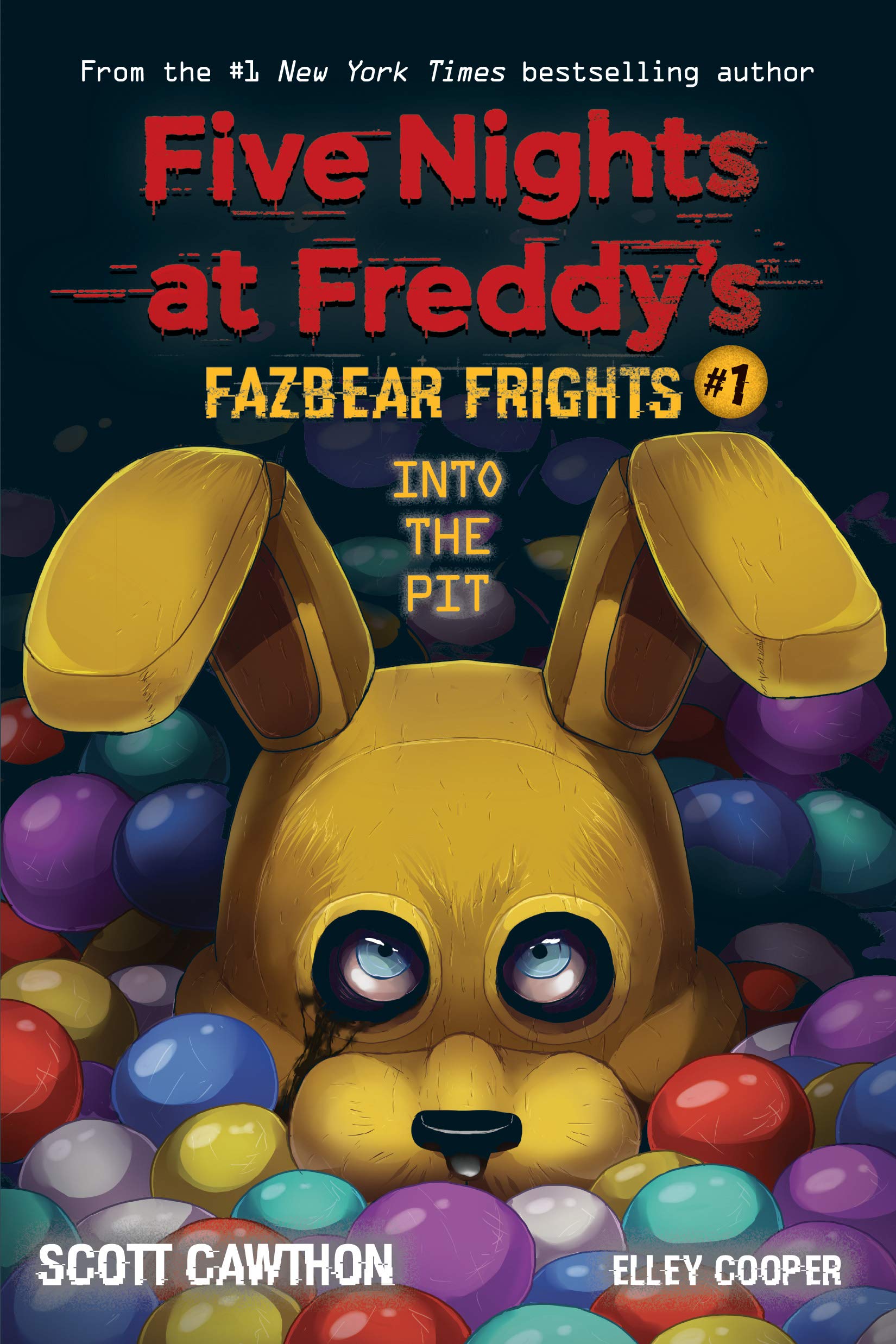
He isn't a robot. That is the first thing you notice when you really look at the Into the Pit Springbonnie. While every other iteration of the Five Nights at Freddy’s antagonist involves gears, wires, and cold steel, this thing is… wet. It’s organic. It breathes.
If you’ve played the Five Nights at Freddy's: Into the Pit game or read the original Fazbear Frights novella, you know this version hits different. Scott Cawthon and the team at Megacat Studios took the classic Yellow Rabbit and turned him into a biological nightmare. It’s a bold move. Honestly, it’s one of the best creative pivots the franchise has ever made. It’s also one of the most confusing pieces of lore for people trying to piece together the timeline.
What is the Into the Pit Springbonnie?
The creature is often called "The Yellow Rabbit" or "Pit Bonnie" by the community. In the story, Oswald discovers a ball pit at a local Jeff’s Pizza that acts as a temporal or mnemotic portal. He’s transported back to 1985. There, he witnesses a mass disappearance—the infamous Missing Children’s Incident (MCI). But the killer isn't just a guy in a suit. It’s a hulking, organic monster that eventually follows him back to the present day and replaces his father.
This isn't William Afton. Not exactly.
Most lore experts, including creators like MatPat (The Game Theorists) and dedicated researchers on the FNaF subreddit, suggest that this entity is an Agony-based creature. It’s a physical manifestation of the trauma left behind by the 1985 murders. Think of it as a memory given flesh. Because it’s born of Agony—a recurring supernatural force in the FNaF universe—it doesn't have to follow the rules of robotics. It can sweat. It can bleed. It can hide in plain sight while looking utterly repulsive to the audience.
The Visual Evolution of a Killer
Let's talk about the design. It's gross.
In the game, the Into the Pit Springbonnie is taller and more imposing than the Springtrap we see in FNaF 3. His eyes aren't plastic or glass; they’re human-like, darting around with a predatory instinct. The suit looks less like fabric and more like matted, decaying fur. When he unhinges his jaw, you don't see endoskeleton parts. You see rows of sharp teeth and a dark, cavernous throat.
The 2D pixel art style of the game actually makes him scarier. Limited detail allows your brain to fill in the gaps. You see him looming in the background of Oswald’s house, and the way he moves—stiff yet rhythmic—is deeply unsettling. It’s the "Uncanny Valley" effect turned up to eleven. He’s trying to act like a dad, but he’s a six-foot-tall rabbit monster.
The 1985 Connection
The game takes us to a specific version of 1985. It’s important to remember that Into the Pit might not be a literal time travel story. Many fans believe Oswald is experiencing a "memory loop" trapped within the ball pit’s remnant-heavy environment. This explains why the Into the Pit Springbonnie is so much more monstrous than the actual William Afton would have been.
It’s an exaggerated version of the killer.
In the real 1985, Afton was likely just a man in a costume. But in the pit? He’s the monster the children perceived him to be. The game reinforces this by showing him hanging out in the open during the party, visible only to those who "know."
Gameplay Mechanics: More Than a Jump Scare
If you're playing the game, you’ve probably noticed that the Into the Pit Springbonnie doesn't just run at you. He stalks. The AI is designed to create a sense of persistent dread.
- Noise Matters: Unlike the original games where you're stationary, here you're moving through rooms. He hears you.
- Hide and Seek: The "Hold Your Breath" mechanic is a nerve-wracking addition. Seeing his face press against the glass of a hiding spot is a highlight of the horror experience.
- The Replacement: The psychological horror of having the creature sit at your dinner table, pretending to be your father while your mother acts like everything is normal, is a top-tier FNaF moment.
Why This Version Matters for the Lore
There is a huge debate about whether Into the Pit is "Stitchline" (connected to the Fazbear Frights books) or part of the main game continuity. Here is the reality: it doesn't matter as much as the implications of the Agony.
The Into the Pit Springbonnie proves that the "haunting" in FNaF isn't just about souls. It’s about emotions. If an event is tragic enough, it leaves a stain. That stain can take the form of a yellow rabbit. This broadens the scope of the entire series. It means that even if William Afton is truly gone (burned, trapped, or deleted), the horror he created can still manifest physically.
Common Misconceptions
People get a lot of things wrong about this character.
First, he’s not "Scraptrap." Scraptrap is the withered, post-fire version of Afton from Pizzeria Simulator. The Pit Bonnie is a separate entity entirely.
Second, he isn't a "demon" in the religious sense. While his appearance is demonic, the FNaF universe sticks to its own brand of "pseudoscience" involving Remnant and Agony. He’s a biological byproduct of a supernatural event.
Third, the "Dad" version of the rabbit isn't a hallucination. Oswald can touch him. He eats food. He drives a car. He is physically there, which makes the ending of the story—where the creature is finally defeated in the ball pit—so much more satisfying.
How to Survive the Pit
If you’re struggling with the game, remember that patience is your best tool. The Into the Pit Springbonnie thrives on player panic.
- Don't sprint unless you have to. Running is a dinner bell.
- Learn the vent paths. The map is your friend, and knowing where you can pop out to avoid a dead end is crucial.
- Watch the eyes. In many sequences, the lighting reflects off his eyes before you can see his body. If you see two yellow glints, back away.
- Listen for the "squelch." Because he’s organic, his footsteps have a distinct, wet sound compared to the metallic clunks of other animatronics.
The Into the Pit Springbonnie is a masterclass in how to refresh a tired character. We’ve seen Springbonnie a million times, but we’ve never seen him like this. He represents the shift in FNaF from "haunted robots" to "cosmic, emotional horror." It’s weird, it’s gross, and it’s exactly what the franchise needed to stay relevant.
Moving Forward with the Lore
To truly understand the Into the Pit Springbonnie, you should look into the "Eleanor" arc from the Fazbear Frights books. Many theorists believe Eleanor—another Agony-based entity—is the true architect behind the events in the pit. Studying the similarities between her shapeshifting abilities and the Rabbit's "Dad" persona reveals a much deeper, darker layer to the Freddy’s mythology. Keep an eye on the background details in the Jeff’s Pizza segments of the game; there are clues hidden in the trash and on the walls that link back to the wider universe in ways most casual players completely miss.