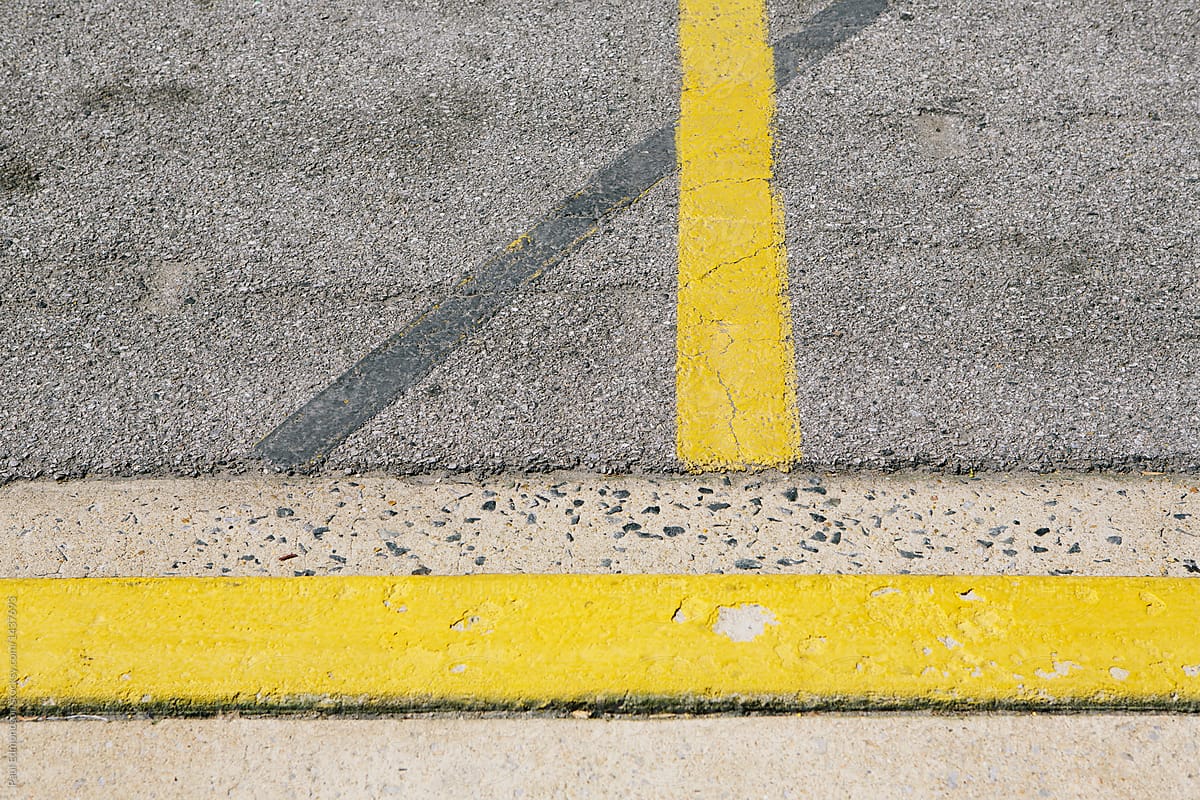
You’re circling the block for the tenth time. Your eyes are stinging from the glare of the afternoon sun, and you’re already three minutes late for that dentist appointment. Then, like a miracle, a gap appears. You pull in, kill the engine, and start to step out when you notice it—the curb is bright, sun-baked yellow.
Does it mean "don't even think about it"? Or is it one of those "just for a second" zones? Honestly, most people just wing it and hope for the best, which is exactly how cities make a fortune in parking tickets. Understanding what yellow paint on a curb mean is basically the difference between a free spot and a $75 fine that ruins your Tuesday.
It isn't just a suggestion. It's a specific legal designation defined by the Manual on Uniform Traffic Control Devices (MUTCD), though cities like Los Angeles, New York, and Chicago add their own local flavors to the rules. Generally, yellow is the "loading zone" of the curb world. But the nuances—like whether you can leave your car or if the rules die after 6:00 PM—are where things get messy.
The Basic Logic of the Yellow Curb
Usually, a yellow curb signifies a loading zone. This sounds simple enough, but "loading" is a loaded term. In many jurisdictions, this refers strictly to commercial loading. Think of those massive box trucks delivering cases of sparkling water to the corner bodega. If you park your Prius there and go in for a haircut, you’re asking for a tow.
However, some cities allow for "passenger loading" at yellow curbs. This means you can stop, let someone out, or pick someone up, provided you stay with the vehicle. The clock is ticking, though. We’re talking three to five minutes, tops. If you shut off the engine and walk into a Starbucks, you have technically stopped "loading" and started "parking." That’s the line police officers and meter maids look for.
It's also worth noting that these rules often have an expiration date. In downtown San Francisco, for instance, many yellow zones revert to general parking after 6:00 PM or on Sundays. But don't bet your paycheck on it. You have to look for the nearby sign. If there’s no sign, the paint itself is the law, and in some towns, that law is 24/7.
Why Some Yellow Curbs Feel Like a Trap
Have you ever noticed how some yellow paint is chipped and fading? That's where the trouble starts. In older neighborhoods, a curb might have been painted yellow twenty years ago for a business that doesn't even exist anymore. You might think, "Oh, this is fine, it’s practically grey."
Nope.
Courts generally rule that if the intent of the paint is visible, the law applies. If you can see even a hint of yellow, the city expects you to treat it as a restricted zone. It’s frustrating. It feels unfair. But the burden of proof is almost always on the driver.
Commercial vs. Non-Commercial Drivers
This is the big one. If you're driving a vehicle with commercial plates, you usually have a lot more leeway. You might get 30 minutes to move crates. If you’re a "civilian," you might not even be allowed to stop there at all depending on the specific municipal code.
In Los Angeles, for example, yellow curbs are strictly for the loading or unloading of passengers (for up to 3 minutes) or freight (for up to 20 minutes). But here’s the kicker: the freight rule only applies to vehicles with a commercial license plate. If you’re moving a couch in your Ford F-150 with standard plates, you’re technically breaking the law in a yellow zone because your truck isn't "commercial" in the eyes of the DMV.
The Regional Wild West of Curb Colors
While the MUTCD tries to keep things standard, local governments love to move the goalposts. It's a nightmare for road trippers.
- California's Strict System: They take their colors very seriously. Yellow is for commercial loading, green is for short-term (usually 15-30 mins), and white is for passengers.
- The East Coast Chaos: In some older cities, yellow is used almost interchangeably with red to mean "No Standing" or "No Parking Anytime." In these areas, yellow is a warning of an active driveway or a fire hydrant clearance.
- Small Town Variables: In rural areas, yellow paint might just be there to mark a sharp curve or a narrowing road, with no parking implications at all.
You have to be a detective. Check the pavement for stenciled letters. Often, the curb will actually say "COMMERCIAL ONLY" or "10 MIN LIMIT" right in the paint. If it’s blank, look for a sign within 50 feet. If there’s still nothing, the safest bet is to assume you can't park there during business hours.
When the Rules Stop Working
Rules aren't forever. Most yellow curb restrictions are tied to the "business day." This usually means Monday through Saturday, 7:00 AM to 6:00 PM. Outside of those hours, the yellow curb effectively disappears, turning into a standard parking spot.
This is the "Golden Hour" for savvy city dwellers. If you find a yellow curb at 6:05 PM, you’ve hit the jackpot. You can leave your car there overnight until the clock hits 7:00 AM the next morning. But—and this is a big but—you have to be certain there isn't a secondary "No Parking 2 AM to 6 AM" street cleaning sign nearby. The yellow paint is just one layer of the bureaucratic onion.
The Mystery of the "Faded" Curb
What happens if you get a ticket because the paint was so faded you couldn't see it? You can fight it, but you'll need photos. Take a wide shot of the car and a close-up of the curb. If the paint is truly unrecognizable, many judges will toss the ticket. However, if there’s a sign nearby that also designates the zone, the faded paint won't save you. The sign always wins.
Surprising Facts About Curb Painting
People think the city sends out crews to paint these all the time. Actually, in many cities, business owners have to apply and pay for a yellow curb designation in front of their shop. They pay an annual fee to keep that loading zone. If they stop paying, the city is supposed to paint over it with grey or leave it to fade.
This leads to "phantom" yellow zones. The business is gone, the fee isn't being paid, but the paint remains. Legally, it's still a restricted zone until the city officially changes it. It’s a classic example of "the law is the law, even when it’s stupid."
Another weird detail? In some states, yellow paint is used on the top of the curb to indicate a different rule than paint on the face of the curb. It’s rare, but it happens. Generally, if any part of the concrete is yellow, stay away.
A Quick Guide to the Other Colors
To understand yellow, you have to know its neighbors. Curb colors are an ecosystem.
- Red: No stopping, standing, or parking. Ever. Don't even think about it. (Unless it's a bus zone and you're a bus).
- Blue: Reserved for persons with disabilities. You need a placard or a specific plate. These are the most expensive tickets you can get.
- Green: Short-term parking. Usually 10 to 30 minutes. Great for running into the dry cleaners.
- White: Passenger loading only. Think airport drop-off vibes. You stay in the car, the passenger jumps out, and you move on.
How to Protect Your Wallet
If you’re staring at a yellow curb and wondering if you should take the risk, ask yourself these three things. First, what time is it? If it's 8:00 PM, you're likely fine. Second, do I have commercial plates? If not, keep the engine running and stay in the driver's seat. Third, is there a sign?
The sign is the ultimate authority. If the curb is yellow but the sign says "Two Hour Parking," the sign usually reflects the most recent ordinance change. The paint might just be an old ghost.
Honestly, the best advice is to treat a yellow curb like a "Running Errands" zone. If you're going to be more than five minutes, or if you're going to lose sight of your car, find a different spot. The cost of a tow and the trip to the impound lot will always be more expensive than the extra three dollars you would have spent in a parking garage.
Actionable Next Steps for Drivers
- Check your local city's DOT website. Search for "Curb Color Codes [Your City]." Some cities have specific holidays where yellow curb rules are suspended.
- Look for the "End of Zone" markers. Sometimes a yellow curb ends abruptly, but there’s no clear line. Look for a small metal bolt or a change in the concrete texture.
- Use a parking app. Apps like SpotHero or Parkopedia often have notes about curb restrictions in specific neighborhoods.
- Download a "fighting tickets" app. If you do get nailed at a faded yellow curb, apps like WinIt or Off The Record can help you contest it by providing the specific legal language needed for your jurisdiction.
- Always check for the "Tow-Away" sign. Some yellow zones aren't just ticket zones; they are active tow zones during peak traffic hours. If you see a picture of a tow truck on a nearby sign, get out of there immediately.



