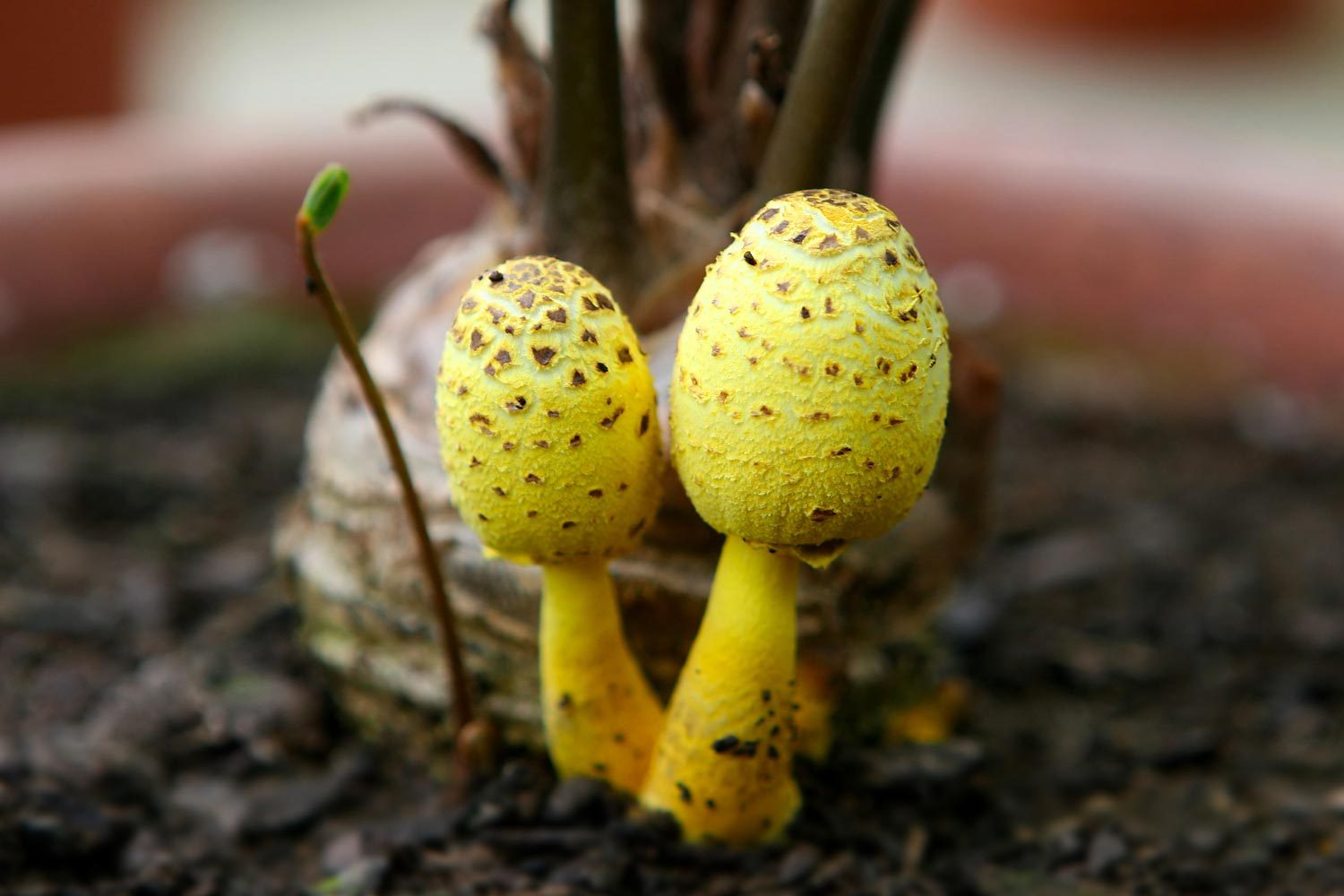
You’re misting your Monstera or checking the soil on your Pothos, and suddenly, there it is. A shock of neon. A cluster of bright, almost radioactive-looking yellow mushrooms in houseplants that seemingly sprouted overnight.
It's a bit jarring. Meanwhile, you can explore similar developments here: The Golden Bubble of 1992 (And the Return of a Crispy American Icon).
Honestly, most people freak out. They think the soil is rotting, the plant is dying, or their living room has turned into a biohazard zone. But here’s the thing: those little yellow invaders—scientifically known as Leucocoprinus birnbaumii—are actually one of the most misunderstood houseguests in the botanical world. They aren't there to kill your plant. In fact, they might be telling you that your soil is actually quite healthy, even if it is a little bit too damp for comfort.
The Secret Life of Leucocoprinus birnbaumii
These aren't your average forest floor mushrooms. They are tropical specialists. Leucocoprinus birnbaumii, often called the Flowerpot Parasol, loves heat and moisture. It’s a saprobe. That basically means it eats dead stuff. It’s not interested in the living roots of your Fiddle Leaf Fig; it’s interested in the decaying peat moss, bark chips, and organic matter inside your potting mix. To see the full picture, check out the detailed analysis by Refinery29.
It’s an efficient recycler.
When you see those bright yellow caps, you're only seeing the "fruit." The actual organism is a massive, invisible web of threads called mycelium living underground. By the time the mushroom pops up, the party has been going on for weeks. It’s been breaking down complex organic molecules into simpler nutrients that your plant can actually use.
Where did they even come from?
You didn't do anything wrong. You likely didn't "catch" them from a dirty window. Most commercial potting soils—even the expensive, sterilized bags—contain dormant spores. These spores are incredibly resilient. They can survive the pasteurization process or hitch a ride on the roots of a plant you bought months ago. They just sit there. They wait for the perfect moment. Usually, that moment involves a humid summer day and a slightly heavy hand with the watering can.
Why Yellow Mushrooms Love Your Living Room
Mushrooms are opportunistic. They don't have chlorophyll, so they don't need the sun. They need three specific things to thrive: food, warmth, and water. Your indoor pots are basically five-star resorts for fungi.
- The Food Source: Modern potting mixes are rich in peat moss and coco coir. This is high-quality fuel for Leucocoprinus.
- The Climate: Most houseplants are tropical. We keep our homes at roughly 70°F to 80°F. This is the exact "Goldilocks zone" for fungal growth.
- The Moisture Factor: If you aren't letting your soil dry out between waterings, the mycelium stays hydrated and happy.
If you notice a sudden explosion of yellow mushrooms in houseplants during a particularly humid week, it’s not a coincidence. The air is thick, the soil is damp, and the fungus decides it's time to reproduce.
Are They Dangerous? (The Honest Truth)
Let's talk safety. There’s a lot of misinformation out there about "toxic mold" and "killer fungi."
For your plants? No. They are harmless. They won't "strangle" the roots. They aren't "stealing" all the nutrients. If anything, they are a sign of a biodiverse soil ecosystem.
For you? Well, don't eat them. Leucocoprinus birnbaumii is considered toxic if ingested. According to mycologists at institutions like the North American Mycological Association (NAMA), eating these can lead to significant gastrointestinal distress. We're talking stomach cramps, nausea, and a very bad afternoon.
If you have curious toddlers or a cat that likes to nibble on anything green and gold, you should probably pluck them out immediately. But just touching them? That won't hurt you. Just wash your hands afterward to be safe.
The Spore Myth
People worry about the spores getting into the air and causing respiratory issues. While some people are sensitive to any fungal spores, these particular mushrooms aren't known for being a major indoor air quality hazard in the way that Stachybotrys (black mold) is. They are "macro-fungi," and their spores are generally localized to the pot.
Getting Rid of the Yellow Guests
So, you want them gone. That’s fair. Even if they are "healthy," a neon yellow fungus doesn't always fit the aesthetic of a minimalist living room.
Getting rid of them is actually harder than it looks.
- Physical Removal: You can pluck the caps. This stops the spores from spreading, but it doesn't kill the fungus. It's like picking an apple off a tree—the tree (the mycelium) is still there.
- Scraping the Soil: You can remove the top inch of soil. This helps, but the mycelium often runs deep.
- The Dry-Out Method: This is the most effective way to manage them. Let your plant dry out as much as it can safely tolerate. Fungi hate drought.
- Cinnamon: Some gardeners swear by dusting the soil with cinnamon. It’s a natural fungicide. It’s not a cure-all, but it can discourage new caps from forming.
- Repotting: This is the nuclear option. You have to wash all the old soil off the roots and use a completely new pot. Even then, a single spore can start the whole cycle over again.
What Your Mushrooms Are Trying To Tell You
Look at the mushrooms as a diagnostic tool. They are a "check engine" light for your watering habits. If you have a constant crop of yellow mushrooms in houseplants, you are likely overwatering.
Or, perhaps your soil has become too "compacted." When soil stays wet for too long, it loses oxygen. This anaerobic environment is a playground for certain fungi. If you see mushrooms, take a wooden skewer and poke some holes in the soil to let it breathe.
Sometimes, the presence of these mushrooms is actually a compliment to your care. It means you’ve created a rich, organic environment. In the wild, plants don't grow in sterile dirt. They grow in a complex web of bacteria and fungi.
Practical Steps for Long-Term Management
If you're tired of the yellow pops of color, change the environment, not just the soil.
- Increase Airflow: Put a small fan in the room. Stagnant air is a mushroom’s best friend.
- Bottom Water: Try sitting your pots in a tray of water for 20 minutes instead of pouring water over the top. This keeps the surface soil dry, which prevents the mushroom caps from being able to push through.
- Switch Your Soil: If a specific brand of soil always produces mushrooms, try switching to a mix with more perlite or pumice. Better drainage equals fewer fungi.
- Adjust Your Humidity: If you use a humidifier for your tropicals, make sure it isn't blasting directly onto the soil surface.
Summary of Actionable Insights
If you find these yellow intruders today, don't panic. Start by assessing the risk—if you have pets or kids, pull the mushrooms out with a gloved hand and toss them in the outdoor trash. If you don't, you can actually just leave them to wither; they usually turn brown and disappear within 48 hours anyway.
Check the moisture level of your soil. If it feels like a wrung-out sponge two inches down, wait another three to four days before watering again. For those dealing with a persistent infestation that bothers them, consider a drench of one part 3% hydrogen peroxide to four parts water. This can help kill off some of the surface mycelium without damaging your plant's root system.
Ultimately, these mushrooms are a natural part of the world coming inside. They are a reminder that your houseplants are living organisms, not just pieces of furniture. Treat the soil, adjust your watering schedule, and the yellow visitors will eventually move on.



