Traffic in Silk Board is a nightmare. Everyone knows it. If you’ve ever sat in a cab watching the meter run while staring at the same dusty billboard for twenty minutes, you’ve probably looked up at the concrete piers of the yellow line metro bangalore and wondered: When is this thing actually going to start?
It’s been a long road.
The Yellow Line, also known as Reach 5 of the Phase 2 project, spans about 18.8 kilometers. It connects RV Road to Bommasandra. This isn't just another train line; it’s the lifeline for the city's tech heart, cutting straight through Electronic City. For years, we've seen the tracks hanging there, tantalizingly close to completion, while BMRCL (Bangalore Metro Rail Corporation Limited) wrestled with signaling glitches and coach delays. But things are finally moving.
Honestly, the real story isn't just the tracks. It’s the trains themselves. These aren't your standard Green or Purple line coaches. We are looking at "driverless" technology, a first for Namma Metro.
The Reality of the Yellow Line Metro Bangalore Timeline
Let’s get the big question out of the way. When can you actually tap your card and ride?
As of early 2026, the progress is finally hitting the home stretch. We saw the first prototype train arrive from China back in early 2024, followed by a long, grueling period of "static and dynamic" testing. You might remember the photos of the bright yellow coaches being craned onto the tracks at Hebbagodi Depot. That was just the beginning.
BMRCL had to wait for Titagarh Rail Systems to ramp up domestic production in West Bengal. It wasn’t a simple "plug and play" situation. They needed enough train sets—specifically 15 to 16 of them—to maintain a decent frequency. Nobody wants a shiny new metro line if the train only shows up every 30 minutes.
The current operational window is targeted for mid-2026. Safety remains the bottleneck. The Commissioner of Railway Safety (CRS) doesn't just sign off because the paint is dry. They scrutinize every millimeter of the Communication-Based Train Control (CBTC) system. This is high-stakes stuff. Because the trains are designed to be driverless (Unattended Train Operation or UTO), the margin for error is basically zero.
Why Electronic City Changes Everything
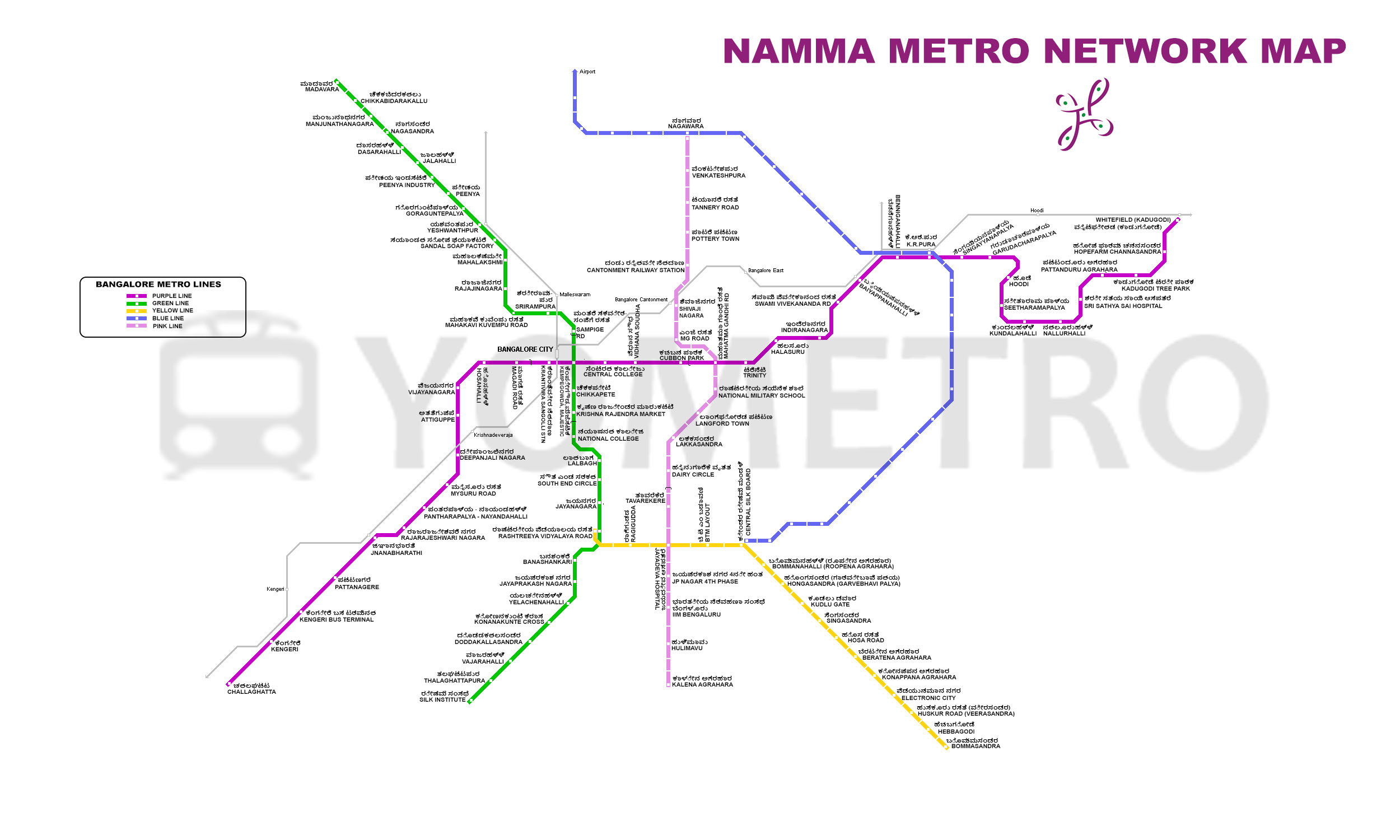
If you work at Infosys, Wipro, or any of the hundreds of firms in E-City, your commute is likely the worst part of your day. The Yellow Line fixes this. It features 16 stations:
- RV Road (Interchange with Green Line)
- Ragigudda
- Jayadeva Hospital (Interchange with Pink Line)
- BTM Layout
- Central Silk Board (Interchange with Blue Line)
- Bommanahalli
- Hongasandra
- Kudlu Gate
- Singasandra
- Hosa Road
- Beratena Agrahara
- Electronic City
- Infosys Foundation Electronic City
- Huskur Road
- Hebbagodi
- Bommasandra
The Jayadeva Hospital station is particularly insane from an engineering perspective. It’s a multi-level interchange. You’ve got the underpass, the road, the Yellow Line, and the Pink Line all stacked up. It’s one of the most complex transit hubs in South India.
The Tech Under the Hood: Driverless Isn't Just a Gimmick
People hear "driverless" and get nervous. Or excited. Mostly nervous.
Basically, the yellow line metro bangalore uses GOA4 (Grade of Automation 4). This means the train can start, stop, operate doors, and handle emergencies without a human on board. However, don't expect it to be empty-fronted on day one. BMRCL will likely keep "loco pilots" or attendants in the cabin for the first year or so, just to keep passengers calm and handle any weird door-alignment issues.
The CBTC system is the brain. It allows trains to run closer together safely. On the old lines, you need a massive gap between trains. Here? The gap shrinks, which means more people moved per hour.
The coaches are also equipped with some pretty smart sensors. They can detect obstacles on the track and monitor the health of the undercarriage in real-time. It’s a massive jump from the older rolling stock we see on the Purple Line.
The Silk Board Situation
Silk Board is a meme for a reason. It’s where dreams go to die in a cloud of diesel exhaust. The Yellow Line station here is part of a massive "multi-modal" hub. They’ve built road flyovers specifically to bypass the junction, integrated directly with the metro structure.
This is the "Blue-Yellow" connection. Eventually, the Blue Line will head toward the Airport from here. Once that's live, you could theoretically go from Electronic City to Kempegowda International Airport with just one change. That’s a game-changer for business travelers who currently spend three hours in a taxi just to catch a domestic flight.
Addressing the Skepticism
Is it late? Yes. Way late.
The original deadlines were missed due to a mix of COVID-19 delays, land acquisition hurdles at certain pockets, and the complex process of "Indigenization." The central government's "Make in India" mandate meant BMRCL couldn't just buy everything from overseas. Titagarh had to set up the line to build these stainless-steel coaches locally.
While it’s easy to be frustrated, the shift to domestic manufacturing means spare parts will be easier to get in 2030. We won't be waiting for a shipping container from Shanghai every time a door sensor fails.
Also, let’s talk about the "last mile" problem. Even with the Yellow Line, getting from the station to your specific office gate in E-City Phase 1 or 2 can be a trek. The ELCITA (Electronic City Town Authority) is working on feeder buses and cycle tracks, but it’s still a work in progress. You’ve got to plan for that 10-minute walk in the Bangalore sun.
Cost and Connectivity
The project cost for the Yellow Line is roughly ₹798 crore for the rolling stock alone. That’s a lot of taxpayer money. But the projected ridership is nearly 3.7 lakh people per day. If those numbers hold, the reduction in carbon emissions and fuel consumption is staggering.
One thing people overlook is the RV Road interchange. This allows people living in Jayanagar, Banashankari, and even as far south as Anjanapura to reach the tech corridor without ever hitting the outer ring road. It stitches the old residential Bangalore to the new commercial Bangalore.
What to Expect on Your First Ride
When you finally step onto a Yellow Line train, the first thing you’ll notice is the interior. It’s wider. The lighting is adaptive. The "Passenger Information Systems" (PIS) are more high-def than the grainy LEDs on the older trains.
There are also specific safety features like front-facing cameras that feed directly back to the Operation Control Centre (OCC) in Baiyappanahalli.
Actionable Steps for Commuters
Stop waiting for the "official" launch to plan your life. If you’re looking to move house or change jobs, here is how you should play it:
- Check the feeder routes now: Look at the Hebbagodi and Bommasandra stations. These are becoming major hubs. Property prices there are already spiking, but there's still a window before the "Metro Effect" fully kicks in.
- Get the National Common Mobility Card (NCMC): Don't wait in line for tokens. The Yellow Line is built for the NCMC. It works across buses and other metro lines.
- Watch the Jayadeva interchange: If your commute involves the Green Line, familiarize yourself with the RV Road layout. It’s a bit of a walk between platforms, so factor in an extra 5 minutes for the transfer.
- Monitor BMRCL's "X" (Twitter) feed: They post the most accurate updates on trial runs. If you see "Integrated Testing" announcements, you know the CRS inspection is only a few months away.
The Yellow Line isn't just a set of tracks. It’s the end of the "Silk Board Trap." It’s the modernization of the city's most congested artery. While the delays have been painful, the technical specs of this line suggest it will be the most reliable piece of infrastructure Bangalore has seen in decades.
Stay patient. The yellow trains are coming, and they don't even need a driver to find their way.