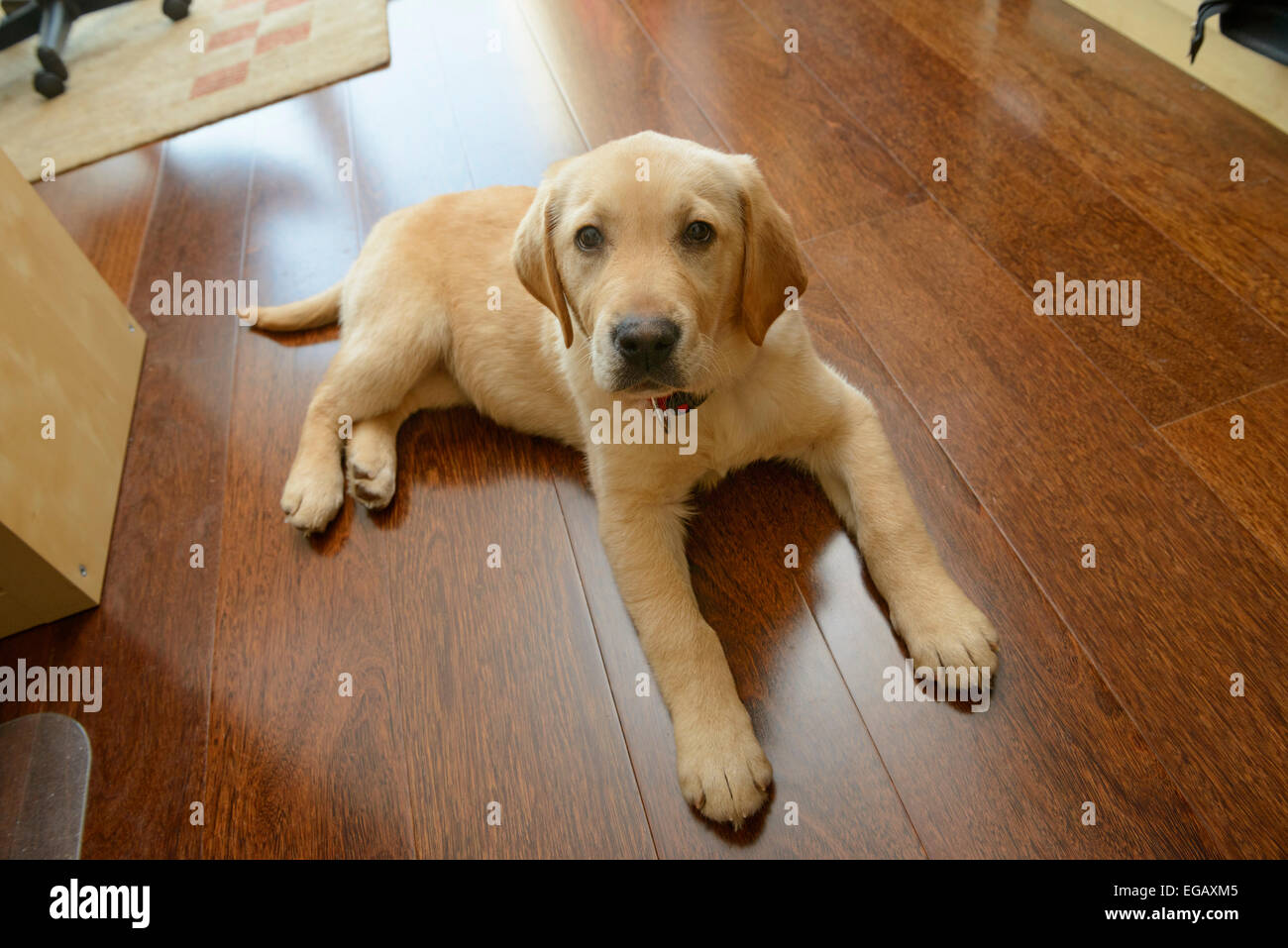
If you’re standing at a dog park and see a blur of yellow fur barreling toward a tennis ball, there’s a 50/50 chance you’ll guess the breed wrong. Most people just see "big blonde dog" and call it a day. But honestly, a yellow lab and golden retriever are about as similar as a rugged Jeep and a luxury SUV. Sure, they both get you where you're going, but the vibe is totally different.
I’ve spent years around both. One will try to eat your drywall if he’s bored for twenty minutes; the other will stare into your soul until you acknowledge his emotional complexity. It’s not just about the hair length. It’s about how they think, how they work, and exactly how much vacuuming you’re willing to do for the next decade.
The Coat is Just the Beginning
Let's talk about the obvious stuff first. Golden Retrievers are famous for that flowing, majestic mane. It’s beautiful. It’s also a magnet for every burr, twig, and mud puddle in a three-mile radius. A yellow lab and golden retriever handle the elements differently. The Lab has this dense, almost oily "double coat" that’s basically a wetsuit. Water rolls right off them. If a Lab jumps in a lake, they’re dry-ish after one good shake that sprays everyone in the vicinity.
Goldens? They stay wet. For hours.
They have that longer "feathering" on their legs and tail. It looks great in photos, but it’s a high-maintenance situation. You have to brush a Golden. If you don't, they turn into one giant walking mat. Labs shed just as much—maybe even more, weirdly enough—but their hair is short and prickly. It weaves itself into the fabric of your car seats like little needles. You don't brush a Lab to prevent mats; you brush them to prevent your house from becoming a literal carpet of tan fur.
Head Shape and the "Soft" Expression
If you look at their faces, the difference is huge. Labs have a broader skull and a very pronounced "stop"—that's the bridge where the forehead meets the nose. They look sturdy. Practical.
Goldens have a softer, more tapered look. Their eyes are usually slightly almond-shaped, giving them that "I love you more than life itself" expression that makes it impossible to be mad when they steal a loaf of bread off the counter. According to the American Kennel Club (AKC) breed standards, the Golden is supposed to have a "kindly" expression. The Lab? They just look ready for a job. Or a snack. Mostly a snack.
Energy Levels: The Sprinter vs. The Marathoner
People think both these dogs are "chill" because they’re popular family pets. That is a massive lie.
A young yellow lab and golden retriever are both high-octane athletes, but the type of energy is different. Labs are explosive. They are the frat brothers of the dog world. They play hard, they hit hard, and they have zero concept of personal space. If a Lab is happy to see you, they might accidentally tackle you.
Goldens are generally a bit more mellow in their approach. They’re still active—they need a good hour of exercise a day—but they have a "throttle." A Lab often has two speeds: Mach 5 and Snoring.
"The Labrador is a retriever of all trades. They were bred to jump out of boats into freezing North Atlantic water to pull in fishing nets. That requires a certain level of physical hardiness and, frankly, a bit of 'reckless' bravery that you don't always see in the more sensitive Golden." — Insight from field trial trainers.
Brains and Training: Who’s Smarter?
Stanley Coren, a renowned canine psychologist, famously ranked the Golden Retriever as the 4th smartest dog for working intelligence. The Lab came in 7th. In reality? That 3-spot difference doesn't mean much in your living room, but the way they learn is fascinating.
A Golden Retriever wants to please you. They are sensitive to your tone of voice. If you yell at a Golden, they might shut down or pout. They want to be "good."
A Lab wants the ball. Or the cookie. They are incredibly food-motivated. You can train a Lab to do almost anything if you have a piece of high-quality kibble, but they’re also more likely to "calculate" the risk. They'll look at you, look at the treat, and decide if the command is worth the effort.
Labs are "mouthy." They explore the world with their teeth. If you have a Lab puppy, your hands will look like you’ve been playing with a bag of razor blades for three months. Goldens have "soft mouths"—bred to carry delicate game birds without bruising the meat—so while they still chew, they tend to be a little gentler about it.
Health Realities You Can't Ignore
This is the part that sucks to talk about, but you have to know it. Both breeds have a rough go when it comes to certain genetic issues.
- Cancer: This is the big one for Goldens. Studies, including the long-term Golden Retriever Lifetime Study by the Morris Animal Foundation, have shown that over 60% of Goldens may die from some form of cancer, specifically hemangiosarcoma or lymphoma. It's heartbreaking.
- Joints: Both breeds are prone to hip and elbow dysplasia. Because they’re both prone to obesity (they will eat until they pop if you let them), the extra weight puts massive strain on their joints.
- Bloat: Technically known as Gastric Dilatation-Volvulus (GDV). Their deep chests make them candidates for this life-threatening condition where the stomach flips.
- Exercise Induced Collapse (EIC): This is more common in Labs. They’ll be sprinting, and suddenly their back legs just give out. It’s a genetic thing you can test for.
Which One Actually Fits Your Life?
Choosing between a yellow lab and golden retriever comes down to your lifestyle, not just which one looks cuter in a bandana.
If you’re a runner, a hiker, or someone who spends every weekend at the lake, get the Lab. They are built for the grind. They are tougher, more weather-resistant, and generally more "up for anything." They’re the ultimate adventure partners.
If you want a dog that’s going to follow you from room to room and rest its head on your knee while you watch Netflix, the Golden is your soulmate. They are "velcro dogs." They don't just want to be near you; they want to be touching you. They are also generally better suited for therapy work because they’re so tuned in to human emotion.
Cost of Ownership
Don't forget the "hidden" costs.
- Grooming: You'll spend way more on a Golden. Unless you’re doing it yourself, professional grooming for a long-haired 70-pound dog isn't cheap.
- Food: Both eat a lot. A lot.
- Insurance: Get it early. Because of the cancer risks in Goldens and the "I ate a sock" risks in Labs, vet bills can hit $5,000 before you even realize what happened.
What Most People Get Wrong
People think Labs are the "easier" version. They aren't. A bored Lab is a destructive force of nature. They have a longer puppyhood than almost any other breed. A Lab isn't "grown up" until they’re about three years old. Until then, they are basically a toddler on methamphetamines.
Goldens are often portrayed as "perfect" dogs in movies (thanks, Air Bud). But they can be prone to separation anxiety. Because they love people so much, being left alone for 10 hours a day while you work can be torture for them. They’ll bark, they’ll chew the door frames, and they’ll get depressed.
How to Tell Them Apart in the Wild
Still confused? Look at the tail.
A Lab has what’s called an "otter tail." It’s thick at the base, round, and covered in short, dense hair. It acts like a rudder when they swim. If they wag it against your shin, it’s going to leave a bruise.
A Golden has a "plume." It’s feathery and fans out. It’s soft. It’s pretty. It also knocks over every coffee cup on your side table with the grace of a windshield wiper.
Actionable Steps for Potential Owners
- Check the Pedigree: If you're buying a puppy, ask for OFA (Orthopedic Foundation for Animals) clearances for the parents' hips, elbows, and hearts. If the breeder doesn't have them, walk away.
- Invest in a Vacuum: Buy a Dyson or a Miele. Don't go cheap. You’re going to be using it every single day.
- Mental Stimulation: Buy food puzzles. Both breeds are smart and food-driven. Making them "work" for their dinner for 20 minutes is more exhausting than a 2-mile walk.
- Training starts Day 1: Don't wait until they weigh 70 pounds to teach them not to jump. A 15-pound puppy jumping is cute; a 70-pound Lab jumping is a liability.
- Weight Management: Keep them lean. You should be able to feel their ribs easily. If they lose their "waist," they’re overweight, and you’re cutting years off their life.



