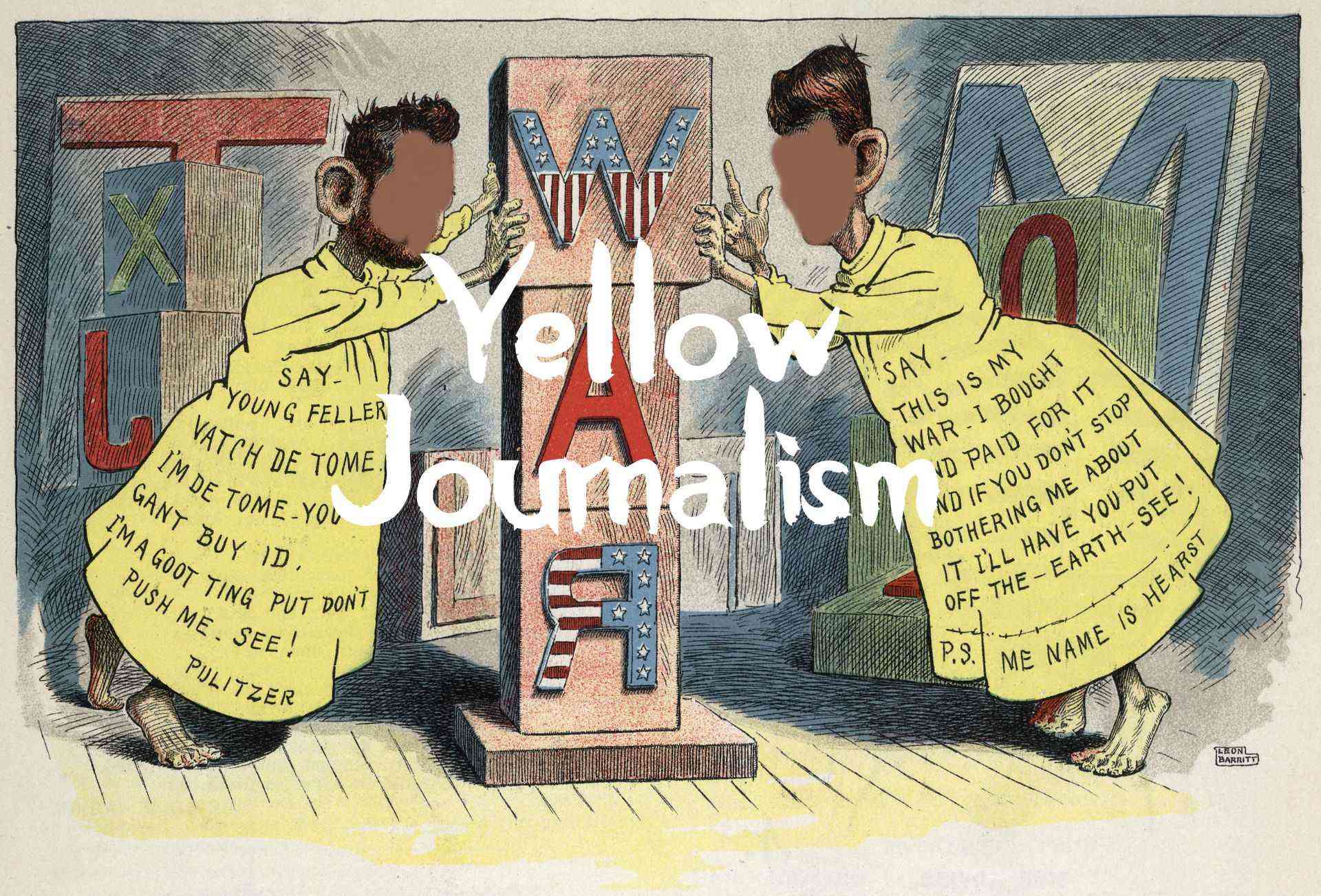
You've probably seen a headline this morning that made your blood boil or your jaw drop. It was likely a bit of "clickbait," designed specifically to hijack your dopamine receptors and get that precious ad-revenue-generating tap. We think this is a new problem, a digital-age curse brought on by social media algorithms and the death of local papers. It isn't. Not even close. If you want to find the real origin of our messy media landscape, you have to look back to the 1890s and the fierce, dirty, and incredibly entertaining war between two guys named Joseph Pulitzer and William Randolph Hearst.
Basically, the yellow journalism definition isn't just "fake news." It is a specific brand of reporting that prioritizes sensationalism over facts, using lurid headlines, scandalous illustrations, and a healthy dose of pure fiction to sell papers. It was news as entertainment. It was loud. It was messy. And honestly, it changed the world—mostly by helping start a war.
What People Get Wrong About the Definition of Yellow Journalism
Most people think "yellow" refers to the color of the paper or maybe cowardice. Nope. The term actually comes from a cartoon character. A weird, bald kid in a yellow nightshirt known as "The Yellow Kid," who appeared in the New York World. When Hearst poached the artist, Richard F. Outcault, to draw the character for his rival paper, the New York Journal, Pulitzer just hired someone else to draw a different version of the same kid.
The two papers were so obsessed with out-shouting each other using this cartoon as a mascot that critics started calling their style "yellow-kid journalism." Eventually, that shortened to just yellow journalism.
It’s about the "wow" factor. If a story about a murder was boring, yellow journalists made it a "fiendish slaying" with a hand-drawn map of the blood spatters. If there wasn't a war happening, they’d try their best to invent one. They didn't care about the high-minded ethics of the "gray lady" establishment. They cared about the immigrant worker on the subway who had a nickel to spend and wanted to be distracted from their grueling day.
The Hearst vs. Pulitzer Deathmatch
Joseph Pulitzer was an immigrant who actually wanted to help the underdog. He used his New York World to expose corruption, but he realized that to get people to read the serious stuff, you had to wrap it in a layer of scandal. He was the pioneer. Then came William Randolph Hearst. Hearst was the son of a mining tycoon with deep pockets and zero chill. He bought the New York Journal and decided he didn't just want to compete with Pulitzer; he wanted to bury him.
Hearst started a talent war. He offered Pulitzer’s best editors and writers double their salaries to jump ship. Pulitzer would match the offer. Hearst would go higher. It was a race to the bottom in terms of ethics but a rocket ship in terms of circulation. They invented the Sunday "funny pages." They popularized the massive, screaming headlines we still see on tabloids at the grocery store checkout.
The Maine, the Myths, and the Spanish-American War
If you want to see yellow journalism in its most dangerous form, look at 1898. Cuba was revolting against Spanish rule. Hearst saw this as the ultimate story. He sent artists and reporters to Havana to find atrocities. When the artist Frederic Remington reportedly told Hearst there was no war to be found, Hearst famously (and perhaps apocryphally) replied, "You furnish the pictures, and I'll furnish the war."
Then the USS Maine exploded in Havana Harbor.
Modern forensic investigations suggest it was likely an internal coal bunker fire. But to the yellow press? It was a Spanish mine. They printed diagrams showing where the "secret torpedo" hit. They called for blood. They whipped the American public into such a frenzy that President McKinley basically had no choice but to go to war. This is the ultimate peak of the yellow journalism definition: when the pursuit of profit and readership dictates national foreign policy.
It wasn't just about being wrong. It was about being loudly wrong for the sake of selling more copies than the guy across the street.
Elements of the Style
You can spot this stuff a mile away once you know what to look for. It’s not subtle.
- Huge, Bleeding Headlines: Sometimes they took up half the front page for stories that weren't even that important.
- Fake Interviews: They’d quote "unnamed sources" or just flat-out invent a person to say what they wanted.
- Pseudo-Science: Early yellow papers loved stories about aliens on the moon or "doctors" claiming a specific diet could make you live to 150.
- Sympathy for the Underdog: This is the part people forget. They often campaigned for better housing and workers' rights, but they did it through sensationalized "sob stories."
Why This Isn't Just a History Lesson
Look at your phone. That notification you just got about a celebrity divorce or a "shocking" political gaffe? That's the ghost of Hearst and Pulitzer. The business model of the internet—The Attention Economy—is just yellow journalism with a better UI.
In the 1890s, the metric was "circulation." Today, it's "engagement."
When a news outlet uses an "outrageous" headline to get you to click, they are using the exact same psychological triggers that the New York Journal used in 1896. They want you angry, scared, or shocked. Those emotions lead to action (clicks/purchases). Neutral, balanced reporting is historically a very bad way to make a lot of money quickly.
The tragedy is that yellow journalism eventually forced a reaction. The "Objectivity" movement of the early 20th century, led by the New York Times, was a direct response to the chaos of the yellow era. We are currently living through a second wave of "yellow" media because the old guard’s gatekeeping power has dissolved.
Does it have to be bad?
Believe it or not, Pulitzer eventually felt bad about his role in the madness. He ended up endowing the Pulitzer Prize to encourage the kind of high-quality, investigative journalism he had occasionally abandoned in the heat of his war with Hearst. He wanted to clean his legacy. He realized that while sensationalism builds an empire, it destroys a society’s ability to agree on what is real.
Hearst, on the other hand, just kept going. He built San Simeon (Hearst Castle) and remained a media mogul until the end, providing the inspiration for Citizen Kane.
The yellow journalism definition isn't just a term for a museum exhibit. It’s a warning. It’s what happens when the "business" of news completely swallows the "service" of news.
How to Protect Your Brain from Modern Yellow Journalism
You can't stop the sensationalism, but you can change how you consume it. Knowing the history of Hearst and Pulitzer gives you a "crap detector." When you see a story that feels too perfectly outrageous to be true, it probably is.
Verify the source of the "Outrage" Before you share that "insane" story, check if the headline matches the content. Yellow journalists love "bait and switch." The headline screams one thing; the third paragraph admits there's no evidence for it.
Look for the "Second Day" story In the 1890s, the first reports of the Maine sinking were 100% wrong. By the second or third day, more sober facts started to leak out. If a story is breaking right now, wait 24 hours. The truth usually catches up once the "yellow" dust settles.
Diversify your feed Hearst and Pulitzer succeeded because they were the only game in town for many people. Today, you have the world at your fingertips. If your entire news intake comes from one social media algorithm, you are living in Hearst’s dream. Break the bubble. Read a source that makes you uncomfortable or bored. Boredom is often a sign of factual, nuanced reporting.
The battle for your attention is never going to end. The tools have changed from ink-stained newsprint to pixels, but the game is identical. Understanding the yellow journalism definition is the first step in making sure you aren't just another nickel in someone else's pocket.
Actionable Next Steps
- Audit your news diet: Spend five minutes looking at the last three news articles you clicked on. Were they informative, or did they just make you angry?
- Support "Slow" Journalism: Consider subscribing to at least one publication that prioritizes long-form, fact-checked reporting over breaking "scoops."
- Cross-Reference: When a major "scandal" breaks, check a primary source—like a full transcript or a government document—rather than relying on a summary from a sensationalist outlet.