History isn't always written by the victors. Sometimes, it’s written by two guys in New York City who really, really wanted to sell more papers than each other. Most of us heard about yellow journalism and the Spanish-American War in a high school history class, usually tucked between a chapter on the Gilded Age and the Panama Canal. The story goes that Joseph Pulitzer and William Randolph Hearst basically lied the United States into a war just to boost their circulation numbers.
It’s a great story. It's also mostly wrong.
Don't get me wrong—these guys were definitely unethical. They were pioneers of the "fake news" we complain about today. They exaggerated. They sensationalized. They used bright yellow ink and screaming headlines to grab attention. But if you think a couple of newspaper moguls had the power to force President William McKinley to send troops to Cuba all by themselves, you're missing the bigger picture. The reality is way more complicated, involving a genuine humanitarian crisis, a mysterious explosion, and a country that was already itching to flex its muscles on the world stage.
The Battle of the New York Giants
In the late 1890s, the New York City media market was a total circus. Joseph Pulitzer owned the New York World. He was a Hungarian immigrant who had revolutionized the industry by focusing on human interest stories, scandal, and crusades against corruption. Then came William Randolph Hearst. Hearst was a wealthy Californian who bought the New York Journal specifically to take Pulitzer down.
Hearst didn't just want to compete; he wanted to dominate. He hired away Pulitzer’s best writers and illustrators by offering them insane salaries. The competition became so fierce that they stopped caring about whether a story was true. They only cared if it was "splashy." This style became known as yellow journalism, named after a popular comic strip character called the Yellow Kid that both papers fought over.
Why Cuba Was the Perfect Target
Cuba was a Spanish colony at the time, and the Cuban people were fighting a brutal war for independence. This was a gift to Hearst and Pulitzer. It had everything: a "villain" (the Spanish Empire), a "victim" (the brave Cuban rebels), and proximity to the United States.
The papers sent reporters to Havana to find stories of Spanish cruelty. When they couldn't find enough, they basically made them up. They wrote about Spanish soldiers searching American women or starving Cuban children. Honestly, the conditions in Cuba were actually terrible. The Spanish "reconcentration" policy led to the deaths of hundreds of thousands of civilians. But the yellow journalism approach wasn't about reporting the tragedy; it was about turning it into a melodrama for profit.
That Famous Telegram That Might Be a Myth
You’ve probably heard the quote. Artist Frederic Remington was in Cuba for Hearst, and he allegedly complained that there was no war to draw. Hearst supposedly replied: "You furnish the pictures and I'll furnish the war."
It’s the ultimate proof of Hearst’s ego, right? Except there is zero evidence he ever actually said it. Historian W. Joseph Campbell has spent a lot of time debunking this myth. It first appeared in a memoir by a journalist named James Creelman years later, and it just doesn't fit the timeline. But it survives because it perfectly captures what people think yellow journalism and the Spanish-American War was all about. It feels true, even if it’s probably not.
The USS Maine: The Match That Lit the Fuse
On February 15, 1898, the USS Maine exploded in Havana Harbor. 266 American sailors died.
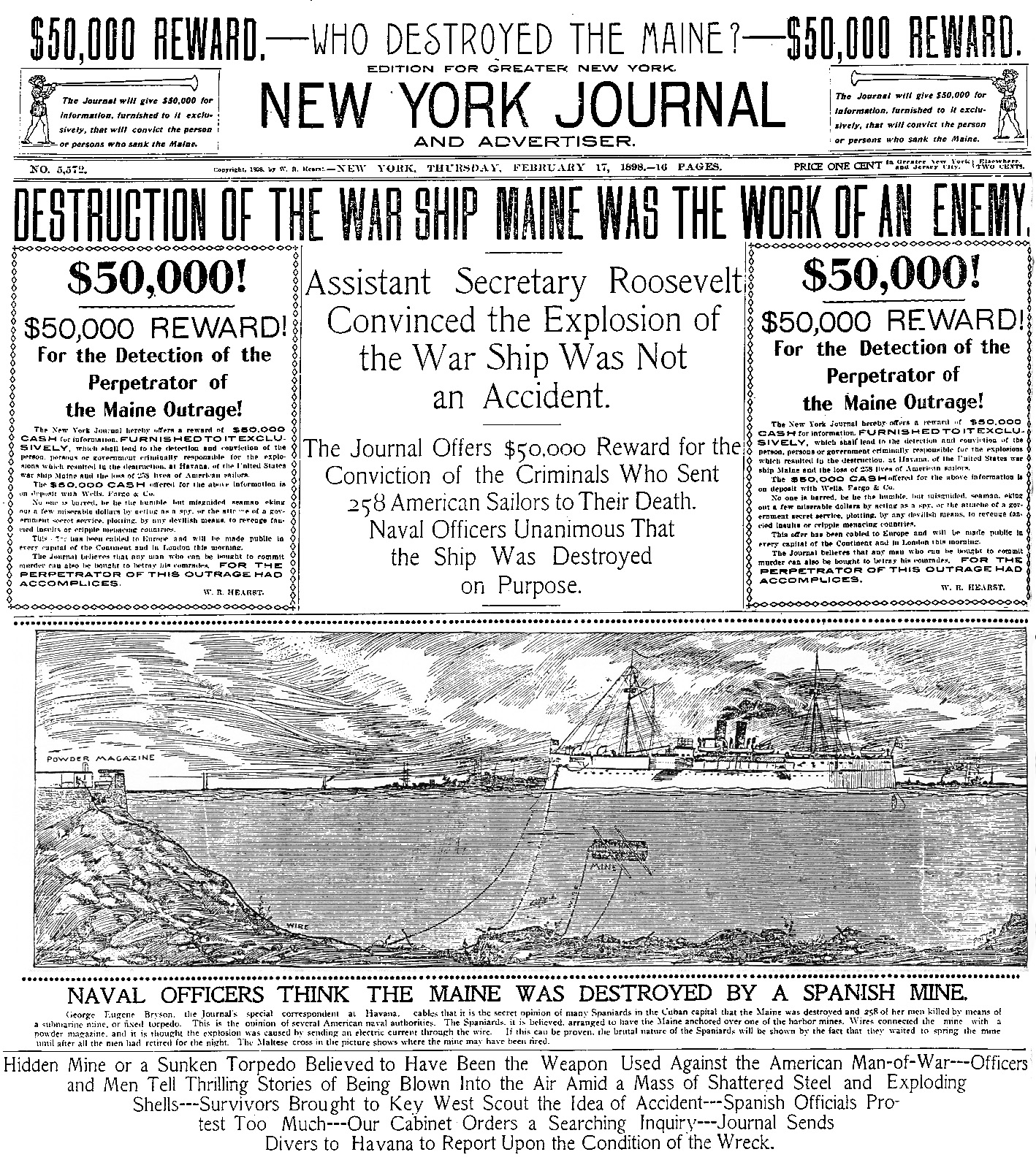
This was the moment Hearst and Pulitzer had been waiting for. Before an investigation could even begin, the New York Journal ran a headline: "THE WARSHIP MAINE WAS SPLIT IN TWO BY AN ENEMY'S INFERNAL MACHINE." They offered a $50,000 reward for the "detection of the perpetrator."
They didn't have proof. They just knew that "Spain did it" was a better headline than "We aren't sure what happened yet."
The public went wild. "Remember the Maine, to Hell with Spain!" became a national chant. While President McKinley tried to keep a cool head, the pressure from the press and the public—fueled by these daily doses of outrage—became unbearable. It’s important to realize that people back then didn't have social media or TV. The newspaper was their only window into the world. If Hearst said there was a mine under the ship, people believed him.
Later investigations, including one in 1976 led by Admiral Hyman Rickover, suggested the explosion was likely an internal accident caused by a coal bunker fire. But in 1898, the truth didn't matter. The yellow journalism machine had already decided it was war.
Beyond the Headlines: Was It Really the Press?
If we blame the war entirely on the newspapers, we’re letting the politicians off the hook. McKinley wasn't a pawn. He was a savvy politician who was being pushed by "Jingoists" like Theodore Roosevelt. These were people who believed that America needed a war to prove its strength and unite the country after the Civil War.
Business interests also played a role. American investors had millions of dollars tied up in Cuban sugar and tobacco. They wanted stability. If the Spanish couldn't provide it, maybe the U.S. military could.
The press provided the "moral" justification. By framing the conflict as a crusade to liberate the Cuban people from Spanish tyranny, they made intervention look like a noble cause rather than an imperialist land grab. This is where yellow journalism and the Spanish-American War intersect most dangerously: when propaganda aligns with political and economic goals.
The Impact of "The Yellow Kid"
Wait, why "Yellow"?
It sounds like it means "cowardly," but it actually refers to the ink. At the time, color printing was new and expensive. The New York World ran a comic strip called Hogan’s Alley, featuring a bald kid in a giant yellow nightshirt. He was a symbol of the working-class tenements. When Hearst stole the artist (Richard F. Outcault) to his paper, Pulitzer just hired a new artist to draw the same kid.
The battle over the "Yellow Kid" became a shorthand for the entire style of sensationalist, low-brow reporting. Critics started calling it yellow journalism. It was a slur, basically. It meant "that trashy stuff the masses read."
How the War Changed Journalism Forever
The war itself was short. It lasted about ten weeks. The U.S. crushed the Spanish fleet, took control of the Philippines, Guam, and Puerto Rico, and "liberated" Cuba.
But for the newspaper industry, things would never be the same. Hearst and Pulitzer had shown that you could manufacture a national mood. They showed that emotion sells better than facts. We see the direct descendants of this today in "clickbait" headlines and polarized cable news.
However, there was a backlash. People started to realize they had been played. This led to a movement toward "objective" journalism in the early 20th century. Figures like Adolph Ochs, who bought The New York Times in 1896, leaned into the opposite direction. His slogan, "All the News That's Fit to Print," was a direct middle finger to the yellow journalists. He wanted to prove that you could be successful by being boring and factual.
Nuance: Was Yellow Journalism All Bad?
Surprisingly, no. While the fake news part was terrible, yellow journalism did some good things.
- It made news accessible to the masses and immigrants who were still learning English.
- It used large illustrations and simple language.
- It championed the "little guy" against big corporations (when it suited the owners).
- It pushed for civic improvements in New York City.
The problem wasn't the style; it was the lack of accountability. When Hearst and Pulitzer realized they could influence foreign policy, they crossed a line from being news providers to being power brokers.
Spotting Modern-Day Yellow Journalism
You might think we're smarter now, but the tactics haven't changed much. The medium shifted from newsprint to pixels, but the psychology is identical.
- Emotional Triggers: If a headline makes you feel immediate rage or fear, it's probably a modern form of yellow journalism.
- Oversimplification: Look for "Good vs. Evil" narratives. Real geopolitical conflicts are messy and involve many shades of gray.
- Lack of Attribution: If an article uses phrases like "people are saying" or "many believe" without naming names, be skeptical.
- Visual Manipulation: Today, this includes doctored images, out-of-context video clips, or "deepfakes."
The Spanish-American War teaches us that the media doesn't just reflect public opinion; it can actively create it. And once that momentum starts, even the President of the United States can find it hard to stop.
Actionable Steps for Navigating Media Today
The best way to honor the history of yellow journalism and the Spanish-American War is to make sure you don't fall for the same tricks today.
- Verify the Source: Before sharing a shocking story about a conflict, check if it’s being reported by multiple outlets with different political leanings.
- Read Past the Headline: Hearst was a master of the "screamer" headline that didn't match the actual story. Most people today still only read the headline before sharing.
- Look for the "Cui Bono": That’s Latin for "who benefits?" Who wins if this story is true? In 1898, it was Hearst and Pulitzer. Today, it might be a political party, a tech billionaire, or a foreign government.
- Support Fact-Based Media: If we only click on sensationalism, that’s all we’ll get. Just like Pulitzer and Hearst, modern algorithms give us exactly what we "vote" for with our attention.
The Spanish-American War was a turning point for the U.S. as a global power, but it was also a warning about the power of the press. We like to think of ourselves as independent thinkers, but history shows that under the right pressure—and with enough yellow ink—even a peaceful nation can be nudged into a fight it wasn't looking for.
Understand the tactics. Check the facts. Don't let the headlines furnish your wars for you.