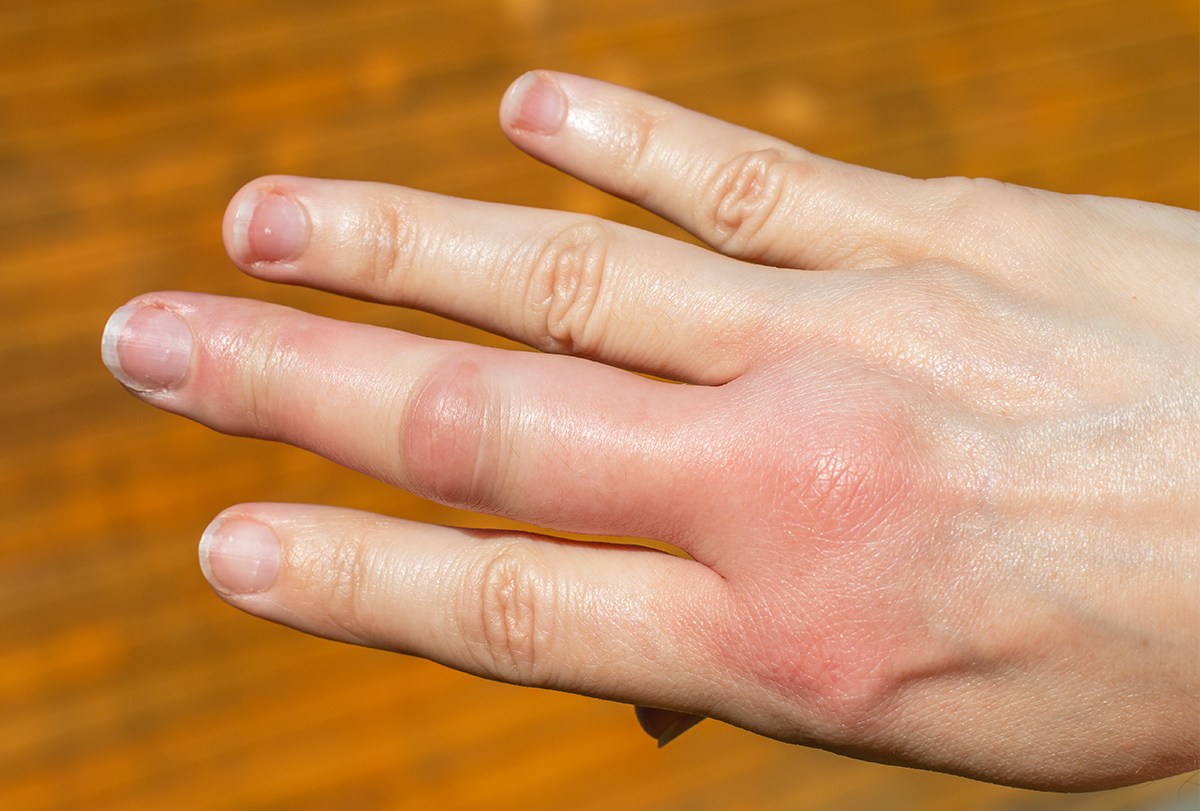
It happens in a flash. You’re mowing the lawn or maybe just sipping a soda on the porch, and suddenly, a sharp, hot needle-poke sensation radiates through your arm. You look down and see that signature yellow-and-black abdomen darting away. Within minutes, the area starts to puff up. Most people panic a little when they see yellow jacket sting swelling getting bigger by the hour, but honestly, what’s happening under your skin is a pretty fascinating—albeit painful—biological war zone.
Yellow jackets (Vespula and Dolichovespula) aren't just bees with a bad attitude. They’re predatory wasps. Unlike honeybees, which have barbed stingers that get ripped out (killing the bee), yellow jackets have smooth lancets. They can stab you, pull out, and stab you again like a tiny, angry sewing machine.
Why the swelling feels so aggressive
The swelling isn't just "the sting." It’s an inflammatory cascade triggered by a cocktail of proteins and enzymes. When that stinger pierces your epidermis, it injects venom containing phospholipase, hyaluronidase, and a particularly nasty peptide called mastoparan.
Mastoparan is the real culprit for that initial "throb." It causes your mast cells to degranulate, dumping a massive amount of histamine into the local tissue. Histamine makes your blood vessels leak. Fluid rushes into the space between your cells, and suddenly, your forearm looks like a Popeye cartoon. It’s localized edema.
Most people expect the swelling to peak immediately. It doesn't. Typically, yellow jacket sting swelling reaches its "impressive" maximum about 48 hours after the event. If you wake up on day two and the area is larger than it was on day one, don't immediately assume you have a flesh-eating bacteria. It’s usually just the peak of the delayed-type hypersensitivity reaction.
The "Large Local" vs. Systemic debate
There is a huge difference between a normal reaction and what doctors call a Large Local Reaction (LLR). About 10% of people will experience swelling that crosses a joint. If you get stung on the finger and your entire hand up to the wrist swells like a surgical glove filled with water, that’s an LLR.
It’s scary. It’s uncomfortable. But it isn't necessarily anaphylaxis.
Anaphylaxis is systemic. You’ll know the difference because your throat will tighten, you’ll get hives in places you weren't even stung, or you’ll feel a sudden, terrifying drop in blood pressure. Dr. David Golden, a leading allergist at Johns Hopkins, has noted in several studies that while Large Local Reactions are miserable, they only carry about a 5% to 10% risk of a future systemic reaction. You’re likely fine, just swollen.
Treating the puffiness: Beyond the baking soda paste
You’ve probably heard the old wives' tale about putting a penny on a sting or slathering it in tobacco juice. Please, don't. You’re just begging for a secondary skin infection.
The most effective way to manage yellow jacket sting swelling is actually quite boring: cold and elevation.
- Ice is your best friend. Constricting those blood vessels slows down the spread of venom and prevents more fluid from leaking out. 20 minutes on, 20 minutes off.
- Antihistamines are non-negotiable. Take a second-generation H1 blocker like cetirizine (Zyrtec) or fexofenadine (Allegra). They don't make you as drowsy as Benadryl but still help stabilize those leaky vessels.
- Elevation matters more than you think. If the sting is on your leg, and you spend all day walking around, gravity is going to pull that fluid down. Your ankle will look like a tree trunk. Keep the site above the level of your heart.
Some people swear by hydrocortisone cream. It helps with the itch, sure, but it rarely penetrates deep enough to stop the deep-tissue swelling of a yellow jacket hit. If the swelling is truly massive, a doctor might prescribe a short course of oral steroids like prednisone. That’s the "big gun" for when you can’t close your hand or see out of an eye.
When should you actually worry about infection?
This is where it gets tricky. Cellulitis (a bacterial skin infection) and a bad sting reaction look almost identical. Both are red, hot, swollen, and painful.
However, true infection rarely sets in within the first 24 hours. If the redness is spreading rapidly 3 or 4 days after the sting, and you start running a fever, that’s when you call the clinic. If the redness has red "streaks" coming off it toward your heart, stop reading this and go to Urgent Care. That’s lymphangitis.
Yellow jackets are scavengers. They hang out in trash cans and crawl over rotting protein. Their stingers aren't sterile. While the venom itself is somewhat bactericidal, the act of scratching the itch with dirty fingernails is usually how the infection actually starts. Stop scratching. Use a topical anesthetic like lidocaine or an oatmeal bath if you have to, but don't break the skin.
The weird psychology of the yellow jacket
Yellow jackets are most aggressive in late summer and early fall. Why? Because their food sources are drying up. The queen has stopped laying as many eggs, so the workers don't have to hunt for protein (insects) to feed larvae anymore. Instead, they’re out looking for sugar to sustain themselves.
This is why they’re all over your lemonade and your fruit salad. They’re hungry, they’re cranky, and they’re protective.
If you stumble upon a nest—usually in the ground or in a wall void—they use a search-and-destroy tactic. They mark you with a chemical pheromone that tells every other wasp in the colony, "This guy. This guy right here." If you get hit once near a nest, run. Don't swat. Swatting just releases more alarm pheromones.
Moving forward: Your post-sting checklist
If you're currently staring at a red, throbbing lump, here is the realistic timeline of what to expect.
Day 1: Sharp pain, immediate redness, and a small wheal (the white bump in the center). Day 2: The "Spreading" phase. The area becomes firm (indurated) and the yellow jacket sting swelling expands. It will feel hot to the touch. Day 3: The Peak. This is usually the worst of it. The itch replaces the pain. Day 4-7: Slow resolution. The skin might look slightly bruised or wrinkled as the fluid recedes.
To speed this up and stay safe, take these specific steps:
- Remove jewelry immediately. If you got stung on the finger or wrist, get your rings and watch off now. If the swelling gets ahead of you, those items will act like a tourniquet and cut off circulation.
- Mark the perimeter. Take a sharpie and draw a circle around the edge of the redness. This is the only way to objectively tell if it's getting better or worse over the next 12 hours.
- Check your Tetanus status. It sounds overkill, but any puncture wound from an animal or insect that spends time in the dirt can technically carry tetanus. If you haven't had a booster in 10 years, it’s a good excuse to get one.
- Monitor your breathing. If you develop a cough, wheeze, or a "feeling of impending doom" (a legitimate medical symptom), use an EpiPen if you have one and call 911.
Yellow jacket stings are a rite of passage for anyone who spends time outdoors. While the swelling is dramatic and legitimately painful, in the vast majority of cases, it's just your immune system doing exactly what it was designed to do: reacting to an invader with everything it's got. Keep it cold, keep it high, and keep your hands off the itch.