You’re scrolling through yellow jacket nest pictures because you just saw something fuzzy and gray tucked under your porch eaves. Or maybe you noticed a steady stream of "bees" disappearing into a hole in your siding. Honestly, most people can’t tell the difference between a paper wasp home and a yellow jacket fortress until someone gets stung. It’s a high-stakes guessing game. Yellow jackets are notoriously cranky, and unlike honeybees, they don't die after one sting. They’re built for combat.
Identifying these nests correctly is basically the difference between a DIY weekend project and a frantic call to an exterminator at 9:00 PM on a Tuesday.
What those yellow jacket nest pictures are actually showing you
When you look at a photo of a yellow jacket nest, you’re usually looking at a paper-like structure made from chewed-up wood fibers mixed with saliva. It’s nature’s cardboard. But here’s the kicker: yellow jackets (the Vespula and Dolichovespula genera) aren't all the same.
Some are ground-dwellers. Others are aerial artists.
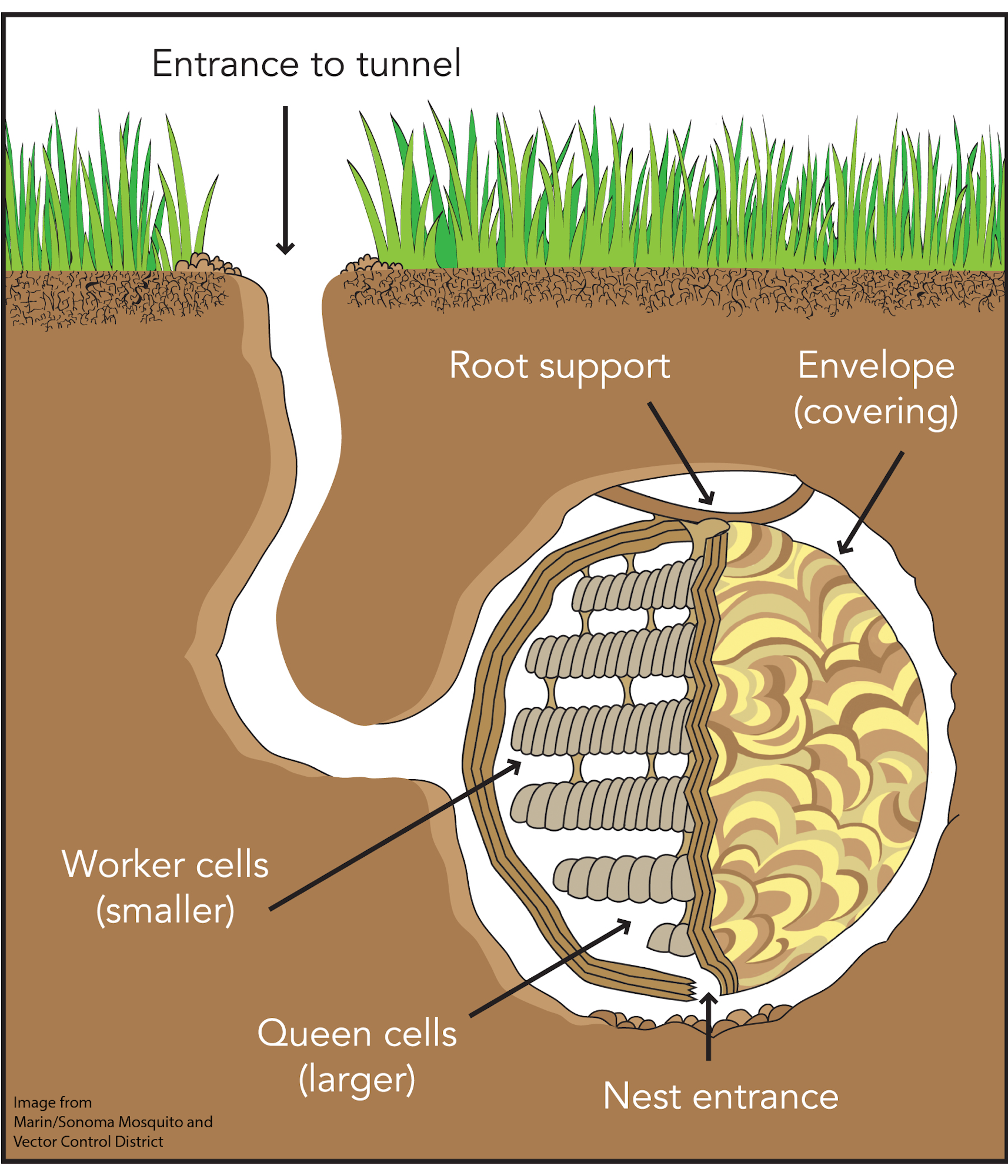
If you see a picture of a large, grey, teardrop-shaped football hanging from a tree limb, you might be looking at a bald-faced hornet nest. Guess what? Those are technically a type of yellow jacket. If the nest is tucked inside a wall cavity or underground, that’s your classic "Common Yellow Jacket" or "German Yellow Jacket." These subterranean homes are huge. They can hold thousands of workers. You might only see a small hole in the dirt, but underneath is a sprawling metropolis of hexagonal combs.
The Texture and Color Palette
Most yellow jacket nest pictures highlight a distinct "scalloped" look. It looks like overlapping layers of grey or brownish paper. If the nest looks like an open umbrella where you can see the individual cells, that’s not a yellow jacket. That’s a paper wasp. Yellow jackets almost always build an outer envelope to hide the "business end" of the nest. They like privacy. They like protection.
Why the location of the nest changes everything
Don't just look at the shape in the photo; look at where it is.
- Subterranean Nests: These are the most dangerous. You’re mowing the lawn, you hit a bump, and suddenly the ground explodes with angry insects. The entrance is often just a small, unassuming hole about the size of a nickel.
- Aerial Nests: These are usually built by the aerial yellow jacket (Dolichovespula arenaria). You’ll find them under eaves, in dense shrubs, or attached to the side of a shed.
- Structural Nests: This is a homeowner's nightmare. They find a gap in your brickwork or a loose piece of soffit. Once they’re in, they can actually chew through drywall.
There are documented cases where homeowners heard a "rustling" or "crinkling" sound in their bedroom wall. That’s the sound of thousands of insects expanding their home by scraping away your house. If you see a wet spot on your ceiling that wasn't there yesterday, and it’s not raining, check for yellow jackets. They use moisture to manipulate the building materials, and eventually, the ceiling can cave in. It’s rare, but it’s a total disaster when it happens.
Comparing yellow jackets to other "look-alikes"
It’s easy to get confused. You’ve got European hornets, mud daubers, and honeybees all competing for space.
- Mud Daubers: They build long, thin tubes out of actual mud. They aren't aggressive. If the picture looks like a bunch of organ pipes made of dirt, breathe a sigh of relief.
- Honeybees: They want cavities, but they produce wax, not paper. Their hives are golden and drippy. Yellow jacket nests are dry and grey.
- European Hornets: These are the giants. Their nests often have a brownish tint because they use different wood sources. They’re also active at night, which is creepy, frankly.
The seasonal lifecycle of a nest
A yellow jacket nest is a temporary empire. It starts in the spring with a single queen. She’s the survivor. She spent the winter shivering under some bark or in your attic insulation, and now she’s on a mission. She builds a tiny "starter" nest—about the size of a golf ball—and raises the first generation of workers.
By July, the workforce takes over. The queen just stays inside and cranks out eggs.
By September, the nest is at peak capacity. This is when they get "hangry." The natural food sources (caterpillars and nectar) start to dry up. They turn to your soda can or your ham sandwich. This is also when the nest produces new queens and males. The old queen dies, the nest falls into chaos, and by the first hard frost, almost everyone is dead.
The nest itself is usually not reused. If you find an old, dusty nest in your attic in February, it’s probably empty. But don't bet your life on it without checking carefully.
Real-world risks of DIY removal
I’ve seen too many people try the "trash bag" method. They think they can just slip a bag over an aerial nest, snip the branch, and walk away. It never works that way. Yellow jackets are faster than you. They will find the one gap in the bag or the one hole in your glove.
And for the love of everything, do not pour gasoline down a ground nest hole. It’s environmentally terrible, it’s a fire hazard, and it often doesn't even reach the main chamber. It just makes the survivors relocate—probably closer to your back door.
According to Dr. Justin Schmidt, the late entomologist who famously created the "Sting Pain Index," yellow jacket stings are a "hot and smoky" kind of pain. On a scale of 1 to 4, they usually land at a 2. That’s manageable if it’s one sting. If it’s fifty? That’s a medical emergency, even if you aren't allergic. Systemic toxic reactions can happen to anyone if the dose of venom is high enough.
What to do if you find a nest on your property
First, stop moving. If you’ve discovered a nest because you’re currently being swarmed, do not swat. Swatting releases pheromones that tell the other wasps, "Hey, this guy is an enemy, come help!" Run in a straight line toward a building or a car. Get inside. Do not jump into a pool; they will literally wait for you to surface for air.
If you’ve just found a nest and everyone is still calm, evaluate the distance. If the nest is 50 feet away in a woodshed you never use, honestly? Just leave it. They’re great at killing garden pests like flies and caterpillars. They are part of the ecosystem.
But if it’s under your deck or near the kids’ swing set, it has to go.
Professional vs. Retail Solutions
Store-bought "foaming" sprays can work for small, visible aerial nests. You have to do it at night. At night, the foragers are all home, and the colony is sluggish. You spray the entrance (the hole at the bottom) and soak the whole thing.
For ground nests or wall nests, call a pro. They have "dusting" equipment that pumps insecticide deep into the tunnels. They have the suits. They have the insurance.
Actionable steps for homeowners
- Inspect your perimeter in June: It’s much easier to kill a queen in a golf-ball-sized nest than a colony of 4,000 in August. Walk around your house and look for "heavy traffic" areas.
- Seal the gaps: Use caulk to seal entries into your home’s siding before the spring search begins. But never seal a hole if you already see wasps going in and out. You’ll just force them to find a way out inside your living room.
- Manage your trash: Keep lids tight. Yellow jackets love protein in the summer and sugar in the fall.
- Use a decoy (Maybe): Some people swear by those "fake" paper nests you can hang up. The theory is that yellow jackets are territorial and won't build near another "colony." The science is hit or miss, but it doesn't hurt to try as a deterrent.
- Check the ground before you mow: If you have patches of tall grass or areas with heavy leaf litter, poke them with a long stick (from a distance!) before running the mower over them.
If you’re looking at yellow jacket nest pictures and realizing yours looks exactly like the "danger" photos, step back. Keep pets and kids away. Decide if you’re brave enough to handle a midnight spray session or if you’d rather pay someone else to take the risk. Most pest control companies will give you a quote over the phone if you can describe the size and location accurately. Be smart. These things have been refining their defense mechanisms for millions of years. You’re just a person with a can of spray and a dream.



