You’re staring at a gray, papery blob under your eaves. It’s scary. Naturally, the first thing you do is whip out your phone and start scrolling through yellow jacket nest photos to figure out if you're about to get swarmed. Most people think they know what a "wasp nest" looks like, but yellow jackets are a different beast entirely. They aren't just your run-of-the-mill paper wasps. They are aggressive, unpredictable, and their homes are often architectural nightmares hidden in plain sight.
Identifying these nests isn't just about curiosity. It’s about safety. Honestly, if you misidentify a bald-faced hornet nest as a yellow jacket nest, or vice versa, you’re still in trouble—but the way you handle them changes.
What yellow jacket nest photos actually show you (and what they hide)
When you look at high-res images of these structures, you’ll notice a distinct, swirling "marbled" texture. That’s not just for aesthetics. Yellow jackets create their homes by chewing up wood fibers and mixing them with saliva to create a literal paper pulp. It’s gray, brittle, and surprisingly sturdy.
Most people expect to see the open, umbrella-shaped honeycombs.
Nope.
If you see the hexagonal cells exposed, you’re likely looking at a paper wasp nest, not a yellow jacket’s. Yellow jackets are "enclosed" builders. They wrap their entire colony in a thick, multi-layered paper envelope. There is usually only one small entry hole near the bottom. It looks like a dusty, gray football.
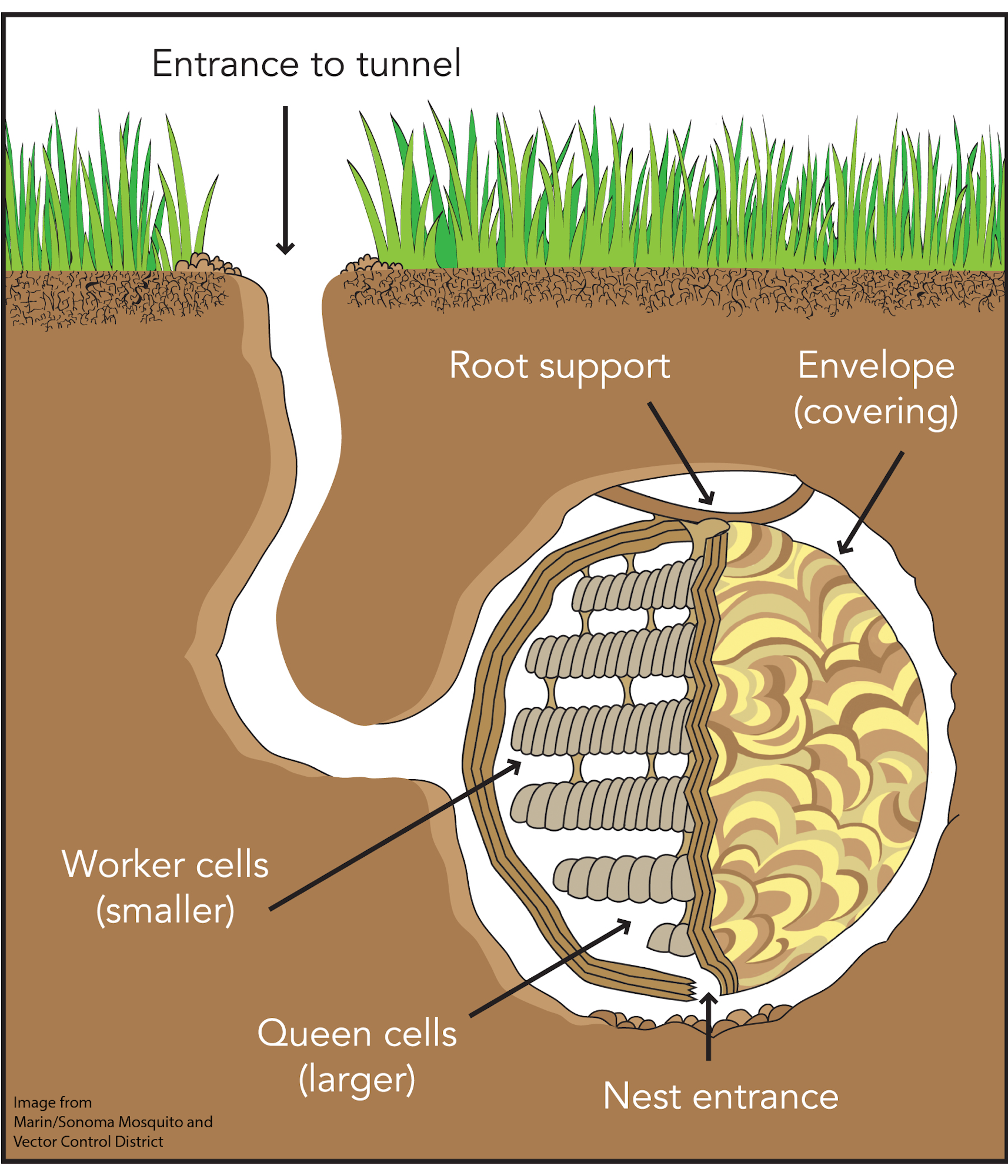
But here is the kicker: the most common yellow jacket species in North America, like Vespula maculifrons (the eastern yellow jacket), doesn't want you to see their nest at all. They are subterranean. When you search for yellow jacket nest photos, you'll often see images of what looks like just a hole in the ground with a few bugs hovering around it. That’s the most dangerous kind. You might think it's just a mouse hole or a dry patch of dirt. Then you hit it with a lawnmower.
The chaos that follows is exactly why professional entomologists like those at the University of California’s Integrated Pest Management (IPM) program emphasize that the "nest" is often 99% invisible.
The hidden architecture of the "underground" nest
If you were to dig up one of those ground nests—which you should absolutely never do—you’d find a massive, multi-tiered city. It’s not just a hole. Inside, there are layers of combs stacked like a high-rise building.
Sometimes these nests get huge.
In "perennial" nests, which happen in warmer climates like Florida or Alabama, the colony doesn't die off in the winter. Entomologist Charles Ray from Auburn University has documented "super nests" that are the size of a car’s interior. Imagine tens of thousands of workers instead of the usual few hundred. Most yellow jacket nest photos of these massive structures look like something out of a sci-fi movie, with the paper pulp dripping off old tires or engulfing the inside of abandoned sheds.
Why the location matters for your ID
- In-ground nests: Usually the Eastern or Western yellow jacket. They love old rodent burrows.
- Aerial nests: Often the Aerial Yellowjacket (Dolichovespula arenaria). These look like the classic "football" hanging from a tree limb.
- Wall voids: These are the worst. You might hear a "crinkling" sound in your drywall. They are literally building a paper city inside your insulation.
Don't confuse them with honeybees or hornets
It’s easy to get them mixed up. A honeybee nest is wax. It looks golden and "wet." A yellow jacket nest is paper. It looks dry and dusty.
If you see a nest that looks like a giant, smooth teardrop hanging from a branch, look closer at the insects. If they have white markings on their face, they are bald-faced hornets. They are technically a type of yellow jacket, but their "nest photos" show a much larger, more sturdy structure than the smaller aerial yellow jacket variety.
The distinction is kind of a big deal because bald-faced hornets are notoriously defensive of their "envelope." If you get within ten feet to take your own yellow jacket nest photos, you might get "sprayed" with venom in your eyes before they even fly at you.
The lifecycle of the structure
Nests aren't permanent. They are seasonal.
Every spring, a lone queen wakes up from hibernation. She’s the only survivor. She finds a spot, builds a tiny little golf-ball-sized nest, and starts laying eggs. By July, the "workers" take over the building duties. This is when the nest expands rapidly.
By late summer and early fall, the nest is at its peak. This is also when yellow jackets get "hangry." Their natural food sources—caterpillars and nectar—start to dry up. They turn to your soda cans and trash bins. This is why most people start searching for yellow jacket nest photos in September; that's when the nest is largest and the inhabitants are most annoying.
In most of the US, the first hard frost kills everyone except the new queens. The nest then becomes a hollow, paper relic. It won’t be reused next year. If you find a dry, brittle nest in your attic in the middle of January, it’s probably safe. Probably.
Real-world risks: The lawnmower incident
Let’s talk about the ground nests again. They are the most common source of multiple-sting incidents. Because the "nest photo" is just a hole in the grass, it’s easy to miss.
Vibrations trigger them.
A lawnmower or a weed whacker sends a "code red" signal to the colony. Unlike honeybees, which die after one sting, a yellow jacket has a lance-like stinger without barbs. They can jab you repeatedly. They also release an alarm pheromone when they sting, which basically tells every other brother and sister in the hole to target you specifically.
How to safely document or identify a nest
If you need to take a photo for an exterminator, don't be a hero.
- Keep your distance: Use the optical zoom on your camera. Stay at least 15-20 feet away.
- Watch the flight path: Yellow jackets usually fly in a straight "beeline" to and from the entrance. If you’re standing in that line, you’re an obstacle.
- No flash at night: If you’re trying to see a nest after dark, don't use a bright white flashlight. They can see the light and will fly toward it. Use a red filter if you absolutely have to.
Honestly, the best yellow jacket nest photos are the ones taken from behind a window. If they’ve built a nest against the glass of your attic window, you have a front-row seat to one of nature’s coolest (and creepiest) engineering feats. You can actually see the larvae wiggling in the cells.
Moving forward with your identification
Once you’ve looked at the photos and confirmed you have a yellow jacket problem, you have a few specific moves to make.
Determine the threat level. If the nest is in a far corner of the backyard where no one goes, you can actually just leave it. They are beneficial predators that eat garden pests. But if it’s near a doorway, in a wall, or in a high-traffic area of the lawn, it has to go.
Check for "frass." If the nest is in your walls, you might see something that looks like sawdust on the floor. That’s "frass"—basically wasp poop and chewed-up drywall. If you see this, do not plug the hole. If you plug their exit, they will chew through the drywall into your living room to find a new way out.
Call a pro for ground nests. DIYing a ground nest with a can of spray is risky because there are often multiple "back doors" you don't see. Professional pest control operators use specialized dusts (like DeltaDust) that the wasps carry deep into the heart of the comb, ensuring the queen is eliminated.
Wait for winter if possible. If it’s late October and you live in a cold climate, the problem will solve itself in a few weeks. Once the temperature stays below freezing for a couple of nights, you can safely knock down aerial nests and toss them in the trash.
Identifying these pests through yellow jacket nest photos is the first step in a smart pest management plan. Just remember that what you see on the surface is almost always just a fraction of the colony living underneath or inside. Stay back, zoom in, and don't vibrate the ground.