So, you’re looking at yellow jacket nest images and feeling that slight crawl on the back of your neck. It’s a visceral reaction. Most people go searching for these pictures because they’ve found something weird in their attic, or maybe a hole in the ground that seems a bit too "busy." But here’s the thing: most of the stock photos you see online are actually kinda misleading. They often show those huge, basketball-sized gray lanterns hanging from a branch. While that is a nest, if you’re in North America, that’s more likely a bald-faced hornet’s home. Real yellow jackets? They’re much more secretive, and their nests are usually hidden from view, tucked away in the "voids" of your life.
Why Most Yellow Jacket Nest Images are Actually Hornets
It’s a common mistake. You see a big, papery globe and think, "Yep, yellow jackets." Actually, those are aerial nests. While some species, like the Aerial Yellowjacket (Dolichovespula arenaria), do build those visible structures, the vast majority of the "pests" we deal with are ground-nesters or cavity-nesters.
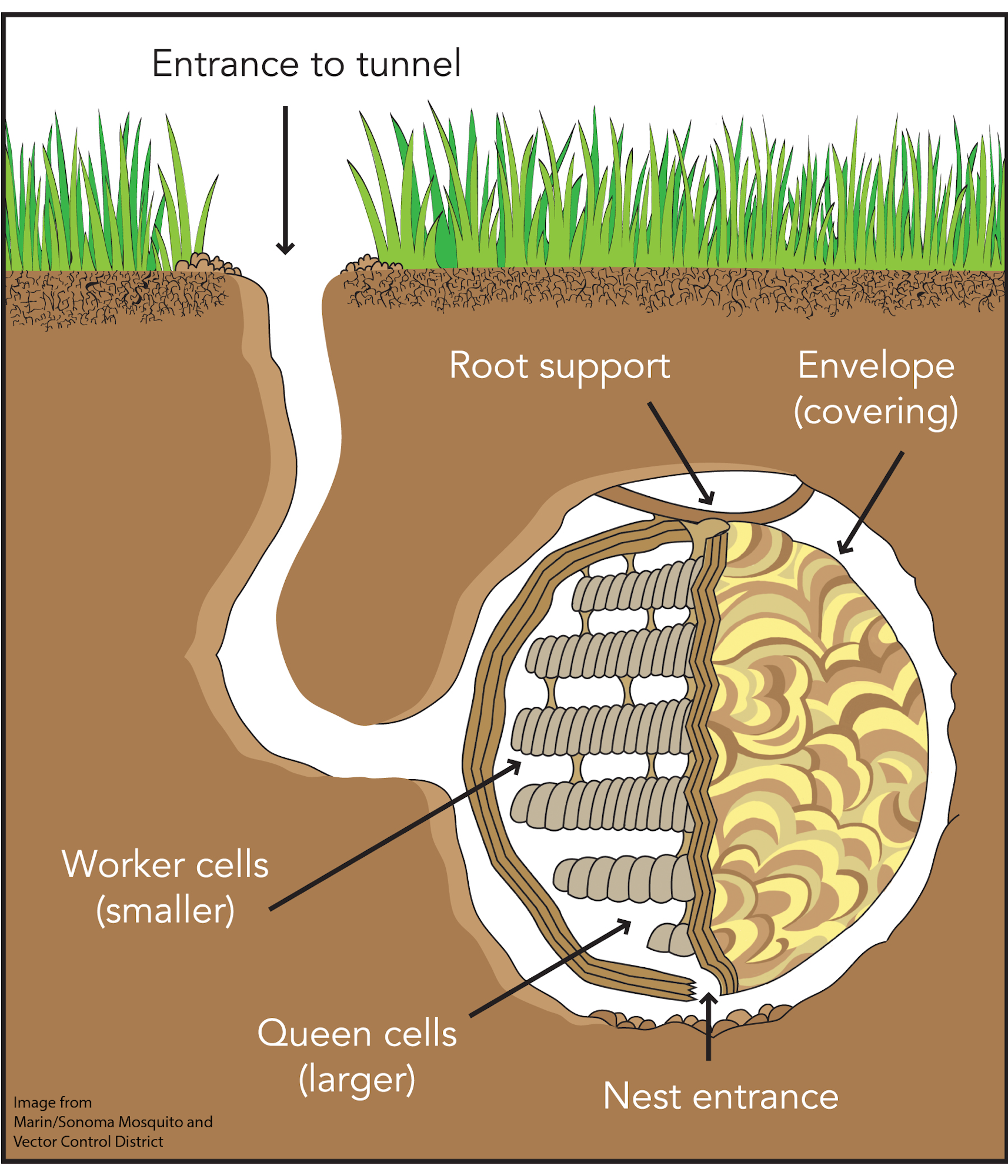
If you’re looking at an image of a hole in the dirt with a few yellow insects hovering around it, that’s the real deal. That’s the Eastern Yellowjacket (Vespula maculifrons) or the Western Yellowjacket (Vespula pensylvanica). These guys are the real troublemakers at your late-summer BBQ. They don't want you to see the nest. They want to hide it under your porch, inside your wall insulation, or deep within an old rodent burrow.
I’ve seen photos of nests pulled out of wall voids that look like something out of a sci-fi movie. They aren't just one big ball. They're stacks of horizontal combs, all wrapped in a brittle, papery envelope made from chewed-up wood fibers mixed with their saliva. It’s basically nature’s version of recycled cardboard. When you see a photo of a nest that has been "excavated," you’ll notice the color varies based on the wood they’ve been chewing. If they’ve been munching on an old cedar fence, the nest might have a reddish tint. If they’re using weathered oak, it’ll be a duller gray.
The Danger of DIY Photography
Look. I get it. You want to get a high-res shot to show the exterminator or post on Reddit for an ID. But getting close enough to get a clear image of a yellow jacket nest is, honestly, a terrible idea. Unlike honeybees, which are generally chill unless you mess with the hive, yellow jackets are notoriously "touchy." They are extremely sensitive to vibrations.
If you walk too close to a ground nest, the vibrations from your footsteps can trigger a defensive swarm. They don't just sting once and die; they have smooth stingers, meaning they can tag you multiple times. And they tag you with a pheromone that basically tells all their sisters, "Hey, this guy right here! Get him!"
If you must take a photo, use a zoom lens. Stay at least 20 feet away. If you see them starting to fly in a rapid, zig-zag pattern near the entrance, you’re already too close. They are "guarding," and the next step is an all-out sortie.
What to Look for in Real-World Photos
When you're browsing yellow jacket nest images to identify a problem in your own yard, pay attention to the "traffic pattern." This is often more helpful than the nest itself.
- The Flight Line: In a clear photo or video, you’ll see a straight line of flight. It looks like a miniature airport runway.
- The Entrance: It’s usually no bigger than a nickel or a quarter.
- Debris: Sometimes you’ll see little pellets of dirt piled up around the entrance of a ground nest. These are the "excavation remains" where the workers are clearing space for the expanding colony.
The Architecture of an Indoor Nest
The most terrifying images are the ones where yellow jackets have moved into a home. They love wall voids. They love attics. They love the space between your floor joists.
There’s a specific type of photo often shared by pest control professionals where the yellow jackets have actually started chewing through the drywall. It starts as a small, damp-looking spot on your ceiling. That’s not a water leak. That’s the wasps thinning out the drywall so they can expand the nest. Eventually, the wall becomes paper-thin. I've seen images where you can actually see the movement of the wasps through the paint.
If you see a photo of a "wall nest," you’ll notice it’s rarely a perfect circle. It conforms to the shape of the wall cavity. It’s an opportunistic piece of engineering. Entomologists like Dr. Mike Raupp often point out that these nests can house up to 5,000 workers by late September. That’s a lot of stinging power hidden behind a layer of Benjamin Moore "eggshell" finish.
Identifying the Species via the Nest
Not all yellow jackets are created equal, and their "architecture" proves it.
The German Yellowjacket (Vespula germanica) is a famous city-dweller. They love structures. Their nests are often a distinct battleship gray. If you see a photo of a nest inside a folded-up patio umbrella or inside a car bumper, it’s probably a German Yellowjacket.
Then you have the Southern Yellowjacket (Vespula squamosa). In warmer climates like Florida or Georgia, these nests can sometimes become "perennial." Most nests die off in the winter when the queen hibernates and the workers freeze. But in the South? They just keep growing. There are images of "perennial" nests that fill the entire interior of a rusted-out 1950s Chevy or take up half a garden shed. We’re talking tens of thousands of individuals. It’s nightmare fuel, honestly.
Variations in Nest Appearance
- Ground Nests: Usually invisible except for the hole.
- Aerial Nests: Papery, gray, usually teardrop-shaped.
- Structural Nests: Hidden in walls, often only identified by the "stain" on the drywall.
- Decoy Nests: You might see images of "fake" nests people hang up. Does it work? The science is hit or miss. Some studies suggest it deters certain species from building nearby, while others show the wasps don't care at all.
Why Late Summer Images Look So Intense
If you look at yellow jacket nest images from May, they’re tiny. The queen starts the nest alone. She builds a small "pedicel" and a few cells. She’s the architect, the hunter, and the nurse all at once.
But by August and September? The nest is a factory. This is when the "nuisance" behavior peaks. The colony is switching from needing protein (to feed the larvae) to needing sugar (to fuel the adults). This is why they’re suddenly hovering over your soda can.
The images of nests from this time of year show "queen cells." These are larger than the worker cells and are usually located at the bottom of the nest. This is the colony’s final act—producing the next generation of queens before the first hard frost kills everyone else. It’s a bit tragic if you think about it, but it’s hard to feel bad for them when they’re nesting in your gas grill.
How to Use These Images for Action
If you’ve looked at enough yellow jacket nest images and confirmed you have an issue, stop. Don't go buy a can of foam and spray the hole.
Here’s why: if you spray the entrance of a wall nest, you might just kill the few guards at the door. The rest of the 4,000 wasps will get frantic. Since you’ve blocked their exit, they will find another way out. Often, that "other way" is into your living room through the electrical outlets or light fixtures.
Actionable Steps for Homeowners:
- Compare the Entrance: Look at your suspect area and compare it to confirmed images of ground nests versus solitary bee holes. Solitary bees usually have much smaller, cleaner holes with no "traffic jam" of insects.
- Observe the Timing: Yellow jackets are active during the day and sleep at night. If you see activity at the hole at 10 PM, it’s not yellow jackets; it’s likely European Hornets (which are attracted to light) or maybe even a small mammal.
- Mark the Spot: If the nest is in the ground, place a bright object (like a brick or a lawn gnome) about 5 feet away from the hole. This helps the pest control tech find it quickly without having to hunt through the grass and risk a sting.
- Thermal Imaging: If you think they’re in your wall, some pros use thermal cameras. The nest actually generates heat because of all the vibrating wing muscles. A thermal image will show a "hot spot" exactly where the nest is located, so you don't have to tear down the whole wall.
- Leave it or Lead it: If the nest is far away from your house and not in a high-traffic area, honestly, just leave it. They’ll be dead by December anyway, and they actually eat a lot of garden pests like caterpillars and flies. But if it's near a door? Call a pro.
The most important thing to remember when looking at these photos is that what you see is only about 10% of the actual structure. The bulk of the nest—and the danger—is always hidden beneath the surface. Treat every "hole in the ground" with the respect (and distance) it deserves. Dealing with these insects requires a mix of caution and the right identification, which usually starts with a simple, albeit slightly scary, photograph.
Once you’ve identified the nest type, your next move should be to monitor the flight path from a distance. If the wasps are entering a structure, check the interior walls for any soft spots or localized warmth. Avoid using "DIY" plugging methods like caulking the hole, as this almost always forces the colony inward toward your living space. If the nest is in the ground and needs to be removed, professional-grade dusts are typically more effective than liquid sprays, as the workers carry the dust deep into the heart of the colony where the queen resides. Use the visual evidence you've gathered to give a clear description to a professional, which can often save you time and money on the initial inspection.