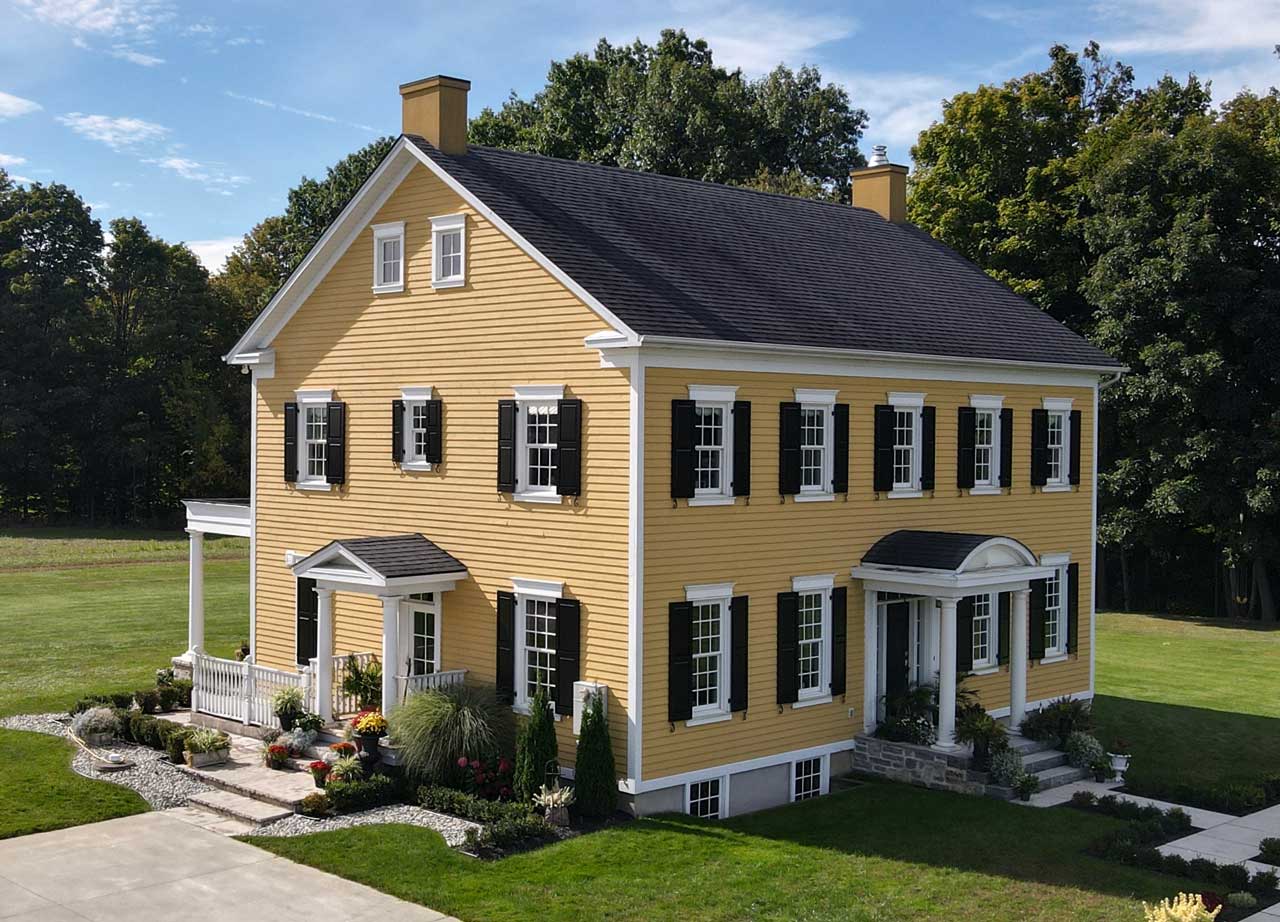
It's a look that basically defines the American curb appeal dream. Walk through any historic neighborhood in New England or a leafy suburb in the Midwest, and you’ll see it. A yellow house with black shutters isn't just a design choice; it’s a vibe. It feels permanent. It feels like home. But why does this specific pairing—bright, sunny walls and dark, ink-black accents—hold such a tight grip on our collective architectural psyche?
Honestly, it’s about contrast.
If you paint a house yellow and put white shutters on it, the whole thing kinda bleeds together into a creamy blur. It’s pretty, sure, but it lacks "teeth." When you slap black shutters on that same yellow siding, the house suddenly gains definition. It’s like putting mascara on eyelashes. The windows pop. The architectural lines of the home become visible from the street. It’s a visual anchor that keeps the yellow from feeling too flighty or whimsical.
The Science of Why Yellow and Black Just Click
You don't need a degree in color theory to see it, but there is some actual science happening here. Yellow is a high-reflectance color. It bounces light. Black, conversely, is the ultimate light absorber. In the world of optics, placing these two next to each other creates the highest possible level of "simultaneous contrast." This is the same reason why caution signs and bumblebees are yellow and black. It demands to be seen.
On a house, this translates to massive curb appeal.
But here is where people get it wrong: they think any yellow will do. It won't. If you pick a neon, highlighter yellow, black shutters will make your house look like a construction zone or a very large, very angry wasp. The pros—people like Maria Killam, a renowned color expert—usually suggest leaning toward "muted" or "complex" yellows. Think of colors like Benjamin Moore’s Hawthorne Yellow or Sherwin-Williams’ Butter Up. These have enough gray or brown in them to feel like a real building material, not a piece of plastic.
Getting the Shutter Style Right
Most people just buy the standard vinyl raised-panel shutters from a big-box store. Please, don't do that without thinking it through. If you have a yellow house black shutters setup, the shutter style actually dictates the "era" of your home.
- Louvered Shutters: These are the ones with the slats. They feel very Colonial or Federal. On a pale yellow house, they give off a breezy, coastal vibe.
- Raised Panel: These look like interior doors. They are more formal. If you have a stately Victorian or a Georgian-style home, these are your best bet.
- Board and Batten: These are the "farmhouse" shutters. They are made of vertical planks. Putting black board-and-batten shutters on a soft yellow cottage is the easiest way to get that "modern farmhouse" look without actually living on a farm.
A quick tip that most contractors won't tell you: size matters more than style. Your shutters should, theoretically, be able to cover the window if they were actually closed. Even if they are just decorative (which 99% of them are these days), if they look too skinny, the house looks "off." It’s a phenomenon called "shutter shaming," and once you see a house with tiny shutters, you can't unsee it.
The "Mustard" Trend and Modern Variations
Lately, we’ve seen a shift away from the buttery, pale yellows of the 1990s toward deeper, more "earthy" ochres and mustards. This is where the yellow house black shutters combo gets really interesting.
A deep mustard house with matte black shutters looks incredibly modern. It’s a bold move. It’s for the person who wants their house to stand out but still wants to respect the neighborhood's traditional bones. When you go darker with the yellow, the black shutters feel less like a contrast and more like a complement.
What about the front door? That’s usually the big question.
You’ve got two paths here. You can match the door to the shutters—solid black. This is the safe, elegant choice. It’s the "little black dress" of home design. Or, you can go wild. A red door on a yellow house with black shutters is a classic "welcome" signal. It’s very traditional. However, if you want something more 2026, try a deep navy or even a forest green door. It adds a third layer of color that keeps the yellow-and-black from feeling too two-dimensional.
Real-World Maintenance: The Dark Side of Black
Let’s talk about the practical stuff that no one mentions in the glossy magazines. Black shutters absorb heat. A lot of it.
If you live in a place like Arizona or Florida, black shutters can actually warp if they are made of cheap vinyl. The sun beats down on that dark pigment, the temperature spikes, and suddenly your shutters are bowing away from the house. If you’re in a high-heat climate, you really need to look into composite materials like Atlantic Premium Shutters or even painted wood.
Also, black shows everything. Pollen? Visible. Bird droppings? Very visible. Dust from the road? You bet. If you aren't the type of person who is going to hosedown your house once a season, you might find that "crisp" black look starts to look a little dingy after a year of neglect.
The ROI of the Yellow and Black Palette
Does it actually help your home value?
According to Zillow’s historical "Paint Color Analysis" reports, homes with specific colors do tend to sell for more. While "Greige" dominated for a decade, there is a rising demand for "joyful" colors. Yellow is the ultimate joyful color. It suggests a happy, well-maintained home. When paired with black shutters—which signal "traditional" and "expensive"—you’re hitting two psychological triggers at once. You’re telling a buyer the house is fun, but it’s also a serious, solid investment.
It’s a safe bet. Unlike a trendy lime green or a dark purple, no one is ever going to look at a yellow house with black shutters and think, "What were they thinking?" It’s timeless. It’s like a navy suit. It never goes out of style because it’s based on fundamental principles of balance and contrast.
How to Start Your Transformation
If you're currently staring at a beige house and thinking about making the jump to yellow, start small.
- Sample your yellows at different times of day. Yellow is notorious for "morphing." In the morning sun, it might look perfect. At sunset, it might look like a giant lemon. Paint a large 3x3 foot square on both the north and south sides of your house.
- Choose your black wisely. Not all blacks are the same. Some have blue undertones (cool), while others have brown undertones (warm). If your yellow is a warm, buttery cream, go with a black that has a hint of bronze or brown. If your yellow is a crisp, lemony shade, a "True Black" or a "Tricorn Black" will look better.
- Don't forget the trim. Most people with yellow houses and black shutters go with white trim. It acts as a "buffer" between the two strong colors. It keeps the transition clean.
- Consider the roof. If you have a bright red roof or a brown shingle roof, a yellow house with black shutters might start to look a bit busy. This combo works best with gray or black roofing.
Basically, the yellow house black shutters look is a classic for a reason. It’s bold without being obnoxious. It’s bright without being overwhelming. It’s a design choice that says you care about tradition, but you aren't afraid to let a little sunshine in.
To make this happen, your first move should be grabbing three distinct yellow samples: one pale cream, one "true" yellow, and one muted ochre. Paint them near your windows. Watch how they interact with the shadows of your existing shutters. Once you see that black-on-yellow contrast in your own lighting, you'll know exactly which direction to take. Turn the "safety" of beige into something that actually makes people stop and look when they drive by.



