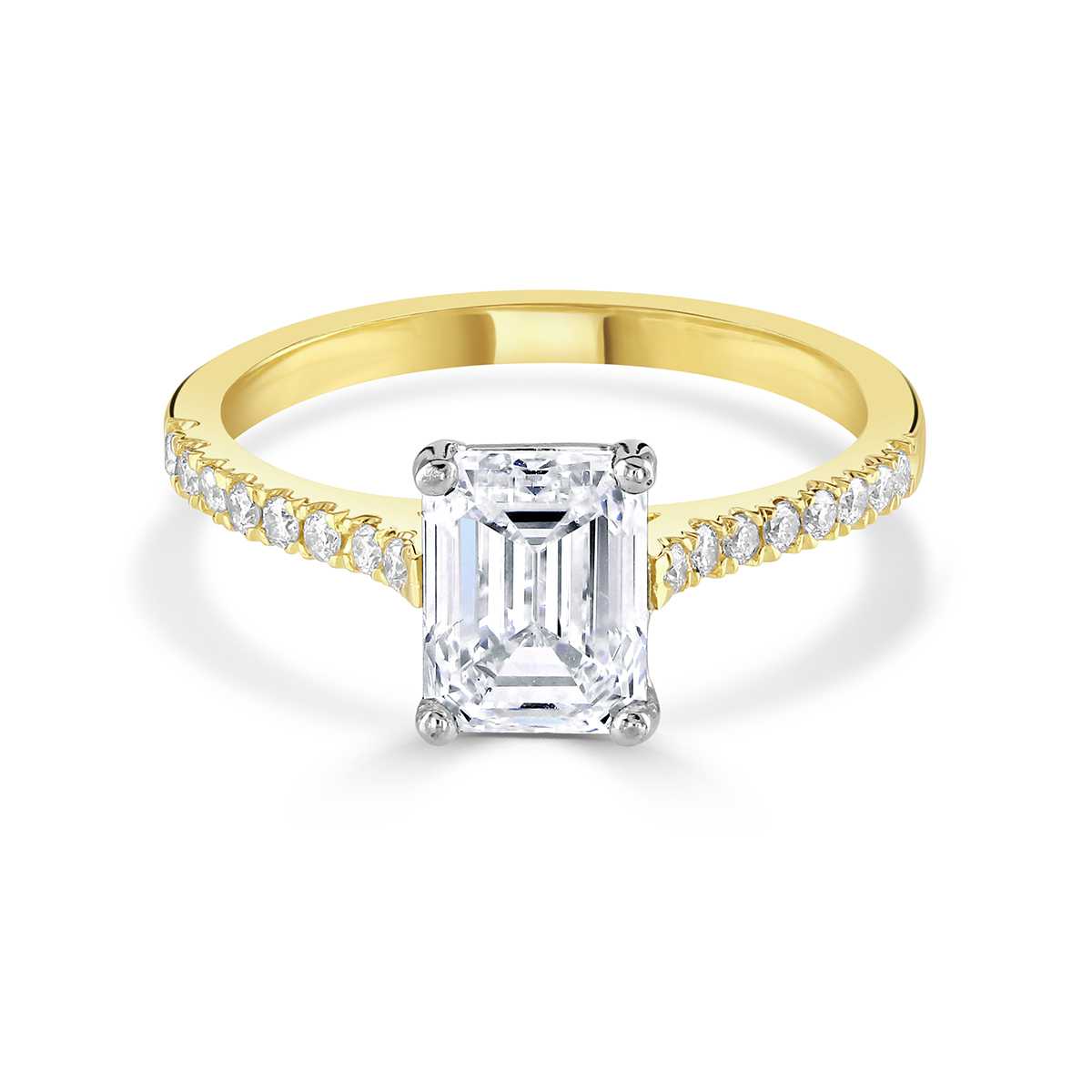
White gold is officially on the defensive. For decades, the cool, silvery tones of platinum and rhodium-plated gold dominated every bridal case from Tiffany’s to the local mall jeweler. It was the "safe" choice. But honestly? Things have shifted dramatically. Yellow gold diamond rings are no longer just something you find in your grandmother’s velvet-lined jewelry box from 1984. They are the standard again.
Walk through Soho or scroll through any high-end bridal stylist’s feed and you’ll see it. The warmth is back. There is something about the way a 14k or 18k yellow gold band catches the late afternoon sun that white metal just can’t replicate. It feels intentional. It feels substantial.
Maybe it's the "quiet luxury" movement. Maybe people just got tired of re-plating their white gold rings every eighteen months to keep them from looking yellow. Whatever the catalyst, the demand for yellow gold diamond rings has skyrocketed, and with that demand comes a lot of confusion about what actually looks good and what’s a total waste of money.
Why 14k and 18k Matter More Than You Think
When you’re buying a yellow gold diamond ring, you aren't just buying "gold." You're buying an alloy. Pure 24k gold is basically the texture of a gummy bear—okay, not literally, but it’s way too soft for a ring you’re going to wear while doing dishes or lifting weights.
Most people get stuck between 14k and 18k. Here is the real talk: 14k gold is roughly 58.3% pure gold. It’s harder, more durable, and has a slightly paler, "champagne" tint. 18k gold is 75% pure. It is significantly richer, more buttery, and heavier on the finger.
If you have a very active lifestyle, 14k is your best friend. It stands up to scratches better. However, if you want that iconic, deep glow that screams "fine jewelry," 18k is the winner. Just know that 18k will develop a "patina" (aka tiny scratches) faster. Some people love that look. It shows the ring has been lived in. Others hate it.
The price difference isn't just about the gold content, either. Because 18k is denser, the ring literally weighs more. You pay for that weight. According to data from the World Gold Council, gold prices have seen significant volatility recently, often hovering around $2,000 to $2,300 per ounce, which means the jump from 14k to 18k can add several hundred dollars to a setting alone.
The Secret Trick to Saving on Your Diamond Color
This is where the real magic of yellow gold diamond rings happens. If you were buying a platinum setting, you would be forced to pay a premium for a D, E, or F color diamond. Why? Because a white metal acts like a mirror. If your diamond has even a hint of yellow (like a K or L grade), the white metal will make it look more yellow. It clashes. It looks "off."
Yellow gold is the ultimate wingman.
Because the metal itself is warm, it masks the faint yellow or brown tints in lower-color diamonds. You can easily drop down to a G, H, or even an I color diamond and it will look perfectly white against the yellow gold band. I’ve seen J-color diamonds in yellow gold settings that look more stunning than D-color diamonds in platinum.
You’re basically hacking the GIA grading scale.
By choosing a slightly "lower" quality color grade, you can redirect those thousands of dollars into a higher carat weight or a better cut grade. Always prioritize the cut. A well-cut diamond reflects light so efficiently that it further masks the body color of the stone.
Modern Settings That Don't Look Dated
Forget those chunky, tapered baguettes from the 90s. Today’s yellow gold diamond rings are all about contrast and minimalism.
One of the biggest trends right now is the "thin and dainty" band. Designers like Catbird or Melanie Casey popularized these ultra-thin 1.2mm to 1.5mm bands. They make the center stone look absolutely massive. But be careful. If the band is too thin, it can warp over time. A 1.8mm band is usually the sweet spot for longevity.
Then you have the bezel setting. This is a total 180 from the "thin band" vibe. A bezel setting wraps the gold entirely around the diamond. It’s sleek. It’s modern. It doesn't snag on your sweaters. More importantly, it protects the diamond's girdle from chipping. In yellow gold, a bezel creates a "halo" of warmth that can make a smaller stone feel much more significant.
Don't overlook the "hidden halo" either. This is where tiny diamonds are set on the gallery (the side profile) of the ring. When you look at the ring from the top, it’s a clean yellow gold look. When you look from the side, it’s a secret disco ball.
Metals and Skin Tones: The Brutal Truth
We’ve all heard that "warm" skin tones should wear gold and "cool" skin tones should wear silver or platinum. Honestly? That's mostly nonsense.
Yellow gold diamond rings look good on everyone. It’s about the hue of the gold. If you have very fair skin with cool undertones, a 14k yellow gold provides a soft, flattering contrast. If you have a deeper skin tone, 18k yellow gold looks absolutely electric. It pops in a way that white gold just can't manage.
The only time you really need to be careful is if you have skin that reacts to nickel. Many 14k gold alloys use nickel to add hardness. If you have a nickel allergy, your finger will turn green or get itchy. In that case, you either need to hunt for nickel-free 14k gold or just bite the bullet and go for 18k, which is much less likely to cause a reaction due to its higher purity.
Caring for the Glow
People think gold is indestructible. It's not.
If you wear your yellow gold diamond ring every day, it’s going to get dull. Lotion, hairspray, and skin oils create a film over the gold and the diamond. The diamond loses its fire, and the gold starts looking like brass.
Clean it. Please.
You don't need fancy ultrasonic cleaners. A bowl of warm water, a few drops of Dawn dish soap, and a soft baby toothbrush will do 90% of the work. Soak it for ten minutes and gently scrub behind the stone where the "gunk" builds up.
Also, keep it away from chlorine. If you’re hitting the pool or the hot tub, take the ring off. Chlorine is a harsh chemical that can actually leach the other metals out of your gold alloy, making the ring brittle. Over time, your prongs could literally snap off. That is a very expensive swim.
Real Examples of the Yellow Gold Revival
Look at the red carpets. Jennifer Lawrence’s engagement ring featured a massive emerald cut set on a thin yellow gold band. Scarlett Johansson went with a unique light brown diamond on a black ceramic and yellow gold band. Even Meghan Markle’s original ring—the one Prince Harry famously designed—was yellow gold because he knew it was her favorite.
These aren't just fashion choices. They are statements about longevity. Yellow gold is "the" precious metal of human history. It doesn't go out of style; it just cycles in and out of the spotlight. Right now, it’s the lead singer.
The Resale Value Reality Check
Let’s be real for a second. Most people don't buy an engagement ring thinking about selling it. But life happens.
If you ever need to resell your ring, yellow gold is generally easier to move than trendy metals like rose gold or blackened cobalt. Because yellow gold is the "standard," its scrap value is tied directly to the spot price of gold, which is easy to track. However, remember that you’re never going to get back what you paid at a retail store. Retail markups are usually 100% to 300%.
Your value lies in the diamond and the weight of the gold. If you bought a "designer" ring, you’re paying for the name. If you bought a custom-made yellow gold diamond ring from a local bench jeweler, you’re usually getting more "metal for your money."
Actionable Steps for Your Purchase
If you're ready to pull the trigger on a yellow gold ring, don't just walk into a store and point at the shiniest thing.
- Check the Prongs: Some yellow gold rings use platinum or white gold prongs to hold the diamond. This is done to keep the "white" light reflecting through the stone. If you want the full-gold look, ask for yellow gold prongs, but know that yellow gold is slightly softer and may need to be "tipped" or repaired more often than platinum prongs.
- Insist on a Grading Report: Whether it's GIA or IGI, never buy a diamond for a yellow gold setting without seeing the paperwork. Use that paperwork to find a stone in the G-H-I-J color range.
- Feel the Weight: Pick up the ring. It shouldn't feel like a toy. If it’s hollowed out on the inside (to save the jeweler money on gold), it’s going to be uncomfortable and trap moisture against your skin. A solid "comfort fit" band is always worth the extra cost.
- Verify the Alloy: Ask what the gold is alloyed with. If you have sensitive skin, this is the most important question you can ask.
- Compare 14k vs 18k in Person: Don't trust photos. The color difference is subtle but real. Put both on your hand and walk to a window. The natural light will tell you which one works with your skin.
Yellow gold diamond rings are a marriage of warmth and brilliance. They offer a classic aesthetic that feels more "human" and less industrial than white metals. By understanding the balance between gold purity and diamond color, you can get a ring that looks twice as expensive as it actually was. Focus on the cut of the stone, the solidity of the band, and the richness of the metal. That's the formula for a ring that looks just as good in thirty years as it does the day you propose.



