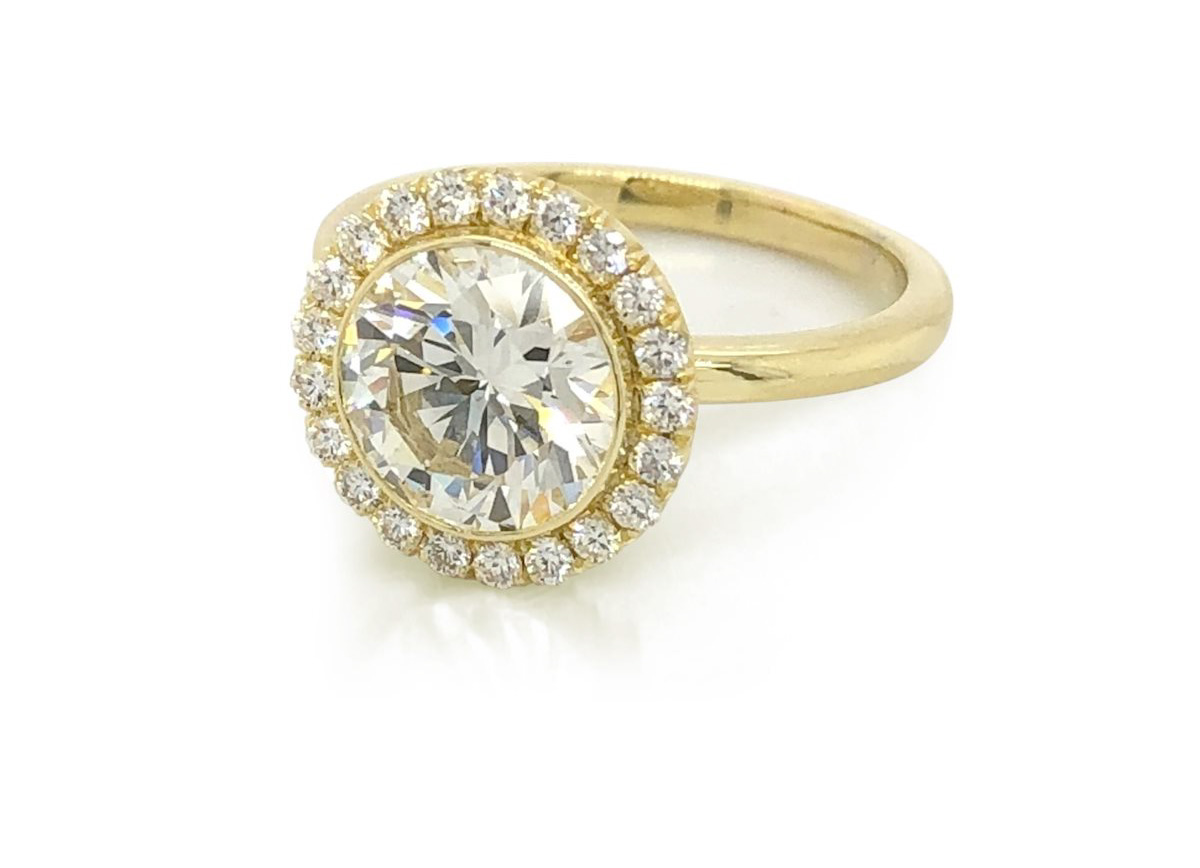
You’ve probably seen them everywhere. On your Instagram feed, on the fingers of celebrities like Lily Collins or Hailey Bieber, and definitely in those high-end boutique windows in Soho. Yellow gold bezel set engagement rings are having a massive moment, but honestly, calling it a "trend" feels a bit reductive. It's more of a reckoning. For decades, the jewelry world was dominated by the classic Tiffany-style prong setting—those little metal claws holding a diamond up like it’s on a pedestal. But people are getting tired of their sweaters getting snagged. They're tired of the "floating" look.
The bezel is different. It’s ancient, actually. It’s one of the oldest ways humans ever secured a stone to a piece of metal. You basically wrap a thin collar of gold all the way around the diamond's edge. It’s sleek. It’s secure. And when you pair that smooth, buttery 18k yellow gold with a crisp white diamond, something magical happens. The contrast is sharp. It looks modern but feels like it could have been dug out of an Egyptian tomb.
The Practical Magic of the Bezel
Let's get real for a second. Prongs are high-maintenance. If you work with your hands, if you’re a nurse pulling on latex gloves, or if you just happen to be a bit of a klutz, a prong-set diamond is a liability. One good whack against a granite countertop and you’re looking at a bent metal tooth or, worse, a lost stone.
Yellow gold bezel set engagement rings solve this by design. Because the metal encases the entire girdle of the diamond, it’s protected from chips and scratches. It’s the ultimate "set it and forget it" ring.
But there’s a trade-off. Some traditionalists will tell you that a bezel "smothers" the diamond. They argue that because light can’t enter through the sides of the stone, the sparkle is diminished. Honestly? That’s mostly a myth. Modern diamonds are cut to reflect light out of the top (the table), not the sides. If the diamond is high quality, it’s going to glow. Plus, the gold rim acts like a mirror, reflecting color back into the stone. In a yellow gold setting, this can actually make a slightly "warmer" diamond (one with a lower color grade like J or K) look intentional and creamy rather than just "yellowish."
Why Yellow Gold is Winning the Color War
For a long time, white gold and platinum were the "it" metals. They were seen as sophisticated, while yellow gold was relegated to your grandmother’s jewelry box. That has flipped.
The warmth of yellow gold feels more human. More organic. When you look at yellow gold bezel set engagement rings, the metal doesn't just hold the stone; it frames it. It’s like the difference between a modern art gallery with stark white walls and a cozy library with mahogany shelves. Both are beautiful, but one feels a lot more personal.
Experts at places like The Knot and Brilliant Earth have noted a massive uptick in 14k and 18k yellow gold sales over the last three years. Why? Because it looks better on more skin tones. It has a "glow" that white metals lack. And specifically with a bezel, that yellow gold border can actually make a diamond look larger. It creates a visual extension of the stone's diameter. You’re basically getting a free size upgrade just by choosing a specific setting style.
The Metal Purity Dilemma
Should you go 14k or 18k?
- 14k Yellow Gold: It’s 58.3% gold. The rest is alloy—zinc, copper, nickel. It’s harder. It’s more durable. If you’re active, this is your best bet. It’s also slightly less "yellow," which some people prefer.
- 18k Yellow Gold: This is 75% gold. It’s richer. It’s heavier. It feels "expensive" on the finger. But gold is soft. An 18k bezel will show scratches and "patina" faster than 14k.
Most high-end designers, like Jennie Kwon or Vrai, tend to lean into 18k because the color is just so much more saturated. It looks like liquid sunshine. If you're going for that "heirloom" vibe, 18k is the move.
Celebrities Who Changed the Game
We can't talk about this without mentioning the "Hailey Bieber effect." While her main ring is a massive oval on a thin gold band with hidden prongs, she has single-handedly made yellow gold the standard for "cool girl" jewelry. Then you look at someone like Mary-Kate Olsen, who famously wore a vintage Cartier bezel-set ring.
These aren't just engagement rings. They’re fashion statements.
A bezel setting says you don't care about the traditional "rules" of bridal jewelry. You aren't trying to show off the most sparkle; you’re showing off a specific aesthetic. It’s low-profile. It sits flush against the skin. It doesn't get caught in your hair when you're washing it. It's sophisticated in a way that feels effortless.
What Most People Get Wrong About Bezel Settings
There is a huge misconception that bezel settings are "cheaper" because they "hide" the diamond. Total nonsense.
In fact, a well-crafted bezel is often more expensive than a prong setting. Why? Because the jeweler has to custom-fit that metal collar to the exact dimensions of your specific stone. It’s precision work. In a prong setting, you can swap stones in and out relatively easily. In a bezel, if the metal isn't perfectly flush, the stone will rattle. Or worse, the metal will look uneven and "lumpy."
You also need to think about the "hidden" parts of the diamond. When you buy a diamond for a yellow gold bezel set engagement ring, you can actually save money on the "clarity" grade. Since the edges of the stone are covered, any tiny inclusions or "birthmarks" near the girdle are hidden forever. You can focus your budget on the "Cut" and the "Carat" instead.
The Different Styles of Bezel
Not all bezels are created equal. You’ve got options:
- Full Bezel: The metal goes 360 degrees around the stone. Maximum protection.
- Half Bezel (or Semi-Bezel): The metal only covers two sides of the stone. It looks like the diamond is being squeezed. It lets in more light from the sides but offers a bit less protection.
- Milgrain Bezel: This is for the vintage lovers. The jeweler adds tiny, beaded metal details along the edge of the gold. It gives it a "Great Gatsby" feel.
- Scalloped Bezel: The metal edge isn't a straight line; it follows the curves of the stone or adds a floral pattern.
Does the Diamond Shape Matter?
Yes. 100%.
An Emerald cut in a yellow gold bezel looks like an Art Deco masterpiece. It’s all straight lines and hall-of-mirrors flashes.
A Round Brilliant in a bezel looks like a classic "button" or a "bubble." It’s soft and feminine.
An Oval or Pear shape in a bezel? That’s where things get tricky. Because those stones have points or elongated curves, the bezel has to be perfectly symmetrical, or it will look crooked. A pear-shaped bezel-set ring is perhaps the most difficult to execute well, but when it’s done right, it’s arguably the most stunning piece of jewelry you’ll ever see. It looks like a drop of golden dew.
The Maintenance Reality Check
People choose bezels because they’re "low maintenance," but let's be honest: soap scum is a thing.
Because the bottom of the diamond is still open (usually) to let light in, lotion, skin oils, and soap will get trapped behind the stone. Since the metal surrounds the top, it’s a bit harder to get a toothbrush in there to clean it out. You’ll need an ultrasonic cleaner or a regular professional steam clean to keep it from looking "foggy."
Also, yellow gold will scratch. Over years, that smooth bezel will develop a "brushed" look from hitting doors, desks, and gym weights. Some people love this—it’s called a patina. It shows the ring has been lived in. If you hate it, you’ll be heading to the jeweler every six months for a polish.
Buying Guide: What to Look For
If you’re ready to pull the trigger on one of these, don’t just buy the first one you see on a big-box retailer's website. Look at the craftsmanship.
The "Lip" of the Bezel: Look at the ring from the side. Is the metal rim even? It shouldn't be thicker on one side than the other. It should look like a perfect frame.
The Depth: Some bezels are "heavy," meaning there’s a lot of gold. This can make a small diamond look tiny. You want a "thin" or "fine" bezel if you want the stone to pop.
The Gallery: Look underneath the stone. Is there a hole? Good. That’s for cleaning and light. Is it solid metal? Avoid it. The diamond will look dead within a week of wear once it gets a little dirty.
The Sizing: Bezel rings are notoriously hard to resize, especially if the band is "tapered" or has stones set into it. Get your finger measured properly. Don't guess.
Real-World Value and Resale
Let's talk business. Engagement rings aren't great "investments" in the traditional sense, but yellow gold holds its value remarkably well. Platinum prices fluctuate wildly, but gold is... well, gold.
From a style perspective, the yellow gold bezel set engagement ring is currently holding its value on the secondary market (sites like LuxeDH or The RealReal) much better than the "halo" rings that were popular in the 2010s. The halo look is starting to feel dated. The bezel feels timeless. It’s a design that’s worked for 2,000 years; it’s probably not going out of style in the next ten.
Actionable Next Steps for Your Search
If you're leaning toward this style, don't just browse. Start testing.
- Visit a local independent jeweler: Ask to see a "semi-mount" bezel. This is the ring without the center stone. See how the yellow gold looks against your skin in natural light, not just under those crazy-bright jewelry store LEDs.
- Check the "V-Cut" Bezel: If you want a more modern look, some designers are doing "V" shaped bezels that show off more of the diamond's side profile while still keeping it secure.
- Prioritize Cut Grade: Since the bezel will "close in" the stone, you need the best cut possible (Excellent or Ideal) to ensure the light reflects back out the top. Don't compromise here.
- Think about the wedding band: This is the biggest "gotcha" with bezels. Because they sit low on the finger, a standard straight wedding band won't fit flush against it. There will be a gap. If you hate gaps, you’ll need to look for a "curved" or "contoured" wedding band designed specifically to hug the bezel's shape.
Yellow gold bezel set engagement rings aren't for everyone. They aren't for the person who wants the maximum "flash" or the most traditional "princess" look. They are for the person who values design, durability, and a sort of "quiet luxury" that doesn't need to scream to be noticed. It’s a ring for a life lived fully, without worrying about a snagged sweater or a loose prong.
The most important thing to remember is that you're choosing a piece of engineering as much as a piece of art. The bezel is a hug for your diamond. In 18k yellow gold, it’s a warm, glowing, indestructible promise. Be picky about the metal thickness, be obsessive about the diamond cut, and make sure you’ve tried it on with a potential wedding band before you commit. This isn't just jewelry; it's the one thing you'll likely wear every single day for the rest of your life. Make sure it's as tough as it is beautiful.



