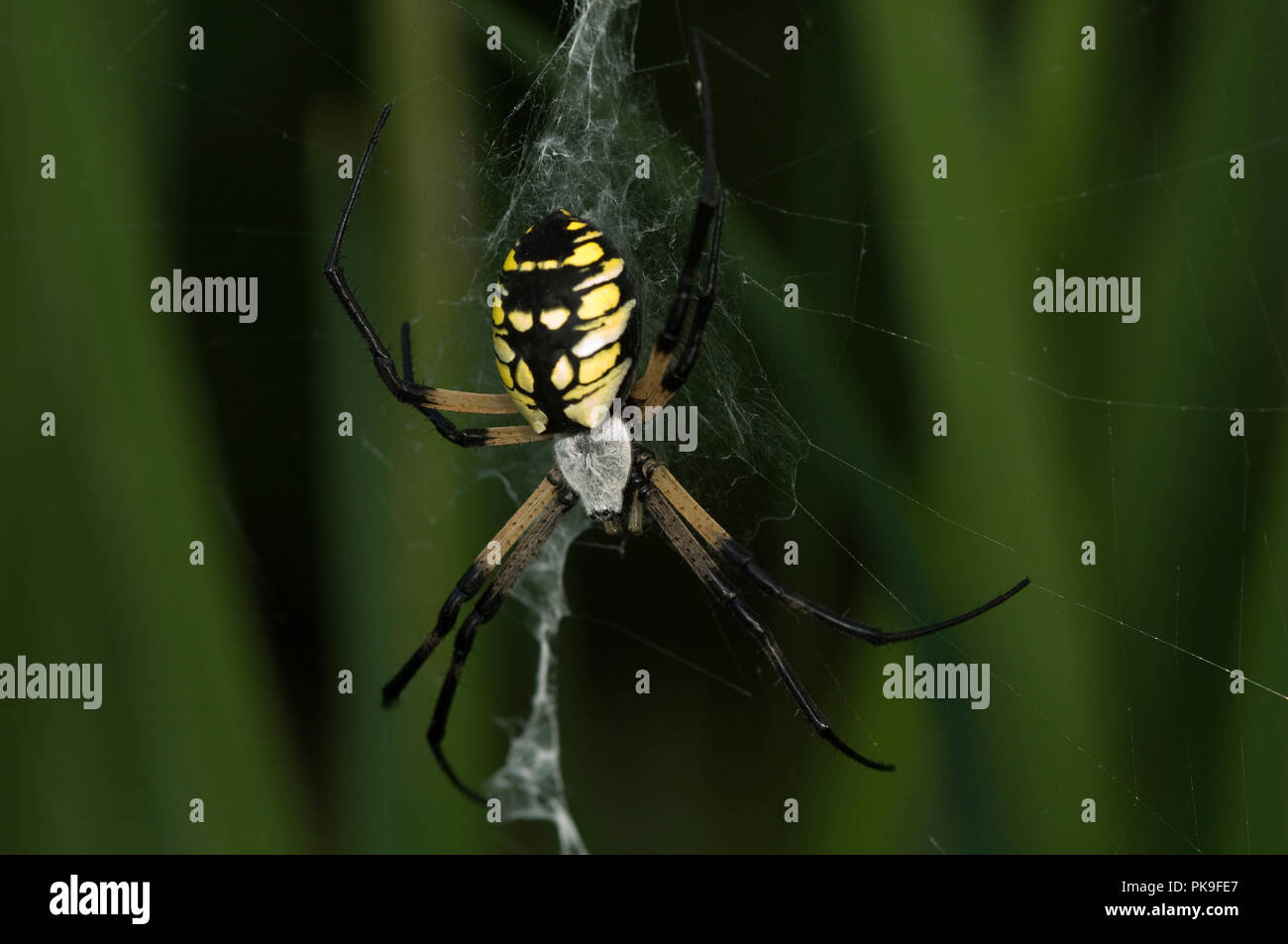
You’re walking through the backyard, coffee in hand, maybe a bit bleary-eyed, when you nearly face-plant into a massive, shimmering web. In the center sits a beast. It’s bright yellow, jet black, and easily the size of a silver dollar. Your first instinct might be to grab a broom or run for the hills, but honestly? You’ve just met the yellow garden spider, and she’s probably the best free pest control you'll ever have.
Commonly known to scientists as Argiope aurantia, this spider is a total showstopper. It’s also got about a dozen nicknames: the writing spider, the zigzag spider, the corn spider, or the McKinley spider. Whatever you call it, it’s a masterpiece of evolution. People often freak out because they see those bold colors and assume "deadly." In reality, they are remarkably chill. Unless you are a grasshopper. If you’re a grasshopper, it’s a bad day.
What's With the Zigzag? The Mystery of the Stabilimentum
The most striking thing about an Argiope aurantia web isn't even the spider itself. It’s that weird, thick vertical zigzag of silk running right down the middle. This is called a stabilimentum. For years, experts were kinda scratching their heads about why they do this. Why would a predator, whose whole job is to stay invisible, put a giant "I am here" sign in the middle of its trap?
One theory suggests it’s a warning sign for birds. Think about it. If a robin flies through that web, the web is destroyed. That’s a massive waste of energy for the spider. By adding a visible white streak, the spider tells the bird, "Hey, don't crash here." Another study by researchers like Thomas C. Jones suggests it might actually attract prey by reflecting UV light, mimicking the patterns found on nectar-rich flowers. It’s basically a neon sign that says "Eat Here" to a passing bee. Or maybe it just makes the spider look bigger to keep wasps from attacking. Nature is rarely simple.
Life on the Silk: The Daily Grind of Argiope Aurantia
The females are the ones you notice. They’re huge. Males? Not so much. A male yellow garden spider is barely a third of the size of his counterpart and often looks like a completely different species—brown, spindly, and generally trying his best not to get eaten during a date.
The female is a construction genius. Every night, she might eat the circular interior part of her web and rebuild it. It’s a recycling program. She consumes the old silk to regain the protein and then spins it fresh for the morning hunt. The web can be two feet across. It’s a high-tension engineering marvel anchored to garden stakes, tomato plants, or tall grass.
She sits there, head down, waiting.
When a bug hits the web, the vibration is like a dinner bell. She doesn't just bite it. She dances. She’ll use her legs to swing the web back and forth, further entangling the prey before rushing in to wrap it in a thick swaddle of silk. It’s fast. It’s efficient. It’s honestly a little terrifying if you watch it up close.
Are They Dangerous? (Short Answer: No)
Let’s clear the air. People see the bright yellow "warning" colors and think they’re looking at a black widow’s cousin. They aren't.
If you poke a yellow garden spider, her first move is to shake the web. She wants to look big and scary so you’ll go away. If you keep poking her, she’ll probably just drop to the ground and hide in the mulch. Could she bite you? Yes. Any animal with mouthparts can bite. But the venom is harmless to humans—it’s roughly equivalent to a bee sting. Unless you have a specific allergy to spider venom, it’s just a dull ache and some redness for a few hours.
They are remarkably non-aggressive. You have to really work at it to get bitten. Usually, it happens when someone accidentally grabs the spider while gardening. Wear gloves. Problem solved.
The Weird Sex Life and the Egg Sac
Autumn is the big season for Argiope aurantia. This is when the females are at their largest because they are full of eggs. After mating—which, as mentioned, is a high-stakes game for the tiny males—the female produces one or more brown, papery egg sacs. They look like little kettledrums or dried-out cloves of garlic.
She’ll hang these sacs near the web, often hidden in a curled leaf.
Inside a single sac, there can be over a thousand spiderlings. They hatch in the winter but stay inside that protective papery cocoon until spring. It’s a tiny, crowded nursery. When the weather warms up, they emerge and "balloon"—letting out a strand of silk that catches the wind and carries them miles away. It’s how they colonize new gardens.
Sadly, the mother spider doesn't survive the first hard frost. Her life is a one-year sprint. She gives everything to those eggs and then, when the cold hits, she's gone.
Why Your Garden Actually Needs Them
If you see a yellow garden spider, leave it alone. Seriously.
These spiders are apex predators in the world of the flower bed. They eat:
- Grasshoppers (which destroy your leaves)
- Flies
- Wasps
- Beetles
- Moths
They are a sign of a healthy ecosystem. If you have spiders, it means you have enough bugs to support them, and it means you aren't over-using pesticides. If you spray your yard with heavy chemicals, the spiders are the first to go. Then the "bad" bugs, which often have faster reproduction cycles, come roaring back without any predators to stop them.
Spotting the Differences: Argiope vs. Others
Sometimes people confuse the garden spider with the Joro spider or the Banded Argiope (Argiope trifasciata).
The Joro is an invasive species from Asia that has been spreading across the American South. Joros have blue-gray stripes and much more chaotic, golden-tinted webs. The Banded Argiope is thinner with many fine lines across its abdomen. Our girl, Argiope aurantia, is the one with the distinct solid yellow patches and the very clean, organized orb web with that famous zigzag.
Keeping Them Around: A Homeowner’s Guide
If you want to encourage these beautiful arachnids to set up shop in your yard, it’s pretty simple.
First, stop the "scorched earth" approach to pest control. A few bugs are okay. Second, provide structure. They love tall perennials, sturdy shrubs, and trellises. If you have a vegetable garden, they are particularly fond of setting up between corn stalks or tomato cages.
If a spider builds a web in a high-traffic area, like right across your front door, you don't have to kill her. You can gently relocate her. Use a large glass or a plastic container, slide a piece of cardboard underneath, and move her to a bush at the edge of your property. She might be a little stressed, but she’ll likely spin a new web by morning.
How to Coexist with Your Resident Garden Spider
Having a yellow garden spider as a neighbor is a privilege. To make the most of this relationship and ensure your garden thrives, keep these practical points in mind.
- Avoid Broad-Spectrum Insecticides: These don't just kill the "pests"—they wipe out your free labor. Use spot treatments or organic options like neem oil if you must, but try to keep the spider's area spray-free.
- Leave the Egg Sacs: If you find a papery brown sac on a dead plant in the fall, don't throw it in the compost or the trash. Leave it where it is. Those are next year's "pest control officers" waiting for spring.
- Give Them Space: They need a gap of about two to three feet to spin a full web. If you see one starting a web in a spot that isn't in your way, let her be.
- Watch and Learn: If you have kids, this is the best biology lesson you’ll ever get. Watching a spider wrap a fly or rebuild its web is fascinating. It’s a tiny window into the complexity of the natural world.
The presence of Argiope aurantia is a compliment to your gardening skills. It means you’ve created a space that is vibrant, alive, and balanced. Instead of reaching for the bug spray, take a second to appreciate the architecture and the appetite of your eight-legged friend.



