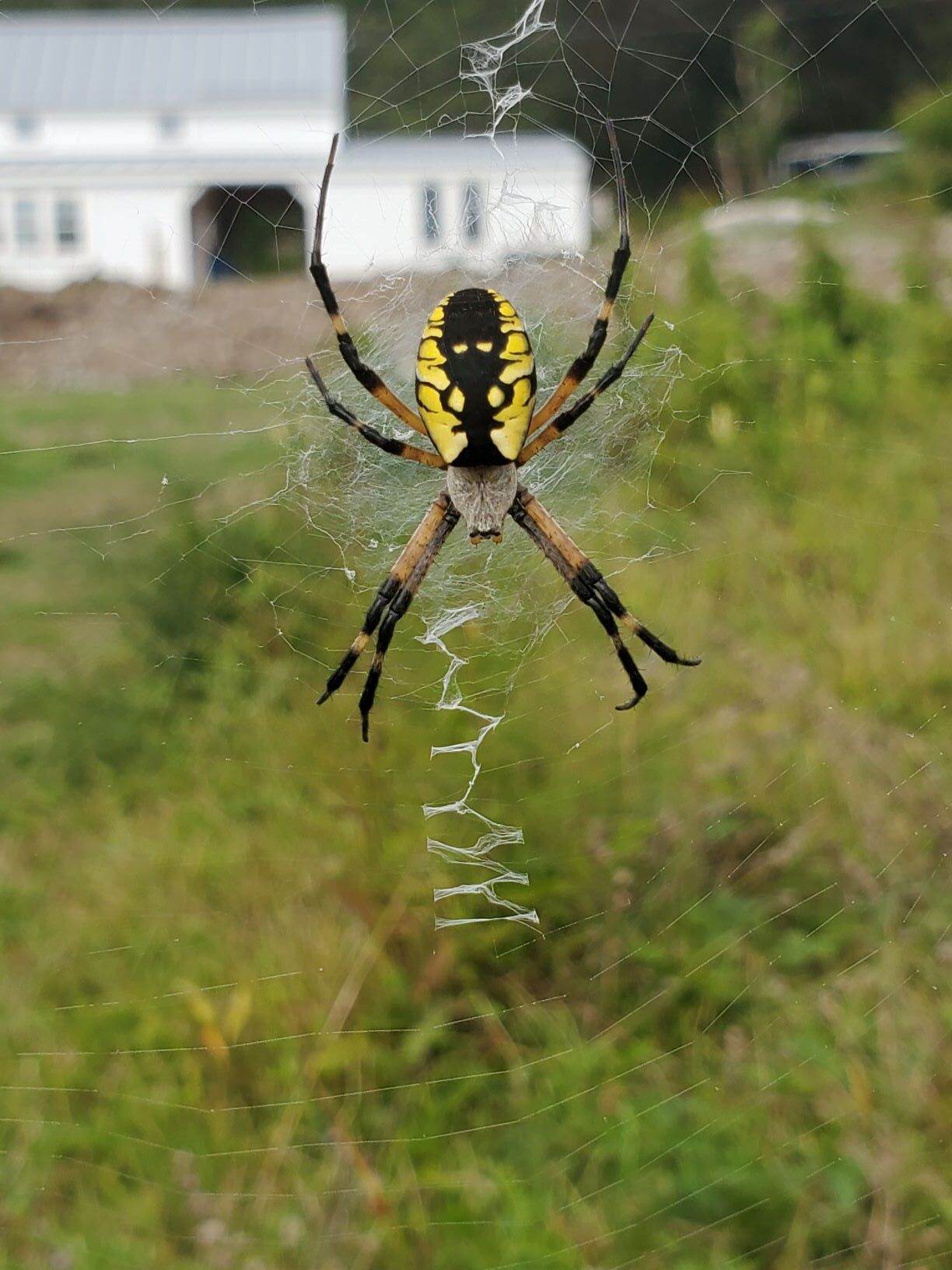
You’re walking through the backyard, maybe coffee in hand, when you suddenly freeze. There, suspended right at eye level between two tomato stakes, is a massive, jet-black creature with electric yellow stripes. It looks like something that crawled out of a tropical rainforest or a high-budget horror flick. Most people call it a big black garden spider, but if we’re being technical, it’s Argiope aurantia.
It’s huge. It’s intimidating. And honestly? It’s probably the most hardworking "employee" in your garden.
A lot of folks get freaked out by the zig-zag pattern in the middle of the web. It looks like a warning sign, right? Scientists call that the stabilimentum. For years, experts like those at the Smithsonian or various university entomology departments argued about why they do it. Some thought it was to strengthen the web. Others guessed it was to attract prey by reflecting UV light. Nowadays, the consensus is leaning toward bird safety. Basically, the spider doesn't want a bird flying through its hard work and destroying it, so it adds a "Do Not Enter" sign that's visible to flyers.
Identifying the Big Black Garden Spider Without Panicking
It’s easy to get confused. Nature loves high-contrast colors. But the Argiope aurantia—the black and yellow garden spider—has a very specific "look."
The females are the stars of the show. They can grow up to an inch long in the body alone, and when you add those spindly legs, they easily cover the palm of a child's hand. Their abdomens are mostly black with these vivid, symmetrical yellow or orange patches. The legs? Mostly black with some reddish or yellow banding near the joints. If you see a smaller, brownish, kinda pathetic-looking spider hanging out on the outskirts of the web, that’s the male. He’s just there for one thing, and frankly, he’s lucky if he survives the encounter.
There’s also the Banded Garden Spider (Argiope trifasciata), which looks similar but has much thinner, more numerous stripes. Then you’ve got the Joro spider, which has been making headlines across the Eastern US lately. Joros are an invasive species from East Asia. They’re also big and yellow, but their webs are golden-hued and massive—sometimes spanning several feet across. If your big black garden spider is sitting in a classic orb-shaped web with a thick white zig-zag, you’re looking at a native North American resident.
The Zig-Zag Mystery
Let’s talk about that "zipper." If you look at the center of the web, you’ll see that thick, silk decoration. It’s a signature move. While we mentioned it might be for birds, there’s also evidence it helps the spider stay camouflaged. When the spider sits right in the middle, its body lines up with the zig-zag, breaking up its silhouette. It makes it harder for wasps—the spider's primary nemesis—to get a clean shot at them.
Evolution is wild.
Are They Dangerous? (The Short Answer is No)
I get asked this constantly. "Will it kill my dog?" "Is it venomous?"
Here is the reality: almost all spiders are venomous. That’s how they eat. But "venomous" doesn't mean "dangerous to humans." The venom of a big black garden spider is designed to liquefy a grasshopper, not take down a mammal. To a human, a bite from one of these is roughly equivalent to a bee sting. You might get some redness, a bit of swelling, and a stinging sensation. Unless you have a specific allergy to spider venom, you’re going to be fine.
The catch? They almost never bite.
You practically have to pick one up and squeeze it to get it to nip you. They are famously docile. If you disturb the web, the spider's first instinct isn't to attack. Instead, it’ll usually do this weird vibrating thing. It shakes the web back and forth so fast that it becomes a blur. It’s a defense mechanism meant to confuse predators. If you keep poking it, the spider will likely just drop to the ground and hide in the grass.
It wants nothing to do with you. You're too big to eat and too much trouble to fight.
Why You Actually Want Them Around
If you have a big black garden spider in your yard, you’ve hit the pest-control lottery. These things are voracious. They don't just sit there looking pretty; they are active hunters that can take down prey much larger than themselves.
I’ve seen them wrap up:
- Huge grasshoppers that eat your lilies.
- Stink bugs (which most birds won’t even touch).
- Wasps and hornets.
- Flies and mosquitoes.
- Those annoying Japanese beetles.
They are the ultimate organic pesticide. If you find one near your vegetable garden, leave it be. It’s protecting your tomatoes more effectively than any spray you can buy at a big-box store.
The life cycle is pretty bittersweet, though. They usually emerge in the spring, grow like crazy all summer, and by autumn, the females are huge and ready to lay eggs. You’ll see them spin a brown, papery egg sac—it looks a bit like a tiny kettlebell—and attach it to the side of the web or a nearby twig. Shortly after that, once the first hard frost hits, the adult spider dies. The babies (spiderlings) stay inside that sac all winter, kept warm by the silk, and emerge when the weather turns.
Dealing with "Inconvenient" Webs
Sometimes, these spiders have terrible spatial awareness. They love sun-drenched spots, which often means they build a web right across your front porch or between the side mirrors of your truck.
If a big black garden spider has set up shop somewhere it shouldn't be, you don’t need to kill it. Just take a broom or a long stick and gently catch the silk at the anchor points. Move the spider to a shrub or a less-trafficked part of the garden. They are surprisingly resilient. As long as they have two sturdy points to anchor a new web, they’ll get back to work within a few hours.
Interestingly, these spiders often eat and rebuild their own webs every single day. They "recycle" the silk to regain the protein. It’s a masterpiece of biological efficiency.
Common Myths vs. Reality
People love to tell tall tales about "banana spiders" (another common nickname). You'll hear stories about them being deadly or "jumping" on people. Let’s clear the air on a few things.
- The "Leg" Myth: Some people think if you count their legs, they’ll count your teeth and you’ll lose them. This is old folklore from the Ozarks and Appalachia. It’s charming, but obviously, the spider doesn't care about your dental health.
- The "Orb" Shape: Not all big spiders are orb-weavers. If the web looks like a messy tangled basement web, it's not our garden spider. The Argiope is a perfectionist. Their webs are almost perfectly circular.
- The Poisonous vs. Venomous Debate: You’ll hear people say they are poisonous. Technically, unless you’re planning on eating the spider, "poisonous" is the wrong word. They are venomous. And again, not in a way that matters to you.
What to do if you find an egg sac
If you’re cleaning up your garden in November and find a brown, marble-sized silk ball, leave it alone. If it’s on a plant you need to prune, try to relocate the whole branch segment to a protected area. Each sac contains hundreds of tiny spiders. Only a few will survive to adulthood, but those few will keep your garden's ecosystem in balance next year.
Actionable Steps for Gardeners
If you’ve spotted a big black garden spider and want to co-exist peacefully, follow these steps to ensure you both stay happy.
Audit your lighting. These spiders are drawn to areas where insects congregate. If you have a porch light on all night, you’re basically setting up a "Golden Corral" for the spider. If you don't want webs by your door, switch to yellow "bug lights" or motion-activated sensors to reduce the insect traffic.
Provide "Spider Real Estate." If you want them in your garden but not on your walkway, provide sturdy tall perennials or trellises in the back of your beds. Plants like sunflowers, Joe Pye Weed, or sturdy tomato cages are prime real estate for an orb-weaver.
Skip the broad-spectrum pesticides. If you spray for "everything," you kill the spiders and the things they eat. This often leads to a "rebound" where the bad bugs come back faster than the predators, leaving your garden defenseless. Let the spiders do the heavy lifting for you.
Observe, don't touch. If you have kids, this is a phenomenal science lesson. You can actually watch them wrap prey in real-time. If a bug hits the web, the spider feels the vibration, rushes out, and uses its back legs to pull silk from its spinnerets, mummifying the prey in seconds. It’s fascinating, slightly macabre, and entirely natural.
Watch for the "Molting" phase. If you see a "dead" spider hanging from a thread but it looks hollow, don't worry. It probably just molted. As they grow, they have to shed their hard outer skin (exoskeleton). The "new" spider will be soft and vulnerable for a few hours, usually hiding nearby until its new skin hardens.
Respect the big black garden spider for what it is: a beautiful, harmless, and incredibly efficient guardian of your backyard. They are a sign of a healthy, thriving ecosystem. If you have them, it means your garden is alive. That's a win in any gardener's book.



