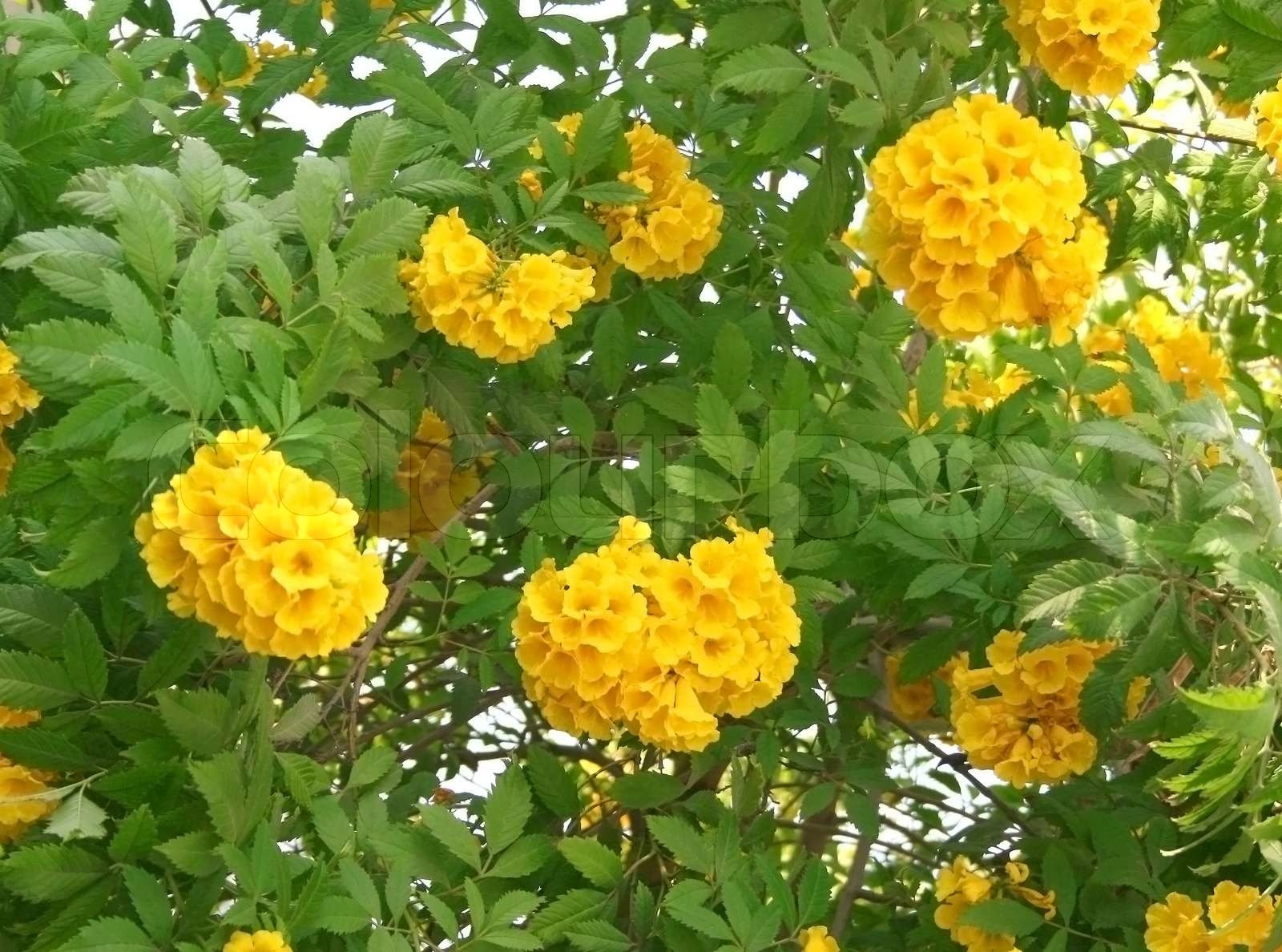
You’re driving down a suburban street or hiking a trail in late March, and suddenly, it hits you. A massive, unapologetic explosion of gold. It’s a tree covered in yellow flowers, and honestly, it’s enough to make you pull the car over just to stare. But what is it? People usually default to calling everything a "Mimosa" or a "Laburnum," but the truth is way more diverse. Nature has a very specific set of reasons for using that high-visibility pigment. It’s all about the bees.
Yellow is one of the most visible colors to pollinators. While humans see a pretty backyard ornament, a honeybee sees a giant neon "Eat Here" sign. Identifying these trees isn't just about being a plant nerd. It’s about knowing if that tree is going to drop messy seed pods on your driveway or if it’s an invasive species that’s quietly choking out your local ecosystem.
The Early Bloomers: Forsythia and Witch Hazel
If you see yellow flowers on a tree before the leaves even show up, you’re likely looking at one of the early spring "scouts." The Forsythia is the classic. Technically, it’s a large shrub, but many people prune it into a small tree shape. It’s the first real sign that winter is losing its grip. Its flowers are four-petaled and grow in dense clusters along the woody stems.
Then there’s the Witch Hazel (Hamamelis). This one is weird. In the deep chill of January or February, while everything else is dormant, Witch Hazel unfurls these tiny, ribbon-like yellow petals that look like shredded paper. It’s incredibly fragrant. If you’re standing near one on a cold day, the scent is spicy and sweet. It’s a survival strategy. By blooming when nothing else does, it gets the undivided attention of the few brave insects out in the cold.
The Golden Chain Tree: Beautiful but Deadly
The Golden Chain Tree (Laburnum × watereri) is the one that looks like it belongs in a Victorian novel. It’s famous for its long, drooping racemes of pea-like yellow flowers. Some of these clusters can reach nearly 20 inches in length. It’s breathtaking. Seriously. But there’s a catch.
Everything about this tree is toxic.
The seeds contain cytisine, which is an alkaloid that’s chemically similar to nicotine but far more dangerous if ingested. If you have curious toddlers or dogs who like to chew on sticks, this might not be the tree for your yard. It’s a classic case of "look but don't touch." It prefers cooler climates, so if you’re in the scorching heat of the American South, you’re probably not seeing a Laburnum; you’re likely seeing a Goldenrain tree instead.
Identifying the Goldenrain Tree
The Goldenrain Tree (Koelreuteria paniculata) is a different beast entirely. It blooms much later, usually in mid-summer when most other flowering trees have already gone green. It doesn't have those long, pendulous chains. Instead, it produces upright panicles of tiny, star-shaped yellow flowers.
When the flowers die off, they fall to the ground like golden "rain," hence the name. But the real giveaway for this species is the seed pods. They look like little Chinese lanterns made of thin, papery husks. They start off green, turn yellow, and eventually become a burnt orange or brown. They are beautiful, but be warned: this tree is a prolific self-seeder. If you plant one, you will find tiny Goldenrain saplings popping up in every flower bed for miles.
The Southern Showstopper: Yellow Tabebuia
If you live in Florida, Southern California, or anywhere tropical, the Yellow Tabebuia (Handroanthus chrysotrichus) is the king of the landscape. Locally, people often call it the "Gold Tree."
It’s spectacular.
The flowers are trumpet-shaped and grow in thick, fuzzy clusters. When it’s in full bloom, the tree often loses all its leaves, leaving nothing but a skeleton of brilliant yellow. It’s a native of Brazil and thrives in heat. Gardeners love it because it’s relatively drought-tolerant once it gets established. However, the wood is somewhat brittle. A strong thunderstorm can snap branches, so it’s not the best choice for planting right next to your roofline.
Why the Yellow Matters to the Ecosystem
Yellow flowers on a tree aren't just an aesthetic choice by evolution. According to research from the University of Sussex’s Goulson Lab, bees have a strong innate preference for the blue-purple end of the spectrum but are highly attracted to yellow because it usually signals high-pollen rewards.
Think about the Tulip Tree (Liriodendron tulipifera). It’s one of the tallest hardwoods in North America. Its flowers are a greenish-yellow with a bright orange band at the base. Because these trees are so tall, you might not even notice the flowers until they fall on your lawn. These flowers are essentially massive cups of nectar. A single Tulip Tree can produce enough nectar to support entire colonies of honeybees, which then produce some of the best "Tulip Poplar" honey you’ll ever taste.
Common Misidentifications and the Invasive "Lookalikes"
Be careful with the Acacia. Specifically, the Silver Wattle (Acacia dealbata). It has those puffy, pom-pom-style yellow flowers that look like something out of a Dr. Seuss book. While it's stunning, it’s considered invasive in many parts of the world, including parts of California and South Africa. It grows fast—too fast. It can outcompete native plants and change the soil chemistry by "fixing" nitrogen, which sounds good but actually makes the ground less hospitable for native species that are used to nutrient-poor soil.
Then there's the Palo Verde. If you’re in the desert Southwest, this is the tree with the green bark. The name literally means "green pole." In the spring, the entire canopy turns into a yellow haze. It’s a master of survival. Because the bark contains chlorophyll, the tree can actually photosynthesize even when it drops its leaves to save water during a drought.
How to Tell Them Apart Quickly
Look at the leaf shape. That’s your biggest clue.
- Heart-shaped leaves? Might be a Redbud (some varieties have yellow foliage) or a Tulip Tree.
- Feathery, fern-like leaves? Probably an Acacia or a Yellow Poinciana.
- Small, oval leaves on a green trunk? Definitely a Palo Verde.
- Three-lobed leaves like a maple? Check for the Norwegian Maple, which has clusters of yellow-green flowers in early spring.
Practical Steps for Your Landscape
If you’re looking to add some of this "living sunshine" to your own yard, don't just buy the first yellow-flowering tree you see at the nursery. You’ve got to check your USDA hardiness zone first.
Start by testing your soil pH. Most yellow-flowering trees, especially the Magnolia 'Elizabeth' (which has stunning creamy yellow blooms), prefer slightly acidic soil. If your soil is too alkaline, the leaves will turn yellow (chlorosis), but not in a good way—it means the tree is starving for iron.
Check the drainage. Most of these species hate "wet feet." If you plant a Goldenrain tree in a swampy spot, it’ll rot before you see a single bloom. Dig a hole, fill it with water, and see how long it takes to disappear. If it’s still there after an hour, you need to pick a different spot or a different tree.
Lastly, consider the "mess factor." Trees like the Sweet Acacia smell like heaven—literally like violet candy—but they drop spent blooms and seed pods. If your goal is a pristine, leaf-free pool deck, look toward something like a yellow-flowered Dogwood (Cornus mas), which is much tidier.
Identify the space you have. A Tulip Tree will eventually hit 80 feet tall. Don't plant it under a power line. A Forsythia or a Witch Hazel stays manageable. Match the tree's ultimate size to your actual acreage. It saves you from the "butcher prune" ten years down the road when the tree starts taking over your house.
Verify the species' status in your local area by checking the Invasive Plant Atlas. If you live in an area where Acacias or Goldenrain trees are encroaching on wildlands, opt for a native alternative like the Yellow Buckeye (Aesculus flava). It offers the same visual punch without the ecological guilt. Get your soil tested by a local university extension office to ensure you’re providing the specific micronutrients these heavy bloomers need to maintain that vibrant pigment year after year.



