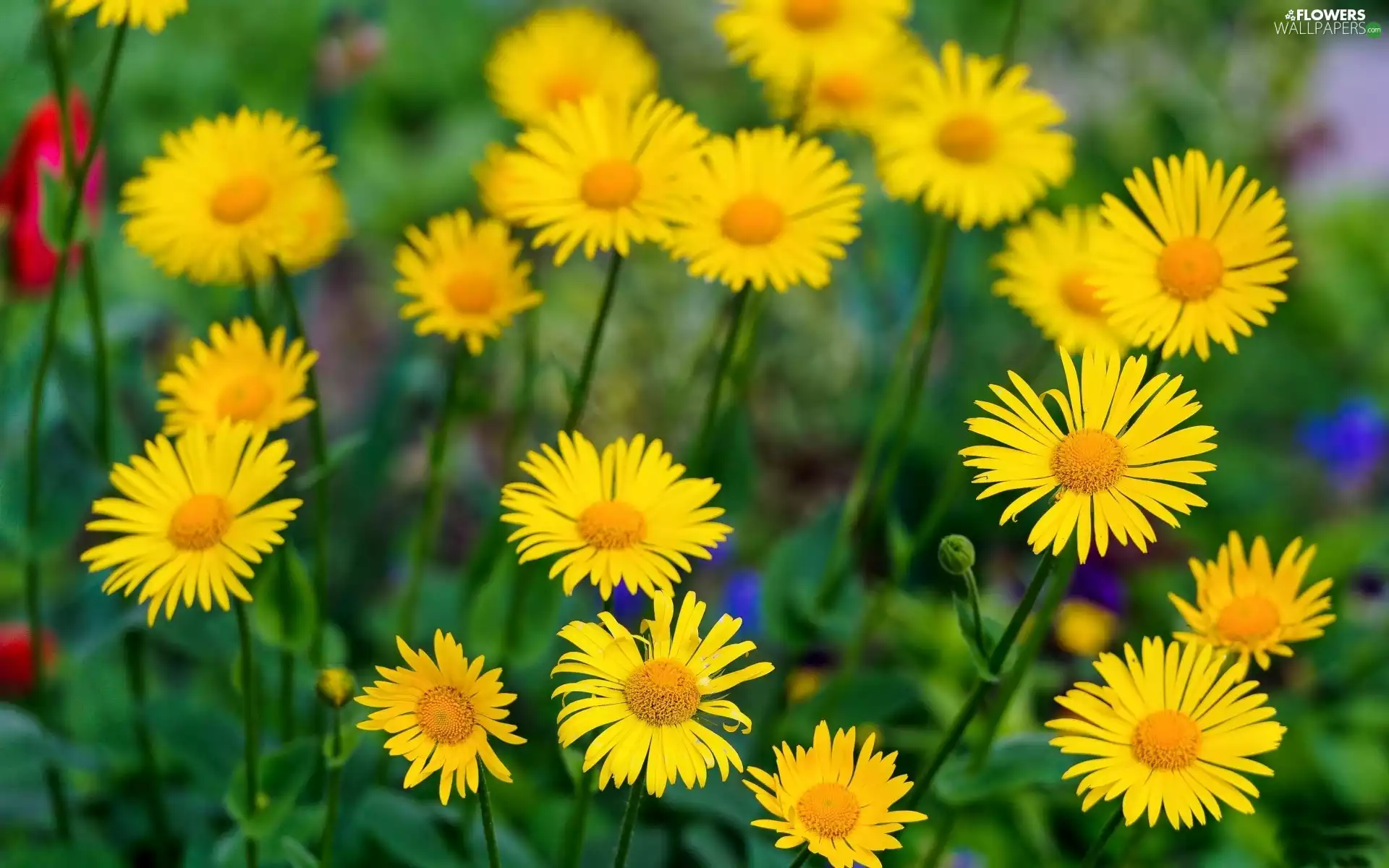
You’re looking at a splash of gold in the garden and thinking, "Hey, that's a daisy." But is it? Most people call anything with a central disk and radiating petals a daisy, but in the world of botany, that yellow flowers daisy like shape belongs to a massive family called Asteraceae. It’s a huge group. Honestly, it’s one of the biggest plant families on Earth. You’ve got everything from high-altitude alpine survivors to the weeds cracking through your driveway.
Identification is tricky. It really is. You see a yellow petal and a dark center and think Black-eyed Susan. Maybe. Or maybe it’s a False Sunflower. Or a Tickseed. Or a Leopard's Bane.
Why We Confuse Yellow Flowers Daisy Like Species
Biology is messy. Evolution loves a good design, and the "composite" flower head is a winner. What you see as one "flower" is actually a community. A village. The center is made of hundreds of tiny "disk florets," and those "petals" on the outside are actually individual "ray florets." It's a clever trick to attract bees.
If you want to know what you’re actually looking at, you have to look past the color. Look at the leaves. Are they fuzzy? Are they jagged? Does the stem bleed milky sap when you break it? Most people ignore the foliage, but the leaves tell the truth when the flowers are lying to you.
The Heavy Hitters: Rudbeckia and Its Lookalikes
When someone mentions yellow flowers daisy like in appearance, they’re usually picturing Rudbeckia hirta. The Black-eyed Susan. It’s the classic American wildflower. You’ll find them in meadows, highway medians, and expensive landscaping. They have that iconic chocolate-brown, dome-shaped center. The petals are stiff, almost like construction paper.
But wait. There’s Rudbeckia fulgida ‘Goldsturm.’ It looks almost identical to the casual observer. However, ‘Goldsturm’ is a perennial that spreads by rhizomes, creating a dense carpet, whereas the basic hirta is often a short-lived biennial. It’s a subtle difference until three years pass and one plant has taken over your entire flower bed while the other just disappeared.
Then there’s the Coneflower. Specifically Echinacea paradoxa. Most people think Coneflowers are purple. Nope. This specific species is bright yellow. It looks so much like a Black-eyed Susan that even seasoned gardeners get tripped up. The giveaway? The central cone is much larger and pricklier. If you touch it and it feels like a tiny, wooden hedgehog, it’s an Echinacea.
The Shady Characters: Leopard’s Bane
Not every yellow daisy wants the sun. Doronicum, commonly known as Leopard’s Bane, is a bit of an oddball. It blooms in early spring when most other yellow flowers daisy like species are still just tiny green nubs in the dirt.
It loves the shade. That's rare for this family. Most daisies are sun-worshippers. If you see a bright yellow daisy under an oak tree in May, it’s probably Doronicum. The leaves are heart-shaped and bright green, looking nothing like the rough, scratchy leaves of a sunflower or a Rudbeckia. It’s a delicate plant, but it packs a punch of color when the rest of the garden is still waking up from winter.
Coreopsis: The "Tickseed" Confusion
Coreopsis is a staple. It’s everywhere. Why? Because you can’t kill it. Well, it’s hard to. These yellow flowers daisy like plants are often called Tickseeds because their seeds look like tiny little bugs. Kinda gross, but helpful for ID.
There are dozens of species. Coreopsis verticillata has thread-like leaves. It looks like a cloud of yellow mist from a distance. Then you have Coreopsis grandiflora, which has much larger, more traditional daisy-shaped heads.
The interesting thing about Coreopsis is the "pinked" edges. If you look closely at the tip of each petal, it looks like someone took a pair of serrated craft scissors to them. They aren't smooth. They have tiny notches. If the petals are notched, you’re almost certainly looking at a Coreopsis.
Helenium: The Sneezeweed Misnomer
Despite the name, Sneezeweed won't make you sneeze. It was historically used to make snuff, which did make people sneeze to "expel spirits," hence the name. Helenium autumnale is a powerhouse of the late summer garden.
These yellow flowers daisy like beauties have a very distinct feature: the petals wedge-shaped and they actually droop backward, away from the center. It looks like the flower is facing a strong wind. The center is a prominent, spherical ball that sticks out. It’s almost architectural.
They love wet feet. If you have a spot in your yard that stays soggy after a rain, most daisies will rot. Not Helenium. They’ll thrive there and grow five feet tall if you let them.
The Giants: Sunflowers and Silphiums
We can't talk about yellow daisy shapes without mentioning the behemoths. Helianthus annuus is the common sunflower, but there are dozens of perennial sunflowers that look more like "normal" daisies. Helianthus decapetalus, the Thin-leaf Sunflower, produces hundreds of small yellow flowers daisy like in structure on a bush that can reach six feet.
Then there’s Silphium perfoliatum, the Cup Plant. It’s a monster. The leaves are fused together around the stem, forming a little "cup" that holds rainwater. Birds actually drink from it. The flowers are bright yellow, perfectly daisy-shaped, and hover way up in the air.
It’s easy to mistake Silphium for a sunflower. But look at the stem. Sunflowers have round stems. Silphium has a square stem. If you can feel four distinct corners when you run your fingers down the stalk, you’ve found a Cup Plant.
Wildflowers or Weeds?
Sometimes that yellow flower is just a weed. Or is it? Hieracium, or Hawkweed, looks like a dandelion on a long, thin, leafless stalk. People hate them in their lawns. But in a meadow, they provide essential nectar for specialist bees.
Dandelions themselves are technically yellow flowers daisy like in their anatomy, but they are "all rays." They don't have that distinct central disk. Once you notice that, you can never un-see it.
How to Grow Them Without Losing Your Mind
If you want these in your garden, you need to understand their "personality." Most yellow daisy-like plants are "pioneer species." In the wild, they are the first ones to show up after a fire or a landslide. They grow fast, bloom hard, and drop a ton of seeds.
In a manicured garden, this can be a problem. Coreopsis and Rudbeckia will self-seed everywhere. You’ll find them in your gravel path. You’ll find them in your rose bushes.
- Deadheading is mandatory. If you don't want a thousand babies next year, cut the flowers off as soon as they fade.
- Airflow matters. These plants are prone to powdery mildew. It looks like someone dusted your plants with flour. Space them out. Don't crowd them.
- Division is your friend. Every three years, dig the clump up, chop it in half with a shovel, and replant. It keeps the plant vigorous.
Why They Turn Brown
It’s the number one complaint. "My yellow daisies look crispy." Usually, it’s not a lack of water. It’s Septoria leaf spot. It’s a fungus that starts at the bottom of the plant and moves up. By August, the bottom half of your Black-eyed Susans might look like burnt toast.
The fix? It’s tough. You can use fungicides, but honestly, just planting them behind shorter, sturdier plants like Sedum or ornamental grasses hides the "ugly legs" of the daisies. It’s a classic landscaping trick.
The Ecological Impact
These aren't just pretty faces. Yellow flowers daisy like species are the gas stations of the insect world. Because the "center" is actually hundreds of tiny flowers, a bee can sit in one spot and drink from dozens of nectar sources without moving. It's efficient.
Goldfinches love them too. If you leave the dried seed heads up in the winter, you’ll see bright yellow birds clinging to the stalks, picking out the seeds. It’s a bit messy, sure. But watching a finch feast on a frozen January morning is worth a little garden untidiness.
Taking the Next Steps with Your Yellow Daisies
Identifying these plants is the first step toward a better garden. Start by looking at the leaves of that yellow flower. If the leaves are deeply lobed and scratchy, it’s likely a Rudbeckia. If they are smooth and narrow, check for Coreopsis.
Once you’ve identified what you have, check the soil moisture. If you have Helenium in dry sand, move it to a wetter spot this fall. If your Coreopsis is flopping over, it needs more sun and less fertilizer—they actually prefer "lean" soil.
Keep a small hand lens in your pocket. Looking at the tiny disk florets in the center of a yellow daisy-like flower reveals a whole world of geometric patterns that you simply can't see from a standing position. It changes how you see your yard. Instead of a sea of yellow, you start to see the individual "villages" of the Asteraceae family.
Observe which insects visit which flowers. You might notice that certain small sweat bees only visit the Coreopsis, while the big bumblebees prefer the sturdy "landing pads" of the Rudbeckia. This data helps you choose what to plant next season to support your local ecosystem. Stop treating them as a generic category and start seeing the specific needs of each species. Your garden will look better, and your local pollinators will definitely thank you.



