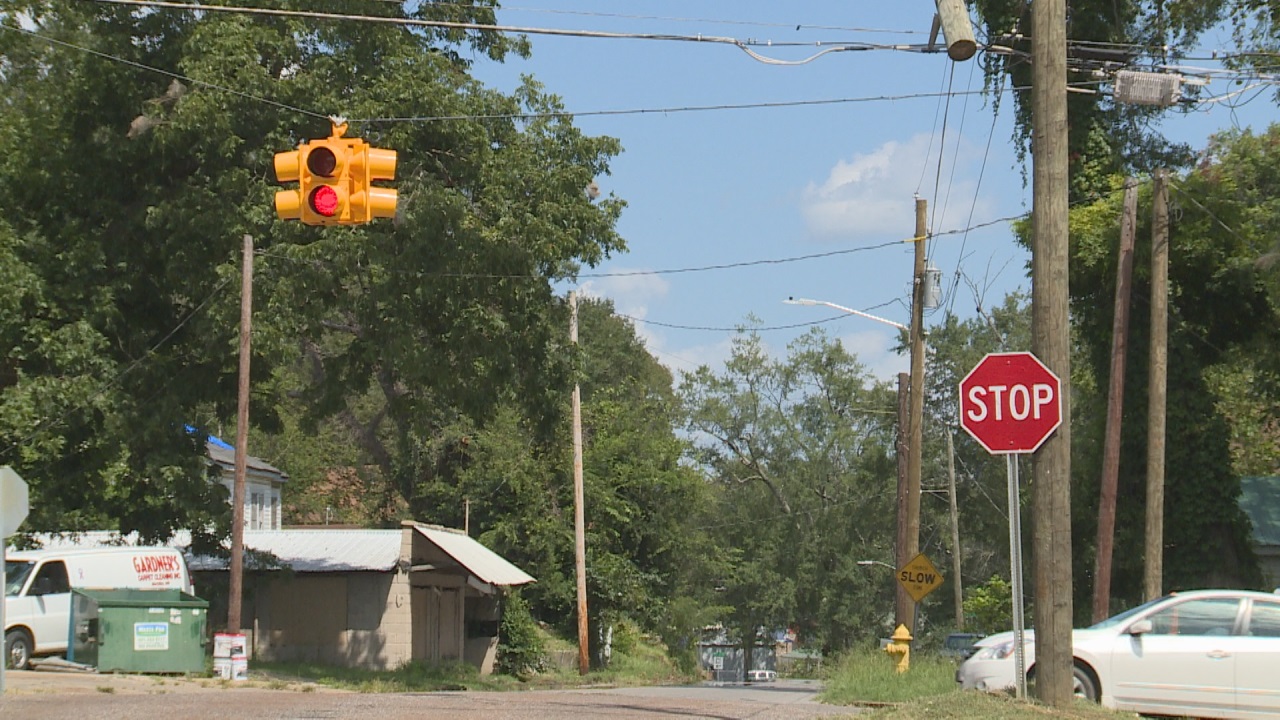
You're driving home late. The streets are mostly empty, but as you approach the main crossroad, the familiar rhythm of the traffic signals has changed. Instead of the standard green-yellow-red cycle, there is a rhythmic, pulsing glow. A yellow flashing light at intersection points can feel like a bit of a gray area if you haven't looked at a driver's manual in a decade. Most people just coast through. Some people slam on their brakes because they confuse it with a flashing red.
It's a mistake that causes thousands of preventable accidents every year.
According to the Federal Highway Administration (FHWA), intersection-related crashes make up about 50% of all combined fatal and injury crashes. A significant chunk of those happen when signal patterns change or when drivers misinterpret "caution" as "free-for-all." If you see that amber pulse, you don't have to stop, but you absolutely cannot just maintain your speed and hope for the best.
The Actual Law Behind the Pulse
Let's be real: traffic laws vary slightly by state, but the Manual on Uniform Traffic Control Devices (MUTCD) is the "bible" for road signs and signals in the United States. It’s the reason a stop sign in Maine looks exactly like one in California. Under the MUTCD, a yellow flashing light at intersection transitions means one specific thing: "Proceed with caution."
It's a warning. It is the road's way of saying, "Hey, something is different here."
Typically, you’ll see these in two scenarios. First, during "night mode" or low-traffic hours where the city decides it’s more efficient to let the main artery flow without stopping. Second, it’s a fail-safe. If a traffic controller experiences a partial malfunction, it might default to a flashing yellow for the primary road and a flashing red for the side streets.
Here is where the danger lives. If you have the yellow, the guy on the cross-street has a flashing red. He is supposed to stop and yield to you. But if you're both guessing what the other is doing, metal meets metal.
Why do cities even use them?
Fuel efficiency is a big one. Idling at a red light when there isn't a single car for three miles is a waste of gas and time. By switching to a yellow flashing light at intersection zones during the 2:00 AM slump, municipalities reduce carbon emissions and keep freight moving.
Engineers also use them to highlight "blind" intersections. If there's a hill or a curve right before a crossing, a permanent flashing yellow beacon acts as a visual shout to wake up.
The Right Way to Drive It
Don't be the person who stops dead in the middle of the road. That's how you get rear-ended by a semi-truck that was expecting you to keep moving. But also, don't be the person who doesn't even lift their foot off the accelerator.
Cover the brake. This is a racing term that applies perfectly to defensive driving. You don't necessarily need to slow down to a crawl, but you should take your foot off the gas and hover it over the brake pedal. This cuts your reaction time in half if a distracted driver on the cross-street decides to "roll" their flashing red light.
Scan left. Scan right. Scan left again.
It sounds like Driver's Ed 101, but at 40 miles per hour, you’re covering about 60 feet every second. By the time you realize the other car isn't stopping, you've already traveled the width of the intersection.
Misconceptions That Cause Wrecks
People get confused when they see a yellow flashing light at intersection turns, specifically left-hand turns. We've all seen the newer "Flashing Yellow Arrow."
This is different from a circular flashing yellow.
The flashing yellow arrow means you can turn left, but you must yield to oncoming traffic and pedestrians. It replaced the old "circular green" for left turns in many states because humans are surprisingly bad at understanding that a green circle doesn't mean "go" for a left turn—it means "go if it's clear." Studies by the National Cooperative Highway Research Program (NCHRP) found that drivers are much less likely to make a mistake when they see a flashing yellow arrow versus a solid green ball. It just feels more like a warning.
The "Four-Way Stop" Myth
There is a persistent myth that if any light is flashing, the whole intersection becomes a four-way stop.
This is false. If you have a flashing yellow and you treat it like a stop sign, you are creating a predictable hazard. The drivers behind you aren't expecting a full stop. If you stop, and the person on the cross-street (who has a flashing red) thinks you are "waving them through," they might pull out right as a car in the lane next to you blows through the yellow light at full speed.
It’s called the "Trap of Politeness." Don't be polite. Be predictable.
The Engineering Perspective
Road designers don't just flip a switch and hope for the best. The decision to use a yellow flashing light at intersection layouts is based on "Warrants." These are specific sets of criteria involving traffic volume, pedestrian counts, and crash history.
If an intersection has a high rate of "T-bone" collisions, engineers will usually pull the plug on flashing yellows and revert to a standard 24-hour red-yellow-green cycle.
Interestingly, some European countries have moved away from flashing yellows entirely, preferring roundabouts. Why? Because roundabouts force a reduction in speed without the ambiguity of a pulsing light. But in the grid-heavy United States, the flashing yellow remains a staple of traffic management.
What to Do If the Power Is Out
Sometimes, a yellow flashing light at intersection signals isn't intentional. It's a glitch. Or worse, the light is completely dark.
If the light is dark, the rules change completely. In almost every jurisdiction, a dead traffic signal must be treated as a four-way stop. This is not the same as a flashing yellow. If there is no light at all, you stop, you look, and you take turns.
If the light is flashing yellow, you have the right of way, but you keep your eyes peeled for the guy who thinks it's a four-way stop.
Real-World Consequences of Misunderstanding
Insurance companies are notoriously brutal when it comes to flashing light accidents. If you are involved in a crash while passing through a yellow flashing light at intersection crossing, the investigation will focus heavily on whether you "exercised due caution."
Simply having the right of way isn't a "get out of jail free" card. If a lawyer can prove you didn't slow down or that you were speeding through a flashing yellow, you could be found partially at fault. This is known as "comparative negligence."
Think about it this way: the light is literally telling you there is a hazard. Ignoring a warning is a bad look in a courtroom.
Surprising Statistics
- Intersections with flashing yellow arrows for left turns have shown a 20% reduction in "left-turn-across-path" crashes compared to traditional signals.
- Nearly 30% of drivers admit to being "unsure" of the exact legal requirement when approaching a flashing yellow circle.
- Nighttime accidents at these intersections are frequently linked to "look-but-failed-to-see" errors, where the driver sees the yellow light but fails to perceive the car waiting at the red light on the cross-street.
Actionable Steps for Your Next Drive
When you see that amber glow ahead, don't panic, but don't go on autopilot.
- Check your rearview mirror. See who is tailgating you. If you have to brake suddenly because a car jumps out, you need to know if the guy behind you is going to end up in your trunk.
- Adjust your speed. You don't need to slam the brakes, but dropping 5-10 mph gives you significantly more time to react.
- Identify the cross-traffic. Look at the light facing the other street. If you can see it’s a flashing red, you know they should stop, but you also know they might be impatient.
- Watch for pedestrians. Flashing yellows often appear in areas where foot traffic is low at night, but that’s exactly when people are most likely to jaywalk or misjudge the speed of an oncoming car.
- Differentiate the signal. Make sure it’s a circular yellow (caution, keep moving) and not a flashing yellow arrow (yield to turn left) or a flashing red (stop).
The yellow flashing light at intersection transitions is a tool for efficiency, but efficiency requires every driver to be on the same page. Staying informed isn't just about avoiding a ticket; it's about making sure everyone gets home without a call to an insurance adjuster. Next time you see that pulse in the distance, remember: it's not a green light, and it’s not a red light. It’s a "think for yourself" light.