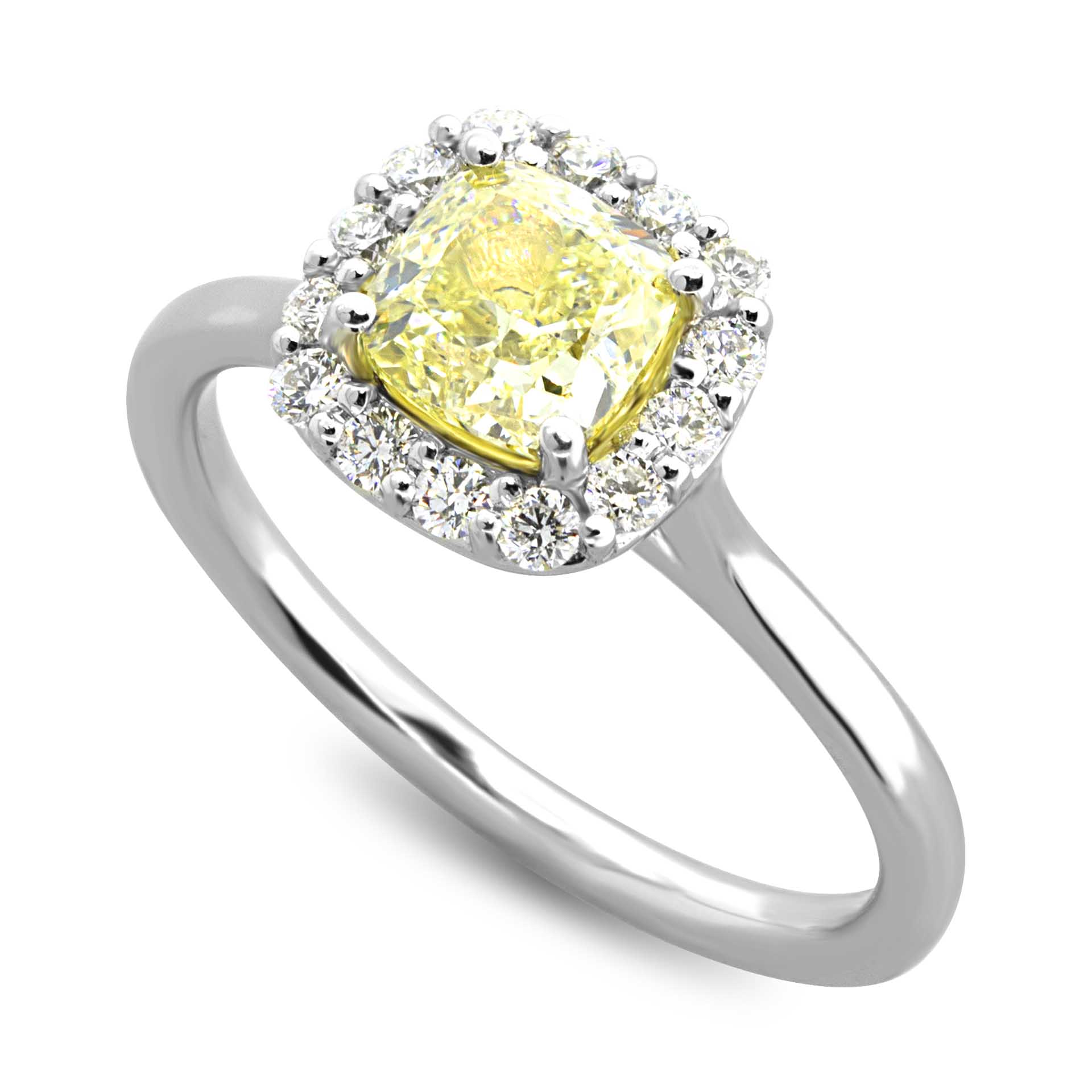
You’ve seen them on the fingers of everyone from Jennifer Lopez to your cousin who just got engaged in Lake Tahoe. The yellow diamond ring is a vibe. It's bold. It's sunny. It’s also incredibly confusing if you’re trying to actually buy one without getting ripped off. Most people walk into a jewelry store thinking they just want "something yellow," but there is a massive technical difference between a "light yellow" diamond and a "Fancy Vivid Yellow" stone. One is a mistake of nature; the other is a masterpiece.
Let's be real.
The diamond industry is built on the "4 Cs," but when it comes to yellow stones, the rules basically get thrown out the window. Color is king. Everything else? It’s just noise. If you buy a yellow diamond based on clarity alone, you’re doing it wrong. I've seen VS1 stones that look like frozen lemonade in a bad way, and SI2 stones that glow like a sunset.
Why a Yellow Diamond Ring Isn't Just a "Stained" White Diamond
Nitrogen. That's the secret sauce. When nitrogen atoms replace carbon atoms in the diamond’s crystal lattice during its formation millions of years ago, the stone begins to absorb blue light. This reflects back as yellow. But here is where it gets tricky for your wallet. In the world of "white" or colorless diamonds, nitrogen is the enemy. It makes a stone look "off-white" or "dingy." These are graded on a scale from D to Z.
Once you cross that Z line? The game changes.
Suddenly, that yellow tint isn't a flaw anymore. It's a "Fancy" color. The GIA (Gemological Institute of America) has a very specific way of looking at this. They look for Hue, Tone, and Saturation. If a stone has just a whisper of yellow, it’s cheap. If it looks like a drop of pure sunshine caught in carbon, you're looking at a five-figure price tag or higher.
Honestly, the "Fancy Intense" and "Fancy Vivid" categories are where the magic happens. A "Fancy Light" yellow diamond ring can look a bit washed out in certain lighting, almost like it’s just a white diamond that needs a good cleaning. You don't want that. You want "Canary." While "Canary" isn't an official GIA term—it's just marketing talk—it usually refers to those high-saturation stones that make people stop you in the grocery store to look at your hand.
The Zimmi Factor
Have you ever heard of the Zimmi mine? Most people haven't. It’s in Sierra Leone, and it produces some of the most insanely saturated yellow diamonds on the planet. These stones have a specific "open" color that doesn't go dark even in low light. While most yellow diamonds are Type Ia, many of these ultra-bright stones have a different atomic structure. If a jeweler mentions "Zimmi" to you, they aren't just making up a word to sound fancy. They're talking about the gold standard of saturation.
The Setting Can Make or Break the Look
This is where people lose money. You can actually "cheat" the color of a yellow diamond ring if you know what you're doing.
If you take a Fancy Light yellow diamond and set it in a platinum or white gold basket, the white metal will wash out the yellow. It’ll look pale. But, if you use a yellow gold cup or "basket" underneath the stone, the gold reflects through the diamond. It acts like a megaphone for the color.
I’ve seen "Fancy" stones look "Fancy Intense" just because the jeweler was smart with the metal.
- Use 18k yellow gold prongs.
- Avoid thick white gold bezels that overlap the stone.
- Consider "halo" settings with white diamonds to create a contrast that pops the yellow center.
But wait. There's a downside. If you're buying a loose stone, always ask to see it against a white background and on the back of your hand. Jewelers love to show these stones on yellow tweezers or against gold backgrounds to hide a weak saturation. Don't fall for it.
The Shape Matters More Than You Think
You’ll notice that almost every yellow diamond ring you see is a Cushion cut or a Radiant cut. There is a reason for this that isn't just "style." Round brilliant cuts are designed to return white light (brilliance). They actually dilute color. If you cut a yellow diamond into a round shape, it might lose its "Fancy" grade because the light bounces out too fast.
Cushion and Radiant cuts have "crushed ice" faceting patterns. This traps the light inside the stone for longer. The longer the light bounces around inside, the more yellow it picks up from those nitrogen atoms. This is why a 1-carat Radiant yellow diamond will almost always look more "yellow" than a 1-carat Round yellow diamond of the same grade.
The Price Gap Nobody Explains
Let’s talk numbers, because the price curve for a yellow diamond ring is a total mountain.
A 1-carat Fancy Yellow diamond might cost you $4,500 to $7,000 depending on the clarity. But move up just one grade to Fancy Intense? Now you're looking at $10,000 to $15,000. Go to Fancy Vivid? You’re entering the $20,000+ range for a single carat.
It's exponential.
Fluorescence is another weird one. In white diamonds, strong blue fluorescence is often seen as a negative because it can make the stone look oily. In yellow diamonds, blue is the literal opposite of yellow on the color wheel. If a yellow diamond has strong blue fluorescence, it can actually cancel out some of the yellow color in sunlight, making the stone look duller. Most collectors look for "None" or "Faint" fluorescence in yellow stones. If you see a "Very Strong" blue fluorescence on a GIA report for a yellow diamond, that's why the price is so much lower. It’s a "discount" stone for a reason.
Secondary Hues: The "Brown" Kiss of Death
When you read a GIA report for a yellow diamond ring, you'll often see two colors. "Fancy Brownish Yellow" or "Fancy Greenish Yellow."
Greenish is actually cool. It gives the stone a neon, electric look that some people pay a premium for. But "Brownish" or "Brown-Yellow"? That’s where the value drops off a cliff. Brown undertones make the diamond look "warm" or "earthy," which is fine if that’s your style, but it’s not a good investment. These stones are significantly cheaper.
Always look for a "straight" color. You want the report to just say "Fancy Yellow" or "Fancy Intense Yellow." No modifiers. No "ish."
Why Celebs Are Obsessed With Them
It’s not just about the money. Yellow diamonds are actually rarer than white diamonds, but they aren't as rare as pinks or blues. This makes them the "accessible" exotic.
Take the Tiffany Diamond. It’s one of the most famous stones in the world—a 128.54-carat yellow cushion cut. It’s been worn by Audrey Hepburn, Beyoncé, and Lady Gaga. When people see a yellow diamond ring, they instinctively associate it with that level of prestige. It feels like "old money" in a way that a massive white diamond sometimes doesn't.
But you don't need Tiffany money.
Lab-grown yellow diamonds have flooded the market recently. You can get a 2-carat Vivid Yellow lab diamond for under $2,000. Is it "real"? Chemically, yes. Is it a good investment? Absolutely not. Lab-grown colored diamonds have zero resale value because they can be mass-produced in a factory in India or China. If you're buying for love and looks, lab is fine. If you're buying as an heirloom, stick to natural.
Sustainability and Sourcing
The Argyle mine in Australia was famous for pinks, but it also produced some "Champagne" and "Cognac" stones that leaned yellow. With Argyle closed, the supply of high-end colored stones is tightening. Most yellow diamonds now come from South Africa (the Ellendale mine was a big player too). If you're worried about ethics, look for "Canadamark" yellow diamonds or stones with GIA "Origin" reports. It's becoming easier to track a stone from the dirt to your finger.
Buying Strategy: The "Sweet Spot"
If you want the best bang for your buck in a yellow diamond ring, here is the insider play:
- Target the "Fancy Yellow" grade (not light, not intense).
- Prioritize "Eye Clean" over "Flawless." You cannot see tiny inclusions in a yellow diamond as easily as you can in a white one. An SI1 or SI2 clarity grade can save you 30% without changing the look of the ring.
- Go for a Radiant Cut. It maximizes color and usually has a larger "face-up" size than a cushion cut of the same weight.
- Demand a GIA report. Don't accept an "in-house" appraisal or a lesser-known lab like EGL. In the colored diamond world, GIA is the only word that matters. If the jeweler won't show you a GIA certificate, walk away.
- Check for "Internal Grain lines." Sometimes yellow diamonds have graining that looks like streaks. If the report says "Graining not shown," it's usually fine. If it says "Heavy internal graining," it might look blurry.
Buying a yellow diamond is an emotional purchase, but it needs a logical approach. You’re buying a piece of history that spent billions of years getting its color from a specific atmospheric fluke. Treat it like art.
Moving Forward With Your Purchase
Once you’ve decided on a budget, your next move is to find a specialist. Most "mall" jewelers carry maybe one or two yellow stones, and they’re usually low quality. You want to look for a dealer who specializes in "Fancy Colors."
Ask them for a "side-by-side" comparison. See a Fancy Yellow next to a Fancy Intense. You might realize that your eyes can't even tell the difference between the two, which could save you five grand instantly. Also, ask to see the stone in natural daylight. Jewelry store lights are designed to make everything look amazing. Take the stone to a window. If it still glows when the sun hits it, you’ve found the one.
Check the girdle of the stone for a laser inscription that matches the GIA report. It's a tiny number you can see under a microscope. This ensures that the stone in the ring is actually the stone you paid for.
Lastly, make sure your insurance policy specifically mentions the color grade. If you lose a "Fancy Intense" ring and the insurance company tries to replace it with a "Fancy Light," you’re losing a fortune. Detail matters.
Practical Steps for Buyers:
- Request a high-definition video of the diamond in "North Light" (indirect sunlight) before buying online.
- Verify the GIA report number on the official GIA Check website.
- Ensure the setting uses 18k yellow gold for the basket, even if the band is platinum.
- Avoid diamonds with "Medium" or "Strong" blue fluorescence to prevent a "cloudy" appearance in sunlight.
- Prioritize Hue over Clarity; a "Fancy" color with an eye-visible inclusion is often more valuable than a "Light" color that is internally flawless.



