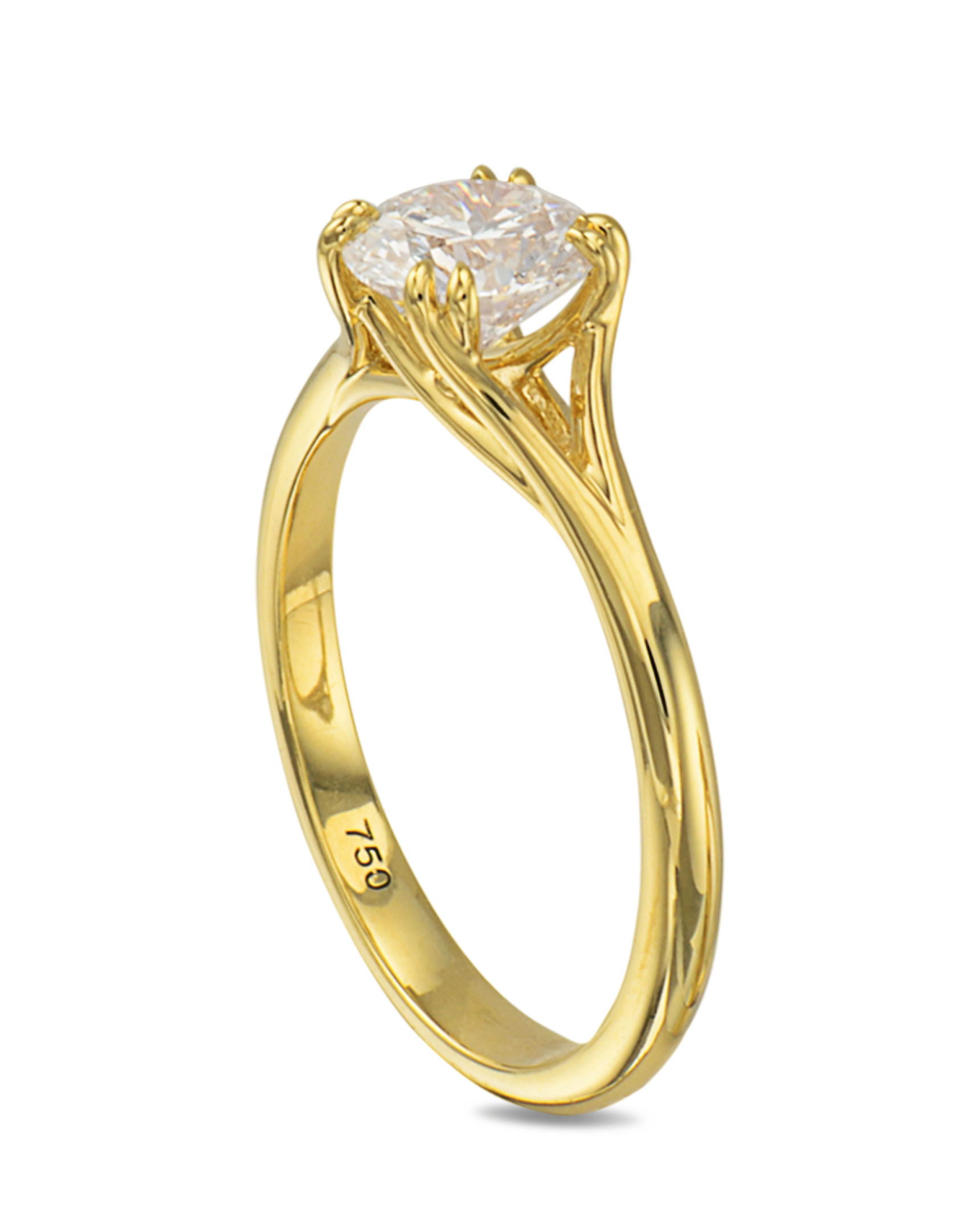
White diamonds are fine. They’re classic. They’re safe. But lately, honestly, they’ve started to feel a bit... expected. If you’ve spent any time looking at yellow diamond engagement rings, you already know they hit differently. They have this warmth, this sort of "liquid sunshine" vibe that a colorless stone just can't mimic.
It isn't just a trend. We aren't just talking about something that popped up on Instagram last week. People have been hunting for these "canary" stones for decades, but the market has shifted dramatically in the last couple of years.
Buying one is tricky. It isn't like buying a standard round brilliant where you just check a box for "G" color and "VS1" clarity. With yellow diamonds, the rules of the GIA (Gemological Institute of America) are flipped on their head. What makes a white diamond "bad" is exactly what makes a yellow diamond expensive.
The Color Trap: Why "White Diamond Logic" Will Fail You
Most people walk into a jewelry store thinking about the 4Cs. They want the D-E-F range—completely colorless. In that world, a hint of yellow is a "flaw." It drops the price. It makes the stone look "off."
But once you cross the "Z" grade on the GIA scale, you enter the "Fancy" range. Suddenly, that yellow isn't a mistake anymore; it’s the whole point.
The color comes from nitrogen. Basically, while the diamond was forming billions of years ago deep in the earth, nitrogen atoms replaced some of the carbon. If there’s just a little nitrogen, you get a dingy, yellowish-white stone that nobody wants. If there’s a lot, you get a yellow diamond engagement ring that glows.
Grading is Kind of a Mess (And That’s Good for You)
You’ll see terms like "Fancy Light," "Fancy," "Fancy Intense," and "Fancy Vivid."
Fancy Vivid is the holy grail. It’s bright. It’s saturated. It’s also incredibly expensive. But here’s the thing—many people actually prefer "Fancy" or "Fancy Intense." Why? Because Vivid can sometimes look almost artificial to the untrained eye, like a piece of Citrine or a yellow sapphire. A "Fancy" grade still looks like a diamond but has that buttery, soft glow that feels more "bridal" to some people.
Leibish Polnauer, a massive name in the world of natural fancy colored diamonds, often points out that the "face-up" color is all that matters. In white diamonds, we look at the stone from the side to grade color. In yellow diamonds? We only care about how it looks from the top.
The Celebrity Effect: It’s Not Just J.Lo
We have to talk about the fame factor. When Jennifer Lopez received a green diamond, the world lost it, but her previous 14-carat yellow diamond from Marc Anthony really cemented the yellow diamond engagement ring in the modern psyche. Then you have Carrie Underwood’s canary yellow halo ring and Heidi Klum’s massive 10-carat yellow stone.
These aren't just "rich people trophies." They represent a move away from the "De Beers standard" of the 1940s. People want something that feels personal.
Setting the Stone: The "Secret" to Making It Pop
I’ve seen people buy a stunning Fancy Intense yellow diamond and then ruin it with the wrong setting.
If you put a yellow diamond in a platinum or white gold basket (the part that actually holds the stone), the white metal will reflect through the diamond. It’ll wash the color out. It makes your expensive yellow stone look like a low-quality white stone.
Always use yellow gold prongs.
Even if the rest of the band is platinum, the basket holding the diamond should be 18k yellow gold. It acts like a mirror, bouncing yellow light back into the stone and intensifying the hue. It’s a literal cheat code for making a "Fancy Light" diamond look like a "Fancy Intense."
Lab-Grown vs. Natural: The Great Debate
This is where things get spicy.
Natural yellow diamonds are rare. Not "red diamond" rare, but definitely rarer than white ones. Because of that, they hold value differently. However, lab-grown technology has mastered the nitrogen infusion process. You can now get a 2-carat, Fancy Vivid yellow diamond engagement ring for a fraction of the cost of a natural one.
Does it matter?
Chemically, they are identical. Emotionally? That’s up to you. If you’re buying for investment or "story," natural wins. If you want the biggest, brightest "wow" factor for a three-month salary budget, lab-grown is the way to go. Just be aware that the resale market for lab-grown stones is basically non-existent.
Shape Matters More Than You Think
You won't find many Round Brilliant yellow diamonds.
The way a round diamond is cut is designed to return white light (brilliance) and hide color. If you cut a yellow diamond into a round shape, you’re literally fighting the stone’s best feature.
Radiant and Cushion cuts are the kings here. Their facet patterns are designed to "trap" light and bounce it around inside the stone, which intensifies the color. An Emerald cut—which is a "step cut"—is much riskier. It’s like a big open window; if the color isn't perfectly even, you’ll see every single patch of weakness.
The Cost Reality Check
Let’s talk numbers. People assume yellow diamonds are always more expensive.
Not true.
A "Fancy Light" yellow diamond can actually be cheaper than a D-color, Flawless white diamond of the same size. It’s only when you get into the "Intense" and "Vivid" categories that the prices start to skyrocket into the stratosphere.
Common Misconceptions About Yellow Diamond Engagement Rings
A lot of people think yellow diamonds are "weak" or "softer" than white diamonds.
That’s total nonsense.
A diamond is a diamond. It’s a 10 on the Mohs scale. It’s the hardest natural substance on Earth. Whether it’s yellow, blue, or white, it’s going to handle daily wear just fine. You don't need to baby it any more than you would a traditional ring.
Another big mistake? Ignoring the "fluorescence."
In white diamonds, strong blue fluorescence is often seen as a negative because it can make the stone look hazy. In yellow diamonds, blue fluorescence can actually neutralize the yellow, making the stone look duller or "greenish" in sunlight. You generally want to look for "None" or "Faint" fluorescence when picking out your stone.
How to Shop Without Getting Ripped Off
- Demand a GIA Report: Don't accept an "in-house" certification. The GIA is the gold standard for grading fancy colors. Other labs can be "soft" on their grading, calling a stone "Fancy" when it’s really just "Fancy Light."
- Look at the Stone in Natural Light: Jewelry store lights are designed to make everything look amazing. Take the stone to a window. See how it looks in the shade. That’s where you’ll see its true soul.
- Check for "Brown" or "Green" modifiers: A GIA report might say "Fancy Brownish Yellow." That "brownish" tag will drop the price significantly. Some people like the "cognac" or "olive" look, but if you want a pure canary yellow, avoid those modifiers.
- Prioritize Cut Over Clarity: You can hide a lot of inclusions (tiny spots) in a colored diamond. A "SI1" clarity yellow diamond often looks perfectly clean to the naked eye. Put that saved money into a better color grade or a larger carat weight.
Actionable Insights for the Savvy Buyer
If you’re ready to pull the trigger on a yellow diamond engagement ring, start by defining your "color floor." Decide if you're okay with a pale, lemony "Fancy Light" or if you absolutely need that "Vivid" punch.
Next, find a jeweler who actually specializes in colored stones. Most mall jewelers carry one or two yellow rings as a novelty. You want someone who has a deep inventory so you can compare shades side-by-side.
Finally, consider a "mismatch" for the side stones. Pair a yellow center stone with colorless trapezoid or half-moon side diamonds. The contrast makes the yellow look even more deliberate and intense. It’s a classic move for a reason. It works.
Skip the white gold prongs, ignore the "round" obsession, and focus on the face-up color. You’ll end up with a ring that doesn't just look like everyone else’s—it’ll look like it has its own heartbeat.
Ensure the GIA certificate mentions "Origin: Natural" if you are paying a premium. For those on a budget, look for "Fancy" grade stones with "Medium" yellow gold settings to "bump" the perceived color. Check the depth percentage on Cushion cuts; anything over 70% might be "hiding" weight in the bottom of the stone where you can't see it, making you pay for carats that don't add to the size. Look for a depth between 60% and 68% for the best visual spread.