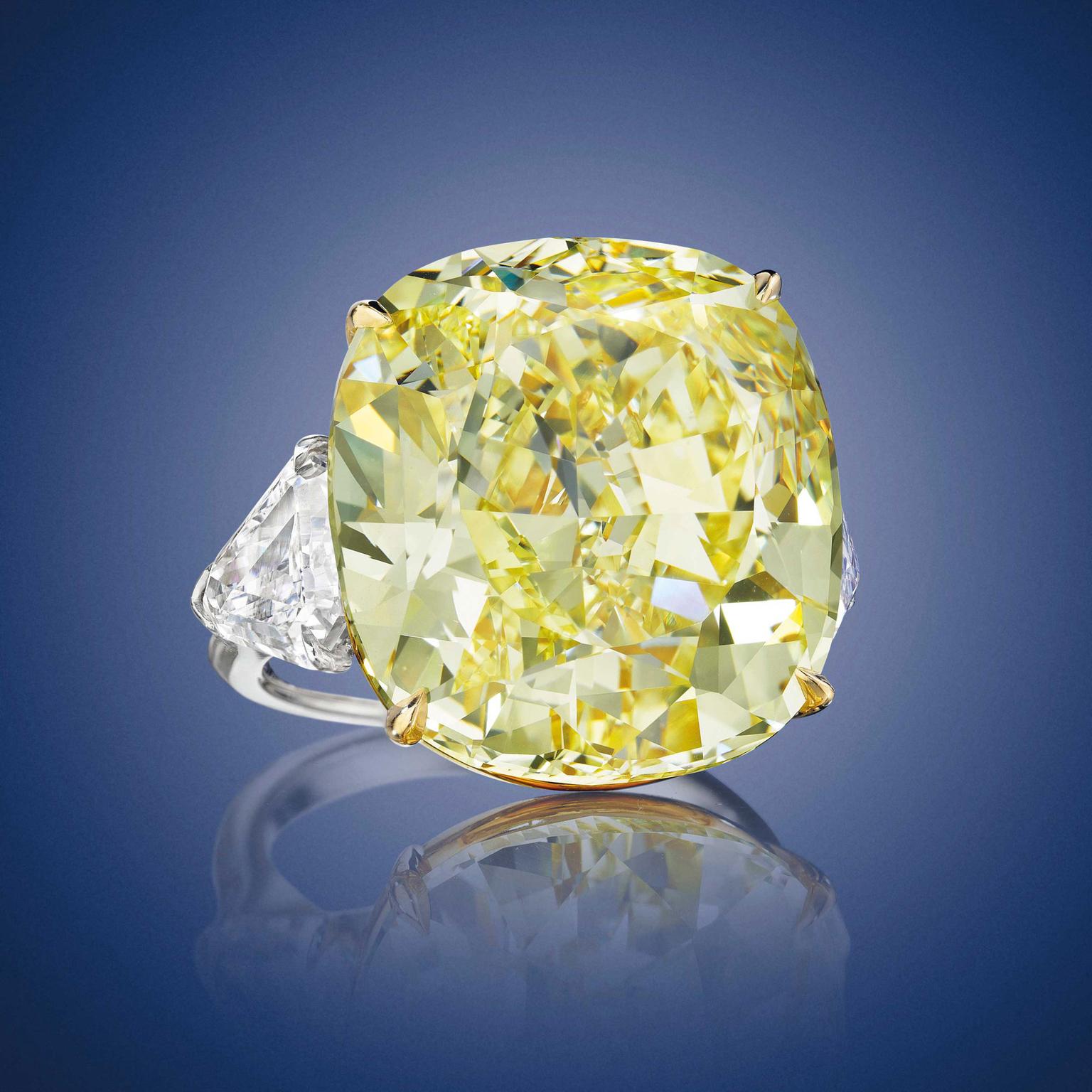
You’ve probably seen them. Those glowing, buttery stones that seem to be everywhere on Instagram and red carpets lately. But there is a massive difference between a yellow diamond cushion cut that looks like a masterpiece and one that just looks like a dingy piece of glass. People think buying a yellow diamond is the same as buying a white one. It isn’t.
Actually, it’s the opposite.
With white diamonds, you’re usually paying for the absence of color. You want a void. With a yellow diamond cushion cut, you are paying for the "soul" of the stone, which is essentially how much nitrogen got trapped in that carbon structure billions of years ago. If you go into a jewelry store and ask for "D color" logic applied to a yellow stone, you’re going to walk out with a very expensive mistake.
Why the Cushion Cut is the "Cheat Code" for Yellow Diamonds
Most people don’t realize that the shape of a diamond changes its color. Honestly, if you take a rough stone that has a faint yellow tint and cut it into a round brilliant, the light will bounce around so fast that the color basically disappears. It washes out.
That’s why you almost never see a round yellow diamond.
The cushion cut—that square-ish shape with rounded corners—is essentially a trap for light. Because it has deeper pavilions and a specific facet arrangement, the light stays inside the stone longer. It bounces around, picking up the yellow hue and intensifying it before it hits your eye. It’s like an echo chamber for color. This is why the GIA (Gemological Institute of America) sees more fancy yellow diamonds in cushion or radiant cuts than anything else.
It’s efficient. It’s smart. It makes a "Fancy Light" look like a "Fancy Intense" if the cutter knows what they’re doing.
Crushed Ice vs. Chunky Facets
Not all cushions are created equal. You’ve got two main vibes here. First, there’s the "crushed ice" look. This happens when the stone has a lot of small, scattered facets on the bottom. It looks like a bowl of glittering salt. It’s great for hiding inclusions, but some people find it a bit chaotic.
Then you have the "Antique" or "Chunky" cushion. These have larger facets that produce broad flashes of light. If you’re going for a vintage, "old money" aesthetic, this is the one. Just know that because the facets are bigger, you can't hide flaws as easily. You’ll need a better clarity grade.
The GIA Grading Trap
When you’re looking at a yellow diamond cushion cut, you’re going to see terms like "Fancy Light," "Fancy," "Fancy Intense," and "Fancy Vivid."
This is where it gets tricky.
A "Fancy Intense" yellow might actually look better than a "Fancy Vivid" if the Vivid stone has too much "fluorescence." Fluorescence is this weird quirk where a diamond glows under UV light. In white diamonds, a little blue fluorescence can make a yellowish stone look whiter. But in a yellow diamond? Strong blue fluorescence can make the stone look "oily" or "milky" in natural sunlight. It kills the crispness.
Don't just buy the certificate. Look at the stone in the shade. Look at it under a tree. If it looks dull or murky outside but bright in the store, the fluorescence is lying to you.
Understanding the "Z" Grade
Did you know there’s a "no man's land" in diamond grading?
The normal scale goes from D to Z. Once you hit Z, you enter the "Fancy" range. Sometimes, a stone graded as a "U-V" or "Y-Z" color is actually a great deal. These are often called "Cape Diamonds." They have a warm, candlelit glow but are significantly cheaper than a "Fancy Light Yellow." If you set a Y-Z stone in 18k yellow gold prongs, the metal will bleed its color into the stone, making it look like a true fancy yellow to the naked eye.
It's a total pro move for anyone on a budget.
Celebs and the "Tiffany" Influence
We can’t talk about this stone without mentioning the Tiffany Diamond. It’s one of the most famous yellow diamond cushion cut stones in history, weighing 128.54 carats. Audrey Hepburn wore it. Lady Gaga wore it. Beyoncé wore it.
The reason that specific stone looks so incredible isn’t just the size; it’s the fact that it has 82 facets instead of the standard 58. It was cut specifically to maximize "smolder" rather than just "sparkle."
In the celebrity world, the yellow cushion is often the "second" engagement ring or the "push present." Think Heidi Klum’s massive 10-carat ring from Seal, or Jennifer Lopez’s rare green-yellow stones. They choose the cushion because it feels substantial. It has "heft."
Real Talk on Pricing
Let's get into the numbers, because this is where people get sticker shock.
Yellow diamonds are generally more affordable than white diamonds—until they aren't.
A 2-carat Fancy Yellow cushion cut might cost you $15,000 to $20,000. A 2-carat D-color Flawless white diamond could easily double that. However, the moment you move into "Fancy Vivid" territory, the price skydives upward. A Vivid yellow is rare. We're talking 1 in 10,000 diamonds rare.
- Fancy Light: The entry-level. Perfect for a daily wearer.
- Fancy Intense: The "sweet spot." It’s undeniably yellow, even from across the room.
- Fancy Vivid: The collector’s choice. These look like they have a battery inside them.
If someone tries to sell you a "Canary Diamond," be careful. "Canary" isn't a technical term used by the GIA. It’s a marketing word. It’s meant to sound expensive, but it doesn't actually tell you anything about the quality. Always demand a GIA report. Always.
Setting Your Stone: The Secret to Success
I’ve seen people buy a beautiful yellow diamond cushion cut and then ruin it with the wrong setting.
If you put a yellow diamond in a platinum or white gold basket, the white metal will reflect through the stone and make the color look diluted. It’ll look "sickly."
The industry standard is to use 18k yellow gold for the "cup" or the prongs that hold the diamond. Even if the rest of the ring is platinum, that tiny bit of yellow gold behind the stone acts like a filter. It punches up the saturation. It’s like putting a filter on a photo to make the colors pop.
The Halo Dilemma
Do you do a halo of white diamonds around it?
Some people love the contrast. A halo of bright white round diamonds creates a "frame" that makes the yellow center stone look even darker by comparison. It’s a classic look. But if you want something more modern, try a "double claw" prong setting in yellow gold with a plain band. It lets the cushion shape speak for itself.
Maintenance and Longevity
Yellow diamonds are just as hard as white diamonds (a 10 on the Mohs scale). They’re tough. But because the appeal is the color, any bit of grease or dirt on the bottom of the stone will kill the look.
A dirty white diamond just looks a bit dull. A dirty yellow diamond cushion cut looks like a piece of frozen cider.
You’ve got to keep the "pavilion" (the bottom part) clean. Use a soft toothbrush and some warm dish soap once a week. Because cushions are deep, they tend to collect lotion and soap scum more than flatter cuts.
Actionable Steps for Your Purchase
If you're actually in the market for one of these, don't just browse websites.
- Request a Video in Natural Light: Never buy based on a static photo. Jewelers use "glamour lighting" that makes everything look Vivid. Ask for a video of the stone being held between fingers near a window.
- Check the L/W Ratio: For a cushion, a length-to-width ratio of 1.00 to 1.05 is a perfect square. If you want a more elongated "moval" (moving toward an oval) look, aim for 1.15 to 1.20.
- Prioritize Color Over Clarity: In white diamonds, a "VS1" is the goal. In yellow diamonds, you can often drop down to "SI1" or even "SI2" because the intense color hides the inclusions. Spend your money on the hue, not the internal microscopic purity.
- The "Brown/Green" Undertone Check: Look at the GIA report under "Color Origin." You want "Natural." But also look at the "Description." If it says "Brownish Yellow" or "Greenish Yellow," the price should be lower. Pure yellow is the gold standard.
Buying a yellow diamond cushion cut is an emotional process, but you’ve got to keep your head on straight. It’s about how the stone makes you feel when the sun hits it. It’s warm. It’s sunny. It’s different from the sea of white diamonds you see at every wedding. Just make sure the "trap" for that light is cut by someone who knows that color is the only thing that matters.



