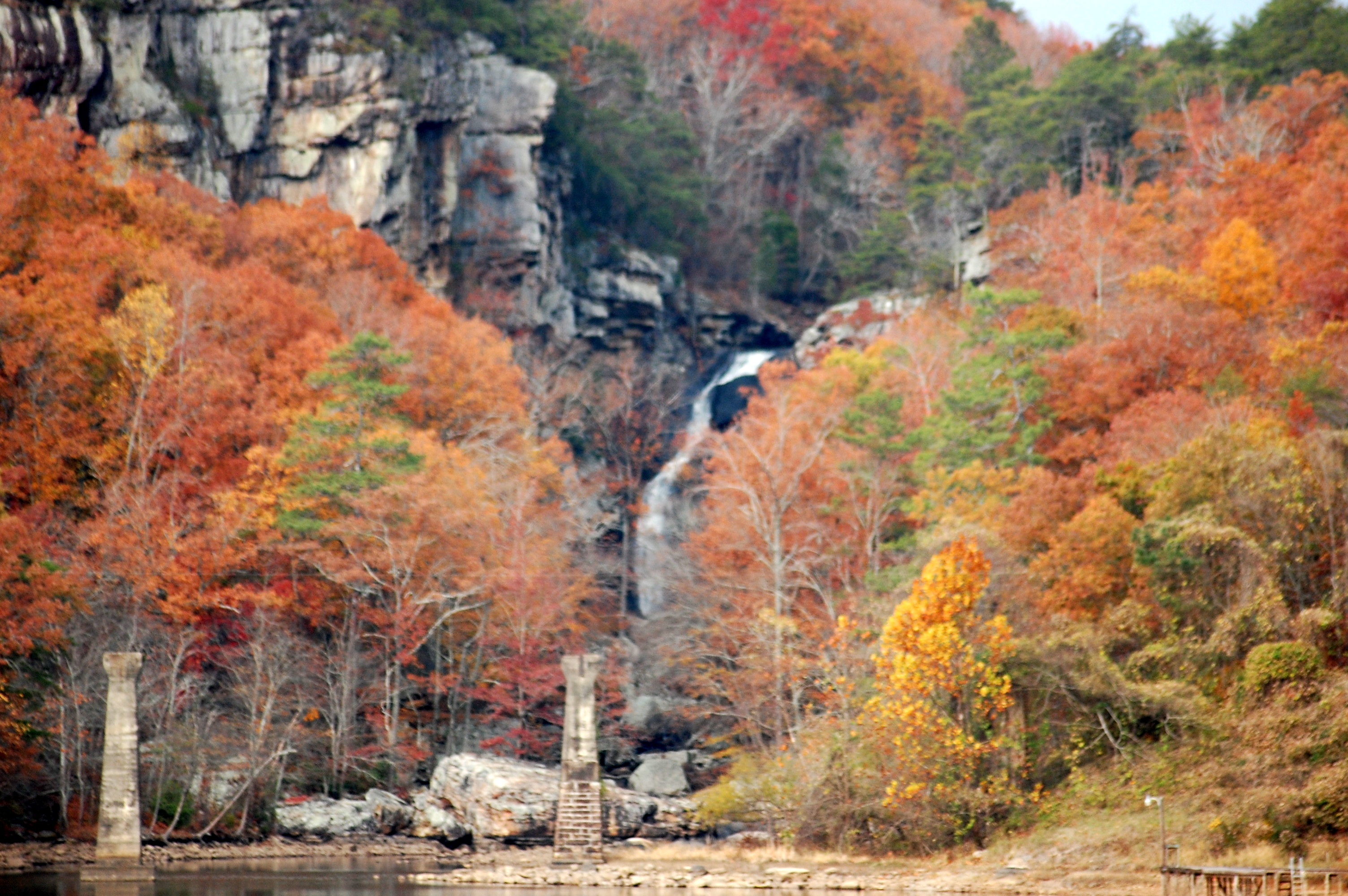
You’re driving down Alabama State Route 273, just outside of Leesburg, and honestly, if you blink, you might miss it. There’s no massive neon sign. No giant visitor center with a gift shop selling overpriced magnets. Just a gravel pull-off and the quiet hum of Cherokee County. Most folks around here know Yellow Creek Falls Alabama as that spot where the water takes a 100-foot plunge into Weiss Lake, but getting there is half the story. It's rugged. It's a bit messy. And if you don't know where the actual trail starts, you’ll end up staring at a rock wall wondering where the postcard view went.
The Layout of the Land
Cherokee County isn't exactly short on water. You’ve got the Coosa River feeding into Weiss Lake, which everyone calls the "Crappie Capital of the World." But the falls are different. They sit on the edge of Lookout Mountain, where the sandstone plateaus decide they’re finished and just drop off.
The waterfall itself is a tiered beauty. It doesn't just fall; it cascades, breaks, and then makes that final, dramatic leap. Because it's fed by Yellow Creek, the flow is totally dependent on how much it rained three days ago. Visit in August after a dry spell? You’re looking at a damp rock. Visit in March? It’s a roaring beast that you can hear from the road.
Getting Your Boots Dirty (The Real Way In)
Most people get confused about the access. There are basically two ways to see Yellow Creek Falls Alabama, and they offer completely different vibes.
The Land Route: This is the one that trips people up. You pull off the highway, and there’s a trail. It’s short—maybe a quarter-mile—but don’t let the distance fool you. It is steep. You’re basically scrambling over roots and rocks. If it rained recently, it’s a mudslide. Wear real shoes. Seriously, leave the flip-flops in the truck. You’ll be navigating a narrow path that hugs the cliffside before it opens up to the top of the falls.
The Water Route: This is the pro move. If you have a kayak or a boat, you can put in at a nearby ramp on Weiss Lake and paddle up the creek. As the canyon walls start to narrow and get taller, you know you’re close. Seeing the falls from the bottom, looking up at that 100-foot drop while sitting in a boat, is probably one of the coolest experiences in North Alabama. It feels like you’ve stumbled into a prehistoric jungle.
What Most People Get Wrong About the Height
There’s a lot of debate online about exactly how high the falls are. Some old USGS maps and local lore suggest it’s around 100 feet. Others say it’s closer to 70 if you only count the final drop. Honestly, the numbers don't matter much when you're standing at the edge. What matters is the sheer volume of the canyon. The way the sound bounces off the rock walls creates this natural amphitheater effect. It’s loud. It’s misty. It’s exactly what you want out of a Southern waterfall.
The "Secret" Top Section
Most visitors scramble down to the base and call it a day. Big mistake. If you explore the area just above the main drop, there are smaller pools and secondary cascades. It’s a great spot to sit and relax, provided the water isn't moving too fast. But a word of caution: the rocks here are incredibly slick. People have actually fallen here because they underestimated the moss. The sandstone looks grippy, but once it gets that thin layer of algae on it, it’s basically ice.
Timing Your Visit
Alabama weather is a fickle thing. If you want the "Discovery Channel" version of Yellow Creek Falls, you need to go in late winter or early spring.
- Winter/Spring: Peak flow. The mist will soak you from 50 feet away.
- Summer: It’s a gamble. Sometimes it’s a nice swimming hole at the bottom; other times it’s a trickle.
- Fall: The foliage is incredible. The hardwoods around the canyon turn these deep burnt oranges and reds that make the white water pop. Just check the rainfall totals before you drive out.
Respecting the Spot
This isn't a manicured state park. It’s largely unmanaged, which is part of the charm, but also the danger. There aren't park rangers sweeping the trails or emptying trash cans every hour. Local organizations and hikers often do "sweep" days to keep the place clean. If you go, pack out your trash. It sounds cliché, but this place stays open because people respect it. If it becomes a dump or a constant site for emergency rescues because people are being reckless, access gets restricted.
Why It Still Matters in 2026
In an age where every "hidden gem" is plastered all over social media with coordinated filters, Yellow Creek Falls Alabama feels surprisingly authentic. It’s still a bit of a "if you know, you know" location. You’ll see locals fishing nearby or college kids from Gadsden or Jacksonville hanging out on the weekends. It hasn't lost that rugged, North Alabama edge. It’s a reminder that you don’t need a $30 entry fee and a shuttle bus to see something spectacular.
Actionable Steps for Your Trip
Check the USGS water gauges for Cherokee County or the Coosa River basin before you head out. If the levels are low, the falls will be underwhelming. Aim for a day or two after a solid rainstorm.
Pack a dry bag if you’re coming by water. The wind coming off the falls can blow spray directly into your boat, and you don’t want your phone getting bricked while you’re trying to take a photo.
Park only in designated gravel areas. Local law enforcement does patrol SR-273, and they will ticket you if your tires are over the white line or if you’re blocking the flow of traffic.
Lastly, check out the nearby town of Leesburg or head over to Gadsden for food afterward. There are some killer local barbecue spots that are much better than any chain you’ll find near the interstate. Supporting the local economy helps keep these natural spots accessible for everyone.
Don't just look at the falls. Look at the rock formations. The geological history of Lookout Mountain is written in those layers of sandstone and shale. It took millions of years for Yellow Creek to carve that canyon, and seeing it in person puts a lot of things into perspective.