It happened fast. One minute, Yellow Corp (formerly YRC Worldwide) was a titan of the American highway, and the next, 30,000 workers were looking for new jobs while lawyers started picking over the bones of a century-old company. If you’ve been digging through the Yellow Corporation bankruptcy docket, you already know it’s a mess. It is a massive, sprawling paper trail of debt, real estate auctions, and bitter litigation that has kept the District of Delaware bankruptcy court very busy since August 2023.
Trucks stopped moving. Freight sat orphaned at terminals. The 100-year-old giant just... buckled.
People keep asking: where did the money go? Honestly, the answer is buried in thousands of pages of court filings. We are talking about a Chapter 11 case that isn't just a simple "we ran out of cash" story. It’s a complex web involving a $700 million federal pandemic loan, a fierce standoff with the International Brotherhood of Teamsters, and a massive liquidation of property that has actually fetched way more money than most analysts initially predicted.
The Current State of the Yellow Corporation Bankruptcy Docket
When you look at Case No. 23-11069, the sheer volume of entries is dizzying. Most bankruptcy cases for companies this size are high-stakes, but Yellow is unique because it’s effectively a "liquidating Chapter 11." They aren't trying to save the business anymore. They are just trying to sell the furniture—and by furniture, I mean some of the most valuable industrial real estate in North America.
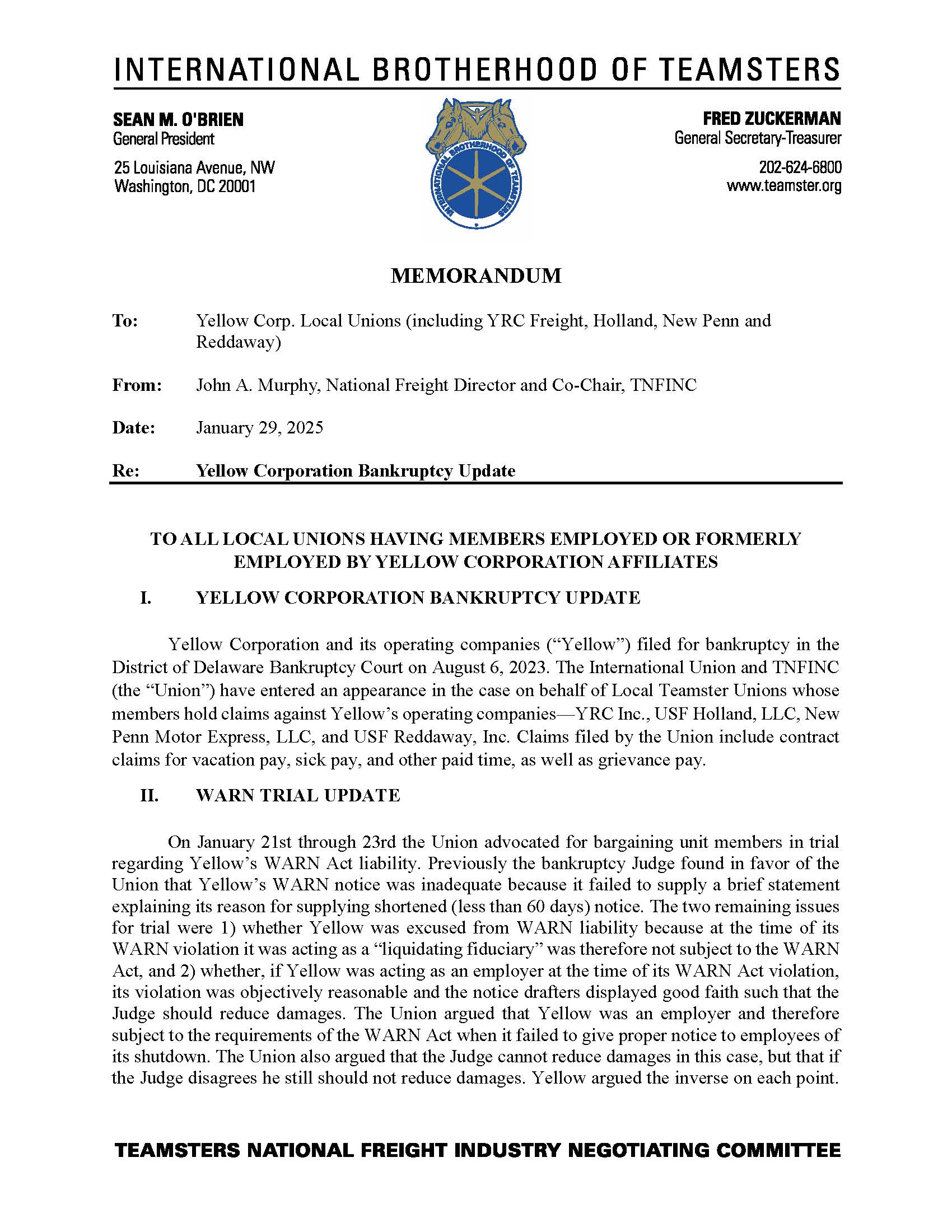
The docket is currently dominated by two big things: the massive payouts to creditors and the ongoing legal war with the Teamsters over pension withdrawal liabilities. It’s a grind. Every few days, a new "Notice of Agenda" or "Schedules of Assets and Liabilities" drops, and each one tells a piece of the story about how a company that brought in $5 billion in revenue could just vanish.
Why does this docket matter to you? If you’re a former employee, a shareholder, or just someone in the logistics industry, these filings are the only source of truth. You can’t trust the rumors on trucking forums. The docket is where the actual checks are cut.
The $700 Million Elephant in the Room
You can't talk about this bankruptcy without mentioning the U.S. Treasury. Back in 2020, Yellow secured a $700 million loan from the federal government under the CARES Act. It was controversial then, and it’s a central theme in the Yellow Corporation bankruptcy docket now.
The good news? The taxpayers actually got paid back.
In early 2024, Yellow used the proceeds from its massive terminal auctions to pay off that $700 million debt in full, including interest. That’s a rare win in the world of government bailouts. Usually, when a company goes belly-up after taking federal money, that cash is gone for good. But because Yellow sat on a goldmine of real estate—terminals in prime locations—the sell-off generated enough capital to clear the slate with the Treasury.
Real Estate: The Feeding Frenzy
The real action in the docket has been the "Sale Motion" entries. While the trucks (the rolling stock) were sold off for decent sums, the real estate was the prize. Companies like Estes Express Lines, Knight-Swift, and XPO were hovering like hawks.
Basically, Yellow owned terminals in places where you can't easily build new ones. Zoning laws and "Not In My Backyard" (NIMBY) sentiment make building new freight hubs nearly impossible in many metros. So, when Yellow’s 300+ terminals hit the block, it triggered a bidding war.
- XPO shelled out about $870 million for 28 terminals.
- Estes Express snatched up a huge portfolio for $1.3 billion.
- Saia and Knight-Swift also walked away with key locations.
The total haul from these auctions climbed north of $1.9 billion. That is a staggering amount of liquidity for a bankrupt company. It’s the reason why the secured creditors—the guys at the front of the line—are smiling, while the stockholders are still left wondering if there will be any "leftover" value for them. Usually, in a Chapter 11, equity gets wiped out to zero. Here? There’s a slim, controversial chance of a "residual" payout, which has turned Yellow’s stock (now trading as YELLQ on the pink sheets) into a gambler’s dream.
The Teamsters Battle: Pension Liabilities
If you scroll through the Yellow Corporation bankruptcy docket long enough, you’ll hit the "claims" section. This is where it gets ugly. The International Brotherhood of Teamsters (IBT) and the various multi-employer pension funds have filed massive claims—billions of dollars—related to "withdrawal liability."
Essentially, when a company stops contributing to a union pension fund because it’s closing shop, the law says they have to pay a massive exit fee to ensure the fund stays solvent for current retirees. Yellow’s lawyers are fighting this tooth and nail. They argue that the union’s aggressive tactics—specifically threatening a strike in mid-2023—is what actually pushed the company over the edge.
It’s a "chicken and egg" argument. The company says the union killed them. The union says years of mismanagement and a mountain of debt killed the company. The court has to decide how much of those billions in real estate cash should go to pension funds versus other claimants.
Why Yellow Failed (The Real Version)
People love to blame one thing. "It was the loan!" "It was the union!" "It was the bad trucks!"
Truthfully? It was a decade of "One Yellow." The company spent years trying to integrate several different brands—YRC Freight, New Penn, Holland, and Reddaway—into one cohesive network. It was a logistical nightmare. They were running separate trucks and separate terminals in the same cities, sometimes competing against themselves. By the time they finally got the "One Yellow" plan moving, they ran out of time and cash.
Then came the labor dispute. In the summer of 2023, Yellow missed a $50 million payment to its health and welfare funds. The Teamsters threatened to walk. Customers, terrified of having their freight stuck in a strike, bailed immediately. In the trucking world, if the freight stops moving for even three days, you’re dead. Yellow was dead by the end of the week.
Understanding the Legal Players
When you see names in the docket, it helps to know who is who.
- Hon. Craig T. Goldblatt: The judge overseeing the case in Delaware. He’s known for being sharp and not putting up with a lot of fluff.
- Kirkland & Ellis: The heavyweight law firm representing Yellow. They are the ones pushing for the auctions and fighting the pension claims.
- The Unsecured Creditors Committee (UCC): These are the vendors and smaller players who are trying to make sure the big banks don't take every last cent.
Can Shareholders Actually Win?
This is the "meme stock" question. Most people will tell you that shareholders in a bankruptcy are toast. And 99% of the time, they are right. But Yellow is weird because the asset sales were so successful.
If the court decides that the pension withdrawal liabilities are much lower than the funds claim, there could—theoretically—be money left over after all debts are paid. This is why the Yellow Corporation bankruptcy docket is being watched by retail investors like a hawk. Every "Objection" filed by the pension funds is a blow to the shareholders. Every "Settlement" or "Reduction in Claim" is a win.
But don't go betting your mortgage on it. The legal fees alone are eating millions of dollars a month. The "burn rate" of a bankruptcy this size is astronomical.
What Most People Get Wrong
A big misconception is that Yellow is "gone." While the trucks aren't on the road, the "Estate of Yellow" is very much alive. It’s a corporate zombie that exists only on paper to sue people, pay debts, and resolve disputes.
Another mistake? Thinking the government "bailed them out" for nothing. The government actually made a profit on the interest. If anything, the taxpayers were the most successful "investors" in this disaster, which is a weird irony.
How to Navigate the Docket Yourself
If you want to track this, don't use the expensive PACER system if you can avoid it. There are "claims agents" like Prime Clerk (now Kroll) that host the Yellow Corporation bankruptcy docket for free. You can search by date, by "Affidavit," or by "Order."
Look for the "Monthly Operating Reports" (MORs). These show exactly how much cash is left in the bank and what the lawyers are spending. It’s the most transparent look you’ll ever get into a multi-billion dollar corporate collapse.
Actionable Insights for Those Affected
If you are following this case, here is what you actually need to do:
- Check the Bar Date: If you are a former vendor or employee who is owed money and you haven't filed a "Proof of Claim," you’re likely too late, but you should check the "Notice of Bar Date" in the docket to see if any supplemental windows have opened.
- Monitor the Pension Rulings: If you are a retiree, the litigation between the IBT and Yellow is the only thing that matters. This will determine the long-term health of the Central States Pension Fund.
- Watch the Rolling Stock Auctions: There are still pieces of equipment, trailers, and miscellaneous "stuff" being sold. If you’re in the trucking industry, these sales are often handled through third-party auction sites, but the "Orders" for these sales are always posted on the docket first.
- Verify Tax Documents: For former employees, the estate is still responsible for W-2s and tax filings. Information on where to get these is usually posted as a "Notice" in the court records during the first quarter of the year.
- Read the Disclosure Statement: Eventually, the company will file a "Plan of Liquidation" and a "Disclosure Statement." This is the "final map" of who gets what. It is the most important document in the entire case. Read it cover to cover when it drops.
The Yellow collapse changed the LTL (Less-Than-Truckload) shipping market forever. Rates went up across the board because a huge chunk of "cheap" capacity vanished overnight. Whether you’re a former driver or a logistics manager, the fallout of Case No. 23-11069 will be felt for another decade. Keep your eyes on the filings; the paper trail is where the truth lives.