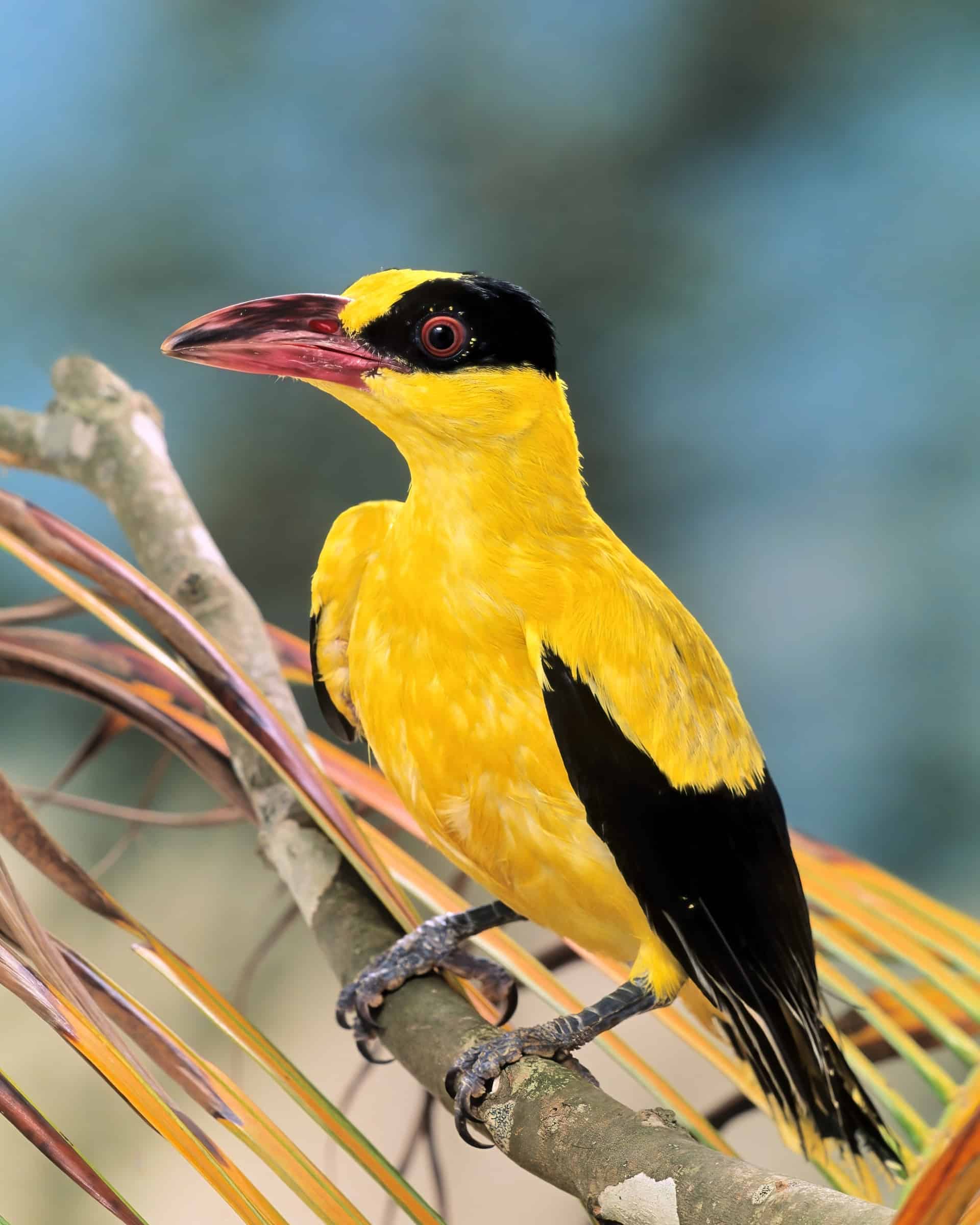
You’re walking through the backyard or a local park, and something neon-bright flashes past. It’s impossible to miss. That striking contrast of a yellow body black wings bird is one of nature’s most effective ways of grabbing your attention. Most people immediately think "Goldfinch!" and move on with their day, but honestly, that’s usually a mistake. Depending on where you live and what time of year it is, you might be looking at a completely different species with totally different habits. Identifying these birds isn't just about the colors; it’s about the behavior, the beak shape, and the way they move through the trees.
I’ve spent years tracking migratory patterns across North America, and it’s fascinating how many people conflate the American Goldfinch with the Hooded Oriole or even the Western Tanager. They aren't the same. Not even close. If you want to actually know what’s visiting your feeder, you have to look closer than just the yellow belly.
The Usual Suspect: The American Goldfinch
When someone asks about a yellow body black wings bird, the American Goldfinch (Spinus tristis) is the most likely candidate in most of the United States. They are tiny. They are bouncy. If you see a bird flying in a literal roller coaster pattern—dipping down and then flapping back up while chirping—that’s your guy.
During the summer, the males are a "high-vis" lemon yellow with a distinct black forehead and jet-black wings marked by white bars. But here is the thing: they don't stay that way. By winter, they turn a dull, brownish-olive color. If you’re looking for that bright yellow bird in January in a northern state, you’re going to be disappointed because they’ve essentially gone into "stealth mode."
They are also incredibly picky eaters. They are one of the few strictly vegetarian birds out there. While other birds might snag a caterpillar to feed their young, Goldfinches wait until the thistle and sunflower seeds are ready. This is why they nest so much later than other birds, often waiting until July or August to lay eggs.
The Western Tanager: The Tropical Outlier
If you’re in the Western U.S. and you see something that looks like a Goldfinch but it’s "on steroids," it might be a Western Tanager. These birds are stunning. The male has a bright yellow body and black wings, but the dead giveaway is the head. It’s often stained a deep, fiery orange-red.
Now, researchers like those at the Cornell Lab of Ornithology have pointed out something cool about that red color. It doesn't come from the same pigments as the yellow. The red comes from rhodoxanthin, a pigment they likely get from eating specific insects that have consumed specific plants. It’s a complex chemical chain just to look that good. Unlike the Goldfinch, which sticks to the bird feeder, the Western Tanager is usually high up in the canopy of coniferous forests. You’ll hear them before you see them; they have a hoarse, raspy song that sounds a bit like a Robin with a sore throat.
The Flashy Orioles: Not Just for Baseball Fans
We have to talk about the Orioles. The Hooded Oriole and the Scott’s Oriole are the heavy hitters of the "yellow and black" world. If you’re in the Southwest, the Scott’s Oriole is a frequent visitor to desert landscapes. They love yucca plants.
- Scott's Oriole: A deep, lemon-custard yellow with a solid black head and back.
- Hooded Oriole: More of a golden-orange hue, often found nesting in palm trees.
- Audubon’s Oriole: Found primarily in South Texas, this one is a bit more reclusive and has a heavier, thicker bill.
People often confuse these with the Baltimore Oriole, but the Baltimore version is famously orange. If it’s definitely yellow, and definitely has those black wings, you’re likely looking at a Scott’s. They have a song that sounds like a person whistling a tune they can't quite remember—lots of random notes and sudden stops.
The Warbler Confusion
Warblers are the bane of every beginner birder's existence. There are dozens of species, and many of them fit the description of a yellow body black wings bird. Take the Blue-winged Warbler. Despite the name, its wings aren't really blue; they are a silvery-gray that looks black in certain lighting.
Then there’s the Yellow Warbler. It’s yellow everywhere. But it has darker wing feathers that can trick the eye. The real pro tip for identifying warblers is to look at the eyes. A Yellow Warbler has a big, black "bead" eye on a plain yellow face. A Magnolia Warbler, on the other hand, has a "bandit mask" and heavy black streaking down its yellow chest.
It's easy to get overwhelmed. Just remember that warblers are "fidgety." They don't sit still. If the bird is hopping frantically from twig to twig looking for bugs, it’s probably a warbler. If it’s sitting calmly at a feeder cracking seeds, it’s a finch.
Why the Contrast Matters
You might wonder why a bird would want to be so bright. Wouldn't that make them easy prey for hawks? Well, yes. But it’s a trade-off. This is basic evolutionary biology. In the bird world, those bright colors are a signal of health. It says, "I have a great immune system and I’m excellent at finding food."
Specifically, the yellow comes from carotenoids in their diet. If a bird is dull or patchy, it’s a sign to potential mates that the bird might be sick or poorly fed. The black wings provide a stark background that makes the yellow pop even more, ensuring the message is received loud and clear.
Common Misconceptions About These Birds
Honestly, the biggest mistake people make is assuming that every yellow bird is a "Yellowbird." That’s not a real species name. Another big one? Thinking that a bird with yellow and black must be a male. While it’s true that males are usually more vibrant, some female orioles can be surprisingly bright, especially as they get older.
Also, don't assume that seeing one means they live in your yard year-round. Most of these species are migratory. The bird you see in May in Pennsylvania might be in Mexico by October. The American Goldfinch is one of the few that sticks around, but as I mentioned, they change their "outfit" so drastically you might not even realize it’s the same bird.
How to Attract Them to Your Yard
If you want to see a yellow body black wings bird up close, you have to cater to their specific needs. You can't just throw out generic "wild bird mix" from the grocery store and expect a show.
- For Goldfinches: Use a Nyjer (thistle) feeder. These have tiny holes that only small-beaked finches can use. They also love black oil sunflower seeds, which have a high fat content.
- For Orioles: They have a massive sweet tooth. Put out halved oranges or specialized nectar feeders. Some people even swear by grape jelly. Just make sure it’s real jelly without artificial sweeteners like xylitol, which is toxic to birds.
- For Tanagers: They are harder to draw to feeders because they prefer insects. However, planting native berry-producing bushes like elderberry or serviceberry can entice them to drop down from the treetops.
- Water is the Great Equalizer: A clean, moving water source (like a birdbath with a dripper) will attract almost any species, regardless of what they eat.
Identification Cheat Sheet
| Bird Species | Primary Habitat | Distinguishing Mark |
|---|---|---|
| American Goldfinch | Open fields, backyards | Black "cap" on the forehead |
| Western Tanager | Western pine forests | Red/Orange tint on the head |
| Scott's Oriole | Desert, Yucca plants | Solid black hood and back |
| Evening Grosbeak | Northern forests | Massive, thick "seed-cracking" beak |
| Yellow-throated Vireo | Deciduous treetops | Yellow "spectacles" around the eyes |
The Impact of Climate on Sightings
We’re seeing shifts. According to data from the National Audubon Society, many of these species are moving their ranges further north as temperatures rise. You might start seeing Scott's Orioles in places they weren't documented thirty years ago.
This makes backyard birding more than just a hobby; it’s actually a form of "citizen science." When you report a sighting of a yellow body black wings bird on apps like eBird, you’re helping scientists track these shifts in real-time. It’s pretty cool to think that the bird on your feeder is a data point in a global study.
Final Thoughts on Observation
The next time you spot one, don't just look at the color. Look at the beak. Is it short and conical (seed eater) or long and slender (nectar/insect eater)? Watch the flight. Is it straight and fast or dipping and rising?
Grab a pair of decent binoculars. You don't need the $2,000 ones; a solid pair of 8x42s will change your life. You’ll start to see the white wing bars, the subtle eyestrings, and the way the feathers overlap. It turns a "yellow bird" into a specific living thing with a specific story.
Start by cleaning your feeders and putting out fresh water today. If it’s spring, get those oranges out for the Orioles. If it’s late summer, keep the thistle stocked for the Goldfinches. You’ll be surprised how quickly your yard becomes a hotspot for the most vibrant colors nature has to offer.



