You’re sitting on your patio in Pasadena or maybe hiking a dusty trail in the Sierra Foothills when it happens. A streak of neon yellow zips past your peripheral vision. It’s bright. Almost distractingly so. You think, "Wait, was that a escaped canary?"
Honestly, it probably wasn't. California is a massive, ecologically diverse playground for some of the most stunning yellow birds in North America, but identifying them is trickier than just spotting a "yellow bird." Most people see a goldfinch and call it a wild canary. Or they spot a Western Tanager and assume it’s some tropical escapee from a local zoo. It's not.
California is home to a dizzying array of species that sport yellow plumage, and depending on whether you are in the humid redwood forests of the North or the arid scrublands of the Coachella Valley, that yellow blur could be anything from a common goldfinch to a rare wood-warbler.
The yellow birds of California you’re most likely seeing right now
If you are in a suburban backyard, the odds-on favorite for your mystery guest is the Lesser Goldfinch. These guys are everywhere. They are tiny, energetic, and they absolutely love nyjer seed feeders. You can tell them apart from their cousins because the males usually have a solid black cap and an olive-green back.
But wait.
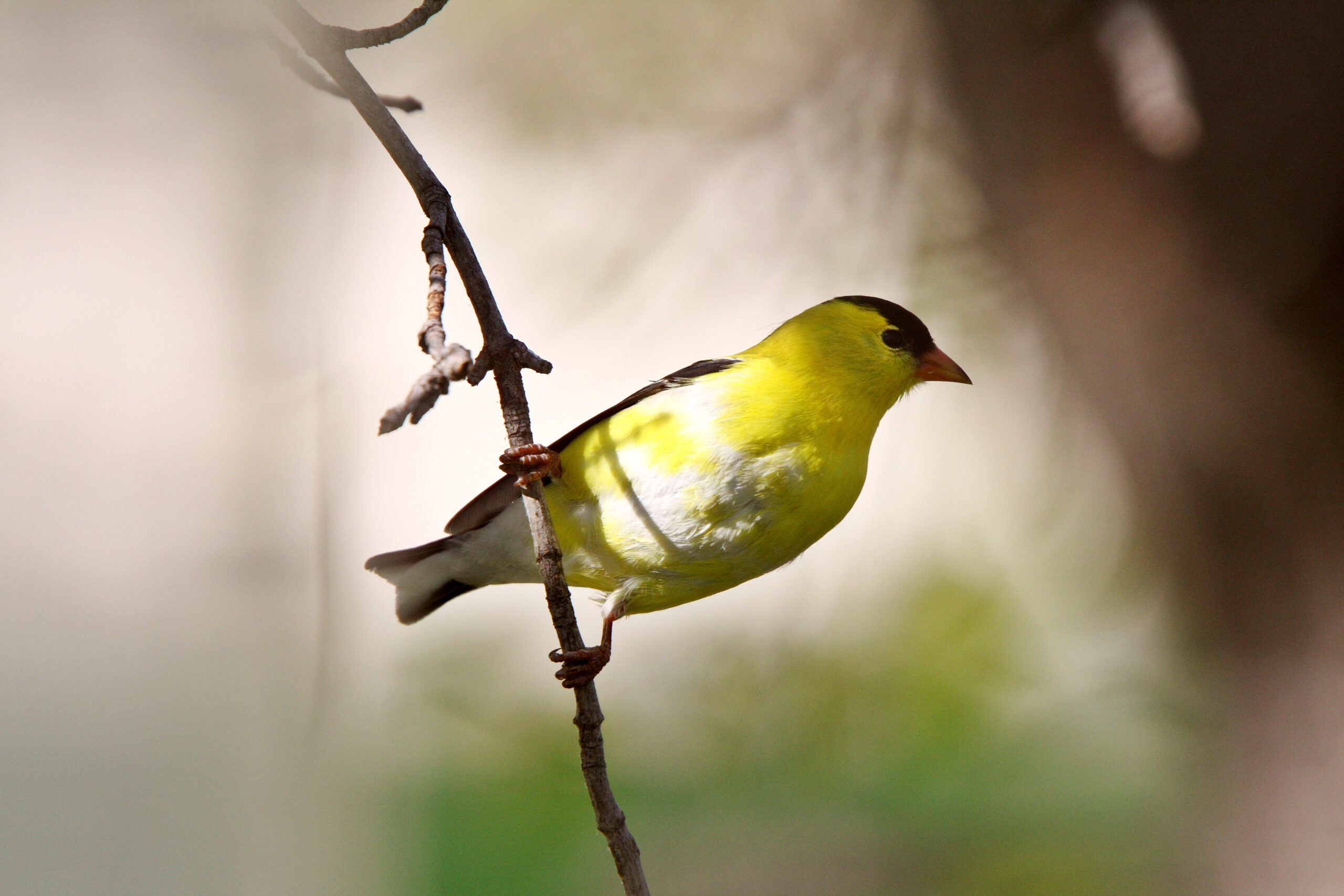
If you see a bird that looks like it was dipped in a bucket of the brightest yellow paint imaginable, with stark black wings and a little black forehead, that’s the American Goldfinch. In the winter, they look like drab little brown things. It’s a total bait-and-switch. Then spring hits, their hormones surge, and suddenly they are the brightest thing in the garden. They’re late nesters, too. While other birds are feeding fledglings in April, American Goldfinches are often waiting until July or August when the thistles go to seed.
The "Tropical" Imposter: Western Tanagers
Every spring, my inbox gets hit with the same question: "I saw a bird with a bright red head and a yellow body—is it a parrot?"
Nope. That’s the Western Tanager.
These birds are fascinating because that red color on their heads isn't even something they produce themselves. It comes from rhodoxanthin, a pigment they get from eating specific insects that have consumed specific plants. If they don't eat those bugs, their heads stay yellow. They spend their winters in Mexico and Central America and then fly thousands of miles to hang out in our pine forests. They are basically the snowbirds of the avian world, just in reverse.
Why color is a lying liar that lies
One thing experts like David Sibley or the folks at the Cornell Lab of Ornithology will tell you is that color is often the least reliable way to ID a bird. Light changes everything.
A Hooded Oriole sitting in the shadow of a palm frond can look almost orange or even a dull, dirty yellow. But get that same bird in the high noon sun of a San Diego summer, and it looks like a glowing coal. These orioles are the masters of the "palm tree suburbs." They specifically look for palm trees to stitch their nests onto the underside of the leaves. If you have palms in your yard and you hang an orange-half or a nectar feeder, you’ll see them. They have that long, slightly curved beak designed for reaching deep into tubular flowers.
Don't confuse them with Bullock’s Orioles, which prefer more open woodlands and have a distinct black line running through their eye, like they're wearing messy eyeliner.
The Warbler Wave
Then we have the warblers. These are the "LBJs" (Little Bright Jobs) that drive birders absolutely insane.
- Yellow Warbler: It’s basically all yellow. Even its wings have yellow edging. If you see a small, plump bird that looks like a lemon with legs, this is it. Look for the reddish streaks on the chest of the males.
- Wilson’s Warbler: Look for the "toupee." These birds have a distinct black cap that makes them look like they’re wearing a tiny, perfectly fitted beret. They love willow thickets.
- Yellow-rumped Warbler: Affectionately called "Butterbutts" by the birding community. Why? Because they have a bright yellow patch right above their tail. They are incredibly hardy. While other warblers flee to the tropics when the temperature drops, Butterbutts stay behind because they can actually digest the wax in bayberries and wax myrtle.
The seasonal shift in California's landscape
The birds you see in January are not the birds you see in June. It’s a revolving door.
In the winter, California becomes a refuge. Birds like the Townsend’s Warbler move down from the Pacific Northwest to hang out in our oaks and eucalyptus trees. They have these striking black-and-yellow patterned faces that look like a complicated tribal mask.
Then comes the spring migration. This is peak "yellow bird" season.
The Central Valley acts as a massive highway—the Pacific Flyway. Millions of birds move through, stopping in places like the Cosumnes River Preserve or the Salton Sea. If you’re out during peak migration in late April, you might see fifteen different species of yellow birds in a single morning. It’s sensory overload.
The impact of the California drought and urban sprawl
We have to talk about the habitat.
California’s landscape is changing, and the yellow birds of California are feeling it. The Yellow-billed Cuckoo, for instance, is now incredibly rare because it depends on riparian (riverside) forests which have been largely cleared for agriculture or housing. It’s a ghost of its former self in the state.
On the flip side, some birds have adapted to us.
Lesser Goldfinches have actually thrived in suburban environments because we love our ornamental gardens. We plant sunflowers, we put out birdbaths, and we provide a year-round water source that wouldn't naturally exist in a Mediterranean climate during a dry August. We’ve accidentally created an oasis for the more adaptable species while pushing the specialists to the brink.
How to actually identify what you're looking at
Stop looking at the yellow. I know, that sounds counterintuitive.
Instead, look at the beak.
- Thick, conical beak? It’s a seed-eater. Think Goldfinches or Evening Grosbeaks. They need that "nutcracker" strength to bust open seeds.
- Thin, needle-like beak? It’s an insect-eater. You’re looking at a warbler or a vireo. They use that beak like tweezers to pluck aphids off the undersides of leaves.
- Long, sturdy, pointed beak? Probably an oriole. They need the reach for fruit and nectar.
Also, check the behavior. Is it hopping on the ground? Is it hovering near the tip of a branch? Is it spiraling down a tree trunk?
Yellow-breasted Chats are a great example of behavior-based ID. They are technically warblers, but they don't act like it. They are big, loud, and frankly, kind of obnoxious. They’ll hide in a dense thicket and make sounds like a car alarm or a whistling teenager. You’ll see that bright yellow chest, and then it’ll vanish.
Common misconceptions about yellow birds in the Golden State
People often think that if a bird is yellow, it must be a "Yellowbird." In reality, yellow is one of the most common "highlight" colors in the avian world because it’s relatively easy to produce from carotenoids in their diet.
Another big one: "The bird in my yard is yellow, so it must be a male."
Not necessarily. While many female birds are drabber to stay camouflaged while nesting, female Yellow Warblers are still quite yellow. Female Western Tanagers are a gorgeous, subtle lime-greenish yellow. Don't assume you're looking at a male just because there's some pigment involved.
And then there's the Cedar Waxwing. People often forget they have yellow on them. They are mostly sleek, silky brown, but they have a bright yellow band at the very tip of their tail. It looks like they dipped their tail in yellow paint. If you see a flock of birds descending on a berry bush and they have little masks and yellow-tipped tails, those are your waxwings.
Actionable steps for California bird spotting
If you want to see these birds, you can't just sit in your living room and hope they fly by the window. You have to be a bit intentional.
Plant the right stuff. If you want Goldfinches, plant sunflowers and native thistles. If you want Orioles, plant California Fuchsia or native salvias. Avoid the "big box store" birdseed mixes that are full of filler like red milo—most yellow birds won't touch it. Go for black oil sunflower seeds or straight nyjer.
Get the right glass. You don't need $2,000 Swarovski binoculars. A decent pair of 8x42 binoculars from a brand like Nikon or Vortex will do the trick. The "8" is the magnification, and the "42" is the diameter of the lens. This combo is the sweet spot for birding because it lets in enough light to see colors accurately even in the shade.
Use the technology available. Download the Merlin Bird ID app from Cornell. It’s free. It has a feature where you can record the sound of a bird, and it will tell you in real-time who is singing. Since many of California’s yellow birds like to hide in dense foliage, your ears are often more helpful than your eyes.
Go where the water is. In California, water is life. Visit local "hotspots" on eBird. Places like the Sepulveda Basin in LA, Golden Gate Park in SF, or the Sacramento National Wildlife Refuge are magnets for these species.
Identifying yellow birds of California takes a little bit of practice and a lot of patience. You’ll misidentify a few. You’ll call a Yellow-rumped Warbler a Goldfinch at least once. It’s fine. Even the experts spend half their time squinting at a branch saying, "Wait, is that... no, maybe it's..."
The key is to start noticing the nuances. Notice the way a Goldfinch undulates when it flies—it looks like a tiny roller coaster. Notice how a Tanager stays high in the canopy while a Common Yellowthroat stays low in the reeds. Once you see those patterns, the "yellow birds" stop being a mystery and start being neighbors you recognize by name.
Start by keeping a simple list of what you see in your own neighborhood this week. Pay attention to the beak shape and the specific shade of yellow—is it lemon, gold, or olive? Check the trees during the first warm week of April when the migrants start pushing through. Keep your binoculars by the window so you're ready when that flash of gold hits the birdbath.



