You’re sitting on the porch, coffee in hand, when a flash of neon lemon zips past your peripheral vision. It’s vibrant. It’s fast. And honestly, it’s probably not what you think it is. Most people see a bright yellow bird and immediately yell out, "Goldfinch!" but nature is never quite that simple.
Identifying what birds are yellow in your neck of the woods requires looking at more than just the paint job. You have to look at the "jizz"—a term birders use for the general size, shape, and behavior of a bird. Is it hopping? Is it spiraling down a tree trunk? Is it screaming its head off from the top of a pine?
The truth is that North America is packed with yellow plumage. From the butter-yellow warblers that hide in the canopy to the chunky evening grosbeaks that look like they’ve been dipped in saffron, the variety is staggering. If you want to stop guessing and start knowing, you have to look at the subtle clues: the wing bars, the beak shape, and the way they move.
The American Goldfinch: The Usual Suspect
If you’re asking about yellow birds, we have to start here. The American Goldfinch (Spinus tristis) is basically the mascot for this category. In the summer, the males are a blinding, "highlighter" yellow with a distinctive black cap and black wings. They look like little flying lemons.
But here’s the thing that trips people up: they don't stay that way.
Unlike many other songbirds, goldfinches molt twice a year. By the time winter rolls around, that brilliant yellow fades into a dull, brownish-olive. If you see a drab bird at your feeder in January, don't write it off. It’s likely the same bird, just in its winter pajamas. They are also late bloomers. While most birds are nesting in May, goldfinches wait until July or August when the thistles are in bloom so they have plenty of seeds to feed their young.
They have a bouncy flight pattern. It’s undulating. Up and down, up and down, often chirping a little "per-chic-o-ree" call as they go. If it’s small, eating seeds, and looks like a wave in the air, you’ve found your goldfinch.
Those Confusing Yellow Warblers
Warblers are the bane of a beginner birder’s existence. They are fast. They are tiny. And a lot of them are yellow.
Take the Yellow Warbler (Setophaga petechia). It’s one of the few birds that is almost entirely yellow. Even its wings have yellow edging. If you look closely at a male, you’ll see delicate reddish-brown streaks on the chest. They love willows and wet thickets. If you’re near water and hear a song that sounds like "sweet, sweet, sweet, I'm so sweet," that’s your guy.
Then you have the Common Yellowthroat. It’s a warbler, but it acts like a wren. It skulks in the reeds. The male has a very cool black mask—think Zorro—which makes it easy to spot. But the females? They are a plain, brownish-yellow that can be incredibly hard to identify if you aren't paying attention to their "witchety-witchety-witchety" call.
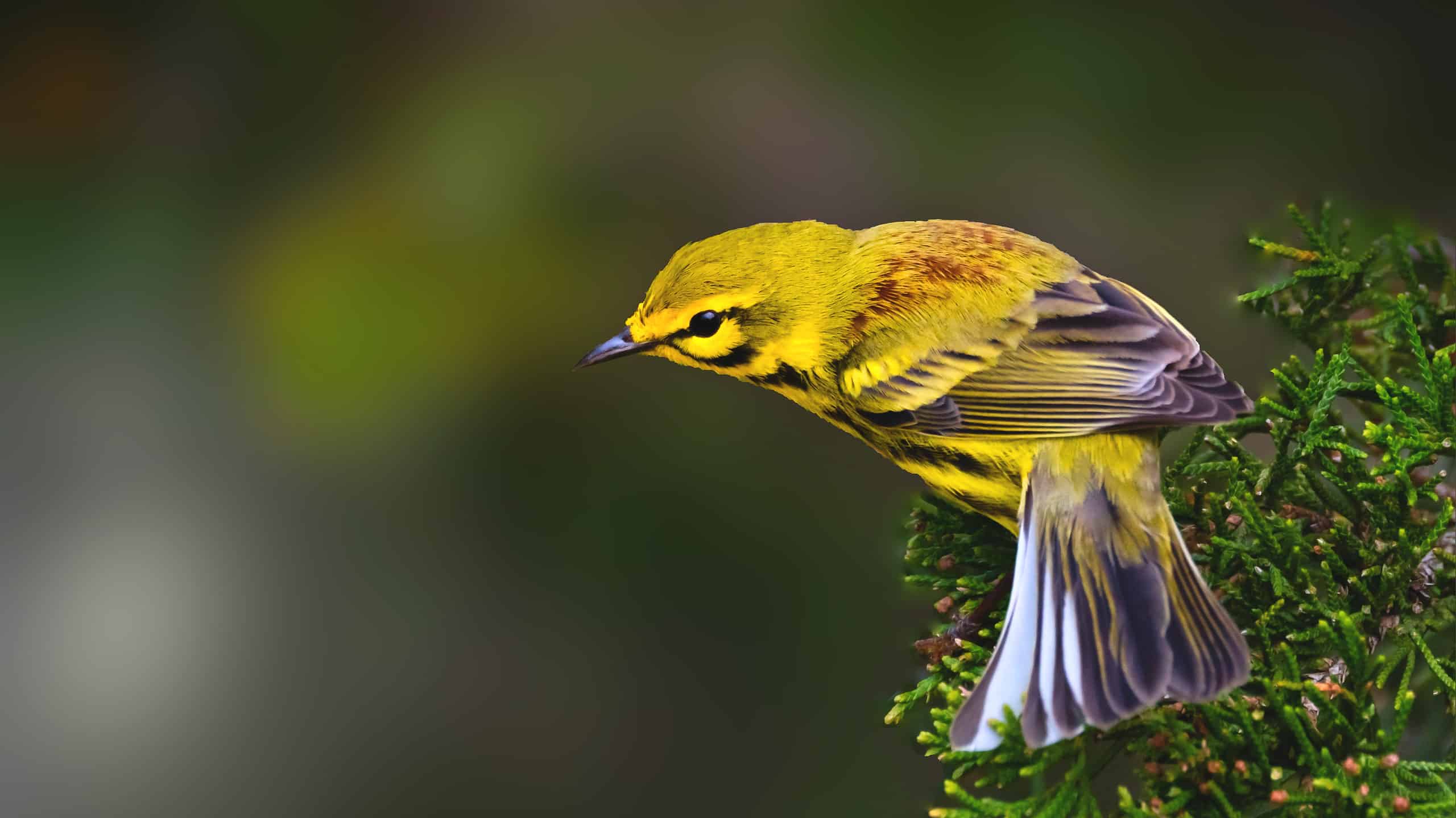
And we can’t forget the Prothonotary Warbler. This bird is a deep, glowing orange-yellow. It’s a swamp specialist. They are one of the only warblers that nest in holes in trees. Seeing one in a dark, cypress swamp is like seeing a golden torch. It’s breathtaking.
The Bigger Guys: Orioles and Tanagers
Not every yellow bird is small enough to fit in your palm. Sometimes, what you’re seeing is more of an architectural statement.
The Western Tanager is a prime example. If you live out West, this bird is a showstopper. The male has a bright yellow body, black wings, and a flame-orange head. It looks like it belongs in the tropics, not a coniferous forest in Idaho. Interestingly, that orange color comes from a pigment called rhodoxanthin, which they get from eating certain insects.
In the East, you might see an Orchard Oriole. While the males are a deep chestnut, the females and young males are a greenish-yellow. They are sleek, with sharp, pointed beaks perfect for weaving those hanging nests or piercing fruit.
Why Are They Even Yellow?
It’s all about the diet. Birds can't manufacture yellow pigment. They have to eat it.
Most yellow birds get their color from carotenoids found in the seeds, fruits, and insects they consume. Specifically, lutein and zeaxanthin are the big players here. If a bird doesn't get enough of these nutrients while it's growing new feathers, the yellow will come out pale or even white. In some cases, like the Cedar Waxwing, eating invasive honeysuckle berries can actually turn the yellow tip of their tail a bright orange. Evolution uses these colors as a signal of health. A brighter bird is a better-fed bird, which usually means it’s a better mate.
The Yellow-Breasted Chat: The Weirdo of the Woods
I have to mention the Yellow-breasted Chat because it’s a bit of an enigma. For a long time, scientists weren't even sure it was a warbler (it’s now in its own family, Icteriidae). It’s much larger than a typical warbler and has a thick, heavy bill.
The chest is a brilliant, saturated yellow, but the behavior is what stands out. Chats are the pranksters of the bird world. They make a bizarre series of whistles, chuckles, and rattles. They’ll even hover in the air with their legs dangling while they sing. If you hear what sounds like a person trying to whistle for their dog in a dense bramble, it’s probably a Chat.
Identifying Your Bird: A Quick Checklist
When you're trying to figure out what birds are yellow in your specific yard, stop looking at the color for a second. Try this instead:
- Check the beak. Is it thick and conical like a nutcracker (Grosbeak/Finch) or thin and pointy like a needle (Warbler/Oriole)?
- Look for "furniture." Does the bird have white wing bars? A black cap? A mask? Rump patches?
- Watch the movement. Is it hopping on the ground or flitting through the leaves? Is it hanging upside down?
- Listen. Is the song a rhythmic melody or a series of harsh chips?
The Evening Grosbeak: A Heavyweight Contender
If you see a bird that looks like a goldfinch on steroids, it’s likely an Evening Grosbeak. These birds are massive compared to finches. They have huge, bone-crushing bills that are a pale lime-green in the spring.
They are nomadic. One year you’ll have fifty of them at your sunflower seed feeder, and then you won’t see them again for five years. They are "irruptive" species, meaning they move south in huge numbers only when the seed crops in the north fail. Their yellow is more of a mustard or gold, concentrated on the brow and the body, contrasted with stark black-and-white wings.
Lesser Goldfinches and Pine Siskins
In the Southwest, the American Goldfinch has a cousin: the Lesser Goldfinch. These guys are even smaller. The males often have black backs (though this varies by geography), but that same bright yellow belly.
Then there’s the Pine Siskin. At first glance, you’d say it’s a brown, streaky bird. But look at the wings. When they take flight, they flash bright yellow patches in the wings and tail. It’s a subtle "secret" yellow that only reveals itself when they move.
How to Attract More Yellow Birds to Your Yard
You don't just have to wait for them to show up. You can invite them.
If you want goldfinches, you need Nyjer (thistle) seed. It’s tiny and black, and it requires a special feeder with very small holes so the seed doesn't just fall out. They also love sunflower hearts—the bits without the shells.
For the insect-eaters like warblers, you need native plants. Plants like native oaks, willows, and dogwoods host the caterpillars that these birds need to survive. A bird-friendly yard isn't just about feeders; it's about the ecosystem. If you have a water feature, especially one with a "mister" or a shallow drip, you’ll attract warblers that would never dream of touching a bird feeder.
Common Misidentifications
- Yellow-Rumped Warbler: Often called "Butterbutts." They aren't mostly yellow, but they have a very distinct yellow patch right above the tail and on their sides.
- Dickcissel: Looks like a tiny Meadowlark. It has a yellow chest and a black "V," but it’s found in grasslands and prairies.
- Verdin: A tiny desert bird. It's mostly gray but has a stunning yellow head. If you’re in the Mojave or Sonoran deserts, this is a common sight.
Taking the Next Step in Birding
Identifying birds isn't just about memorizing a list. It's about developing an eye for detail. The next time you see a yellow bird, don't just reach for your phone. Sit with it. Watch how it feeds. Notice if it stays in the shadows or prefers the sun.
To get better, download an app like Merlin Bird ID from the Cornell Lab of Ornithology. It allows you to upload a photo or record a sound, and it uses AI to give you a highly accurate guess based on your location. It’s a game-changer for those fast-moving warblers.
Start a simple log. Note the date, the weather, and the specific shade of yellow you saw. You’ll be surprised how quickly "that yellow bird" turns into a specific, recognizable friend that visits your garden every year. Focus on the wing bars and the beak shape first; the color is just the icing on the cake.